



.png)




On Wednesday, January 21st, the Kawartha Land Trust (KLT) and the Ontario Butterfly Species at Risk (BSAR) recovery team hosted a webinar about the Mottled Duskywing (Erynnis martialis) butterfly.
As part of the KLT’s ongoing Passport to Nature series, the free seminar introduced the largely-unknown species to the public, and explained the ongoing conservation efforts around its habitat.
“Passport to Nature, I really hope, is a wide-reaching avenue that [helps] more and more people get involved in conservation,” said Hayden Wilson, KLT’s Land Stewardship Manager, “whether that’s getting involved in conservation with us, or a partner organization that’s working on one of the Passport to Nature events.”
The first part of the seminar was a brief presentation from Wilson about KLT’s ongoing work in protecting the Mottled Duskywing. Right now, this looks like maintaining the ecosystem of Big (Boyd/Chiminis) Island, a 1000-acre island located in Pigeon Lake near Bobcaygeon. The site is home to a small, isolated population of Mottled Duskywing butterflies, who take refuge in the Eastern Whitecedar as they mature.
Much of what makes Big Island a stable habitat for the Mottled Duskywing is its abundance of New Jersey Tea (Ceanothus americanus) plant, a primary food source for the butterfly.
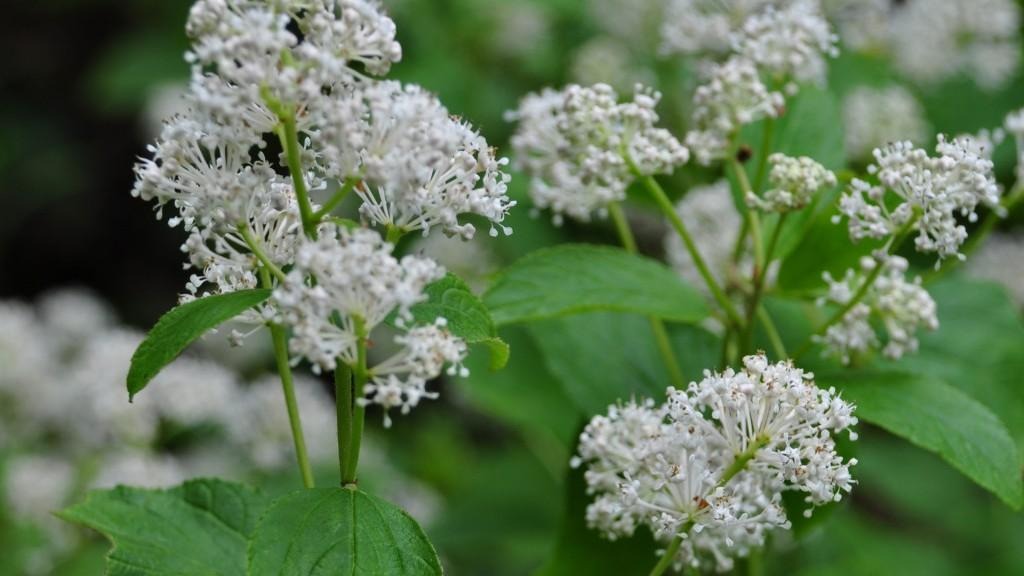
Unfortunately, New Jersey Tea is also frequently eaten by White-tailed Deer, which is part of what has led to the Mottled Duskywing’s endangerment. The other major factor is habitat fragmentation.
“When you get these species that used to be in really wide areas, and you start chopping up the habitat into smaller and smaller blocks, you get smaller and smaller bits of suitable habitat for that species,” Wilson explained. “So a species that we know was historically a bit wider in range, like the mottled duskywing . . . [will have fewer] areas that are feasible for its habitat to continue to actually exist.”
“I think you can write that same narrative for a lot of other species in decline,” he continued. “[If they] don’t have a place to live, you have fewer of them.”
To address this, the KLT has been restoring the Hammer Family Nature Preserve to better host a mottled duskywing population in the near future. With 200 acres of potential habitat, the Preserve is directly adjacent to Pigeon Lake, making the migration of a Mottled Duskywing subgroup entirely plausible. The Preserve is primarily an Oak and Pine savanna, and hosts several fire-dependent plants, making it an ideal space for the New Jersey Tea and Mottled Duskywing butterfly.
“A lot of our service area . . . is in an area of great transition, where we go from St. Lawrence Lowlands bedrock to Canadian Shield bedrock, and the various ecosystems that are associated with those two geologic regions . . . [give] us a huge diversity of different habitats, including ones that are really beneficial for the mottled duskywing,” Wilson explained.
“[In] lower parts of our service area, we get to support habitats like tallgrass prairie, or oak woodland, or savanna, that the mottled duskywing tends to hang out in. But we also have been finding other places that are farther north in our service area that have these little pockets of suitable habitat . . . [such as] the Carden Alvar that’s in the city of Kawartha Lakes.”
Through staff and volunteer work, the KLT has aided plant germination, harvested and re-dispersed seeds, and maintained wildlife refugia on Big Island and the Hammer Family Nature Preserve. The organization has also increased viable habitat for New Jersey Tea plants, and planted thick shrubbery around them in order to prevent herbivory by whitetailed deer. This protection will likely be reinforced by building fences and planting alternative food sources for the deer in the coming years.
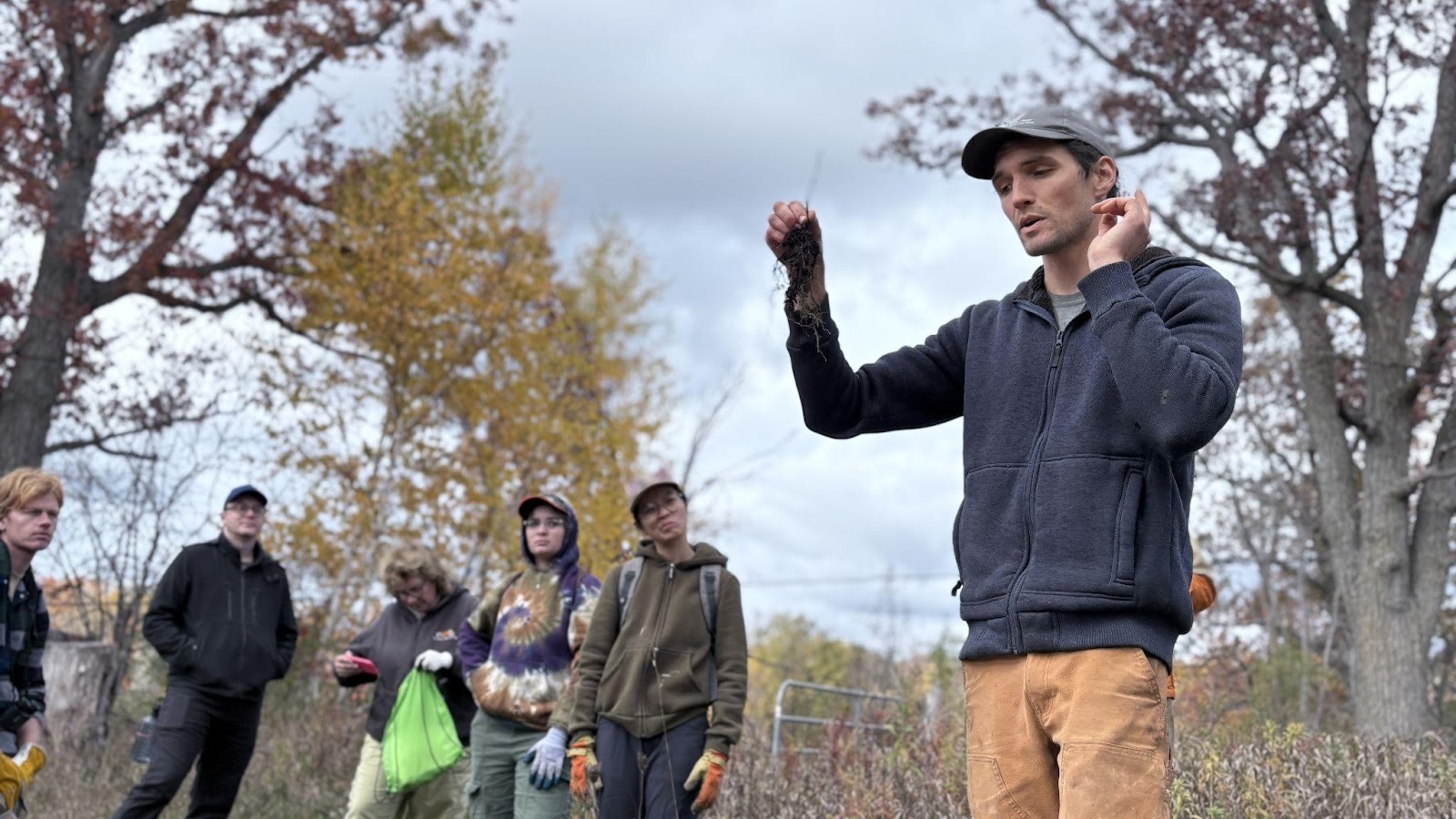
The KLT is also considering implementing a prescribed burn as a method of reducing undesirable plant competition and promoting seed germination for species like New Jersey Tea.
According to Wilson, this “top-down, whole-ecosystem approach” is critical to the success of many restoration projects.
“Every species has a really defined role within the ecosystem, and tugging away at the different strings to figure out which ones are or aren’t important is a really easy way to pull the web of life apart,” he explained. “A lot of the work to help conserve and support this species also helps to conserve and support a lot of other species that depend on that habitat complex of tallgrass prairie, oak woodlands, and savanna that contains its host plants.”
Jessica Linton, senior biologist and chair/founder of the Ontario Butterfly Species At Risk Recovery Team, also spoke to this interconnected approach. In her presentation, Linton spoke of seven at-risk butterfly species, which all occurred in tallgrass prairie ecosystems. The Mottled Duskywing was the only butterfly listed as endangered in Ontario in 2015, but the other at-risk species were threatened by the same hazards of habitat loss and fragmentation, herbivory, climate change and pesticide use.
“[The Mottled Duskywing is] a flagship species for species-at-risk,” Linton told Arthur. “It’s one of the underdog species—it’s not bright or flashy or beautiful like the monarch or other butterflies, but is still important.”
When a species is listed as endangered, the provincial government is required to complete a recovery plan within one year. Linton’s recovery team began collaborating with the Ontario government to protect Mottled Duskywing habitat in 2017, and have since gained significant recognition in the conservation world.
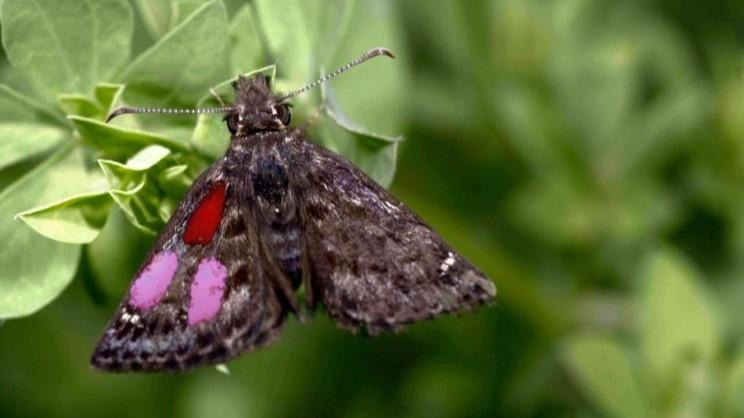
Linton’s recovery team has also done substantial lab research, including a captive rearing project, into the Mottled Duskywing’s diet and life cycle. Through this, they made the exciting discovery that the butterfly’s pupae are pink when they emerge from hibernation.
Linton’s team has prioritized making scientific research accessible to the general public through educational initiatives—such as this seminar—and an upcoming documentary made in partnership with Pinegrove Productions, titled Butterflies on the Brink.
“[The Mottled Duskywing] represents the progress we’ve made in restoring habitats,” Linton said. “[We’re trying to] use our reintroduction as a story of hope, because I think people are thirsty for that these days . . . We talk about big, charismatic species at risk, like polar bears and seals, but insects are imperative to our entire ecosystem functioning, so I try to promote them.”
Between the Ontario BSAR recovery team, the KLT, and other non-for-profits, there are plenty of boots on the ground working to promote and protect the Mottled Duskywing.
“I hope people attending this webinar realise that yes, this is a species at risk, and yes, it’s facing lots of challenges . . . but there are actual people who are working on this,” Wilson said. “People are taking action to actually have this species see an increase instead of just having it slip away. We don’t know if those projects will work long-term, [but] we’re seeing a lot of positive response to different projects for conservation, not only for mottled duskywing, but for other [species] . . . These [restoration projects] are being run by people, and people can do lots of cool, wild stuff.”




.png)
The rich text element allows you to create and format headings, paragraphs, blockquotes, images, and video all in one place instead of having to add and format them individually. Just double-click and easily create content.
A rich text element can be used with static or dynamic content. For static content, just drop it into any page and begin editing. For dynamic content, add a rich text field to any collection and then connect a rich text element to that field in the settings panel. Voila!
"Headings, paragraphs, blockquotes, figures, images, and figure captions can all be styled after a class is added to the rich text element using the "When inside of" nested selector system."
The rich text element allows you to create and format headings, paragraphs, blockquotes, images, and video all in one place instead of having to add and format them individually. Just double-click and easily create content.
A rich text element can be used with static or dynamic content. For static content, just drop it into any page and begin editing. For dynamic content, add a rich text field to any collection and then connect a rich text element to that field in the settings panel. Voila!
"Headings, paragraphs, blockquotes, figures, images, and figure captions can all be styled after a class is added to the rich text element using the "When inside of" nested selector system."

.jpg)

.png)

.jpg)

