




.png)



Well, it’s official. This is Clair Obscur: Expedition 33’s world. We just so happen to be living in it.
On December 11th the debut game from developer Sandfall Interactive, released by independent publisher Kepler, all but swept the 2025 Game Awards. While past awards have seen standout winners in The Last of Us Part II’s seven award wins in 2020, and Baldur’s Gate 3’s six in 2023, Clair Obscur’s nine wins across the eleven categories set an unprecedented record for the most awards ever received by one title. Even that number’s doing it somewhat a disservice: Expedition 33 received 13 nominations in total, with three of them being duplicate nominations in the Best Performance category for actors Charlie Cox, Jennifer English, and Ben Starr.
In a single night, the game tied Sony first-party franchises The Last of Us and God of War for number of lifetime awards, falling one short of SquareEnix’s monolithic Final Fantasy franchise. Expedition 33’s dominion was so assured even before the event, that Hollow Knight Silksong’s developers said they wouldn’t attend the event because they didn’t expect to win anything.
In brief: On December 11th, 2025, Clair Obscur made Game Awards history—even if thousands of viewers were fuming mad in Twitch chat the whole time.
Now, there’s a lot one could say about The Game Awards—how they serve less as an actual award show than as a vessel to advertise games, the bulk of which might never be released; how “Most Anticipated Game” is at best a pointless category and at worst a brazenly irresponsible one which only fuels hype for games like GTA VI, built on a foundation of labour abuses; how they’re the ego trip of one strange Canadian man who is himself something of a charisma black hole.
Not that these things aren’t worth saying, though as a rule most of them have already been said. What interests me more, this year, is what the unquestioned supremacy of one French independent RPG means for The Game Awards as, well, an awards show.
There are a number of things, after all, which make The Game Awards something of a strange beast.
For one, they’ve only been going since 2014. While yes, creator Geoff Keighley did host the late Spike VGX Awards prior to the establishment of the The Game Awards as we know them today, it’d be hyperbole to claim they had anywhere close to the same prestige.
Before The Game Awards became the only gig in town, PlayStation touted The Last of Us—a game which would today be accused of baiting The Game Awards something gnarly—as “Winner of over 200 Game of the Year Awards” on the box of its Remastered edition, which goes some way to dispel the notion that the The Game Awards were the only game awards at the time that mattered.
Heck, how many publishers in the mid twenty-teens released a “Game of the Year Edition” of a game that hadn’t even won one of the The Game Awards’ eponymous accolades?
Critical consensus in the games industry, outside a handful of niche blogs and the received wisdom of the PlayStation 1 generation, is a relatively new thing.
Games are of course, at this point, no longer a “New” medium in anything but a relative sense, even if the idea that someone—more specifically, an institution—should proffer an authoritative verdict on their quality is.
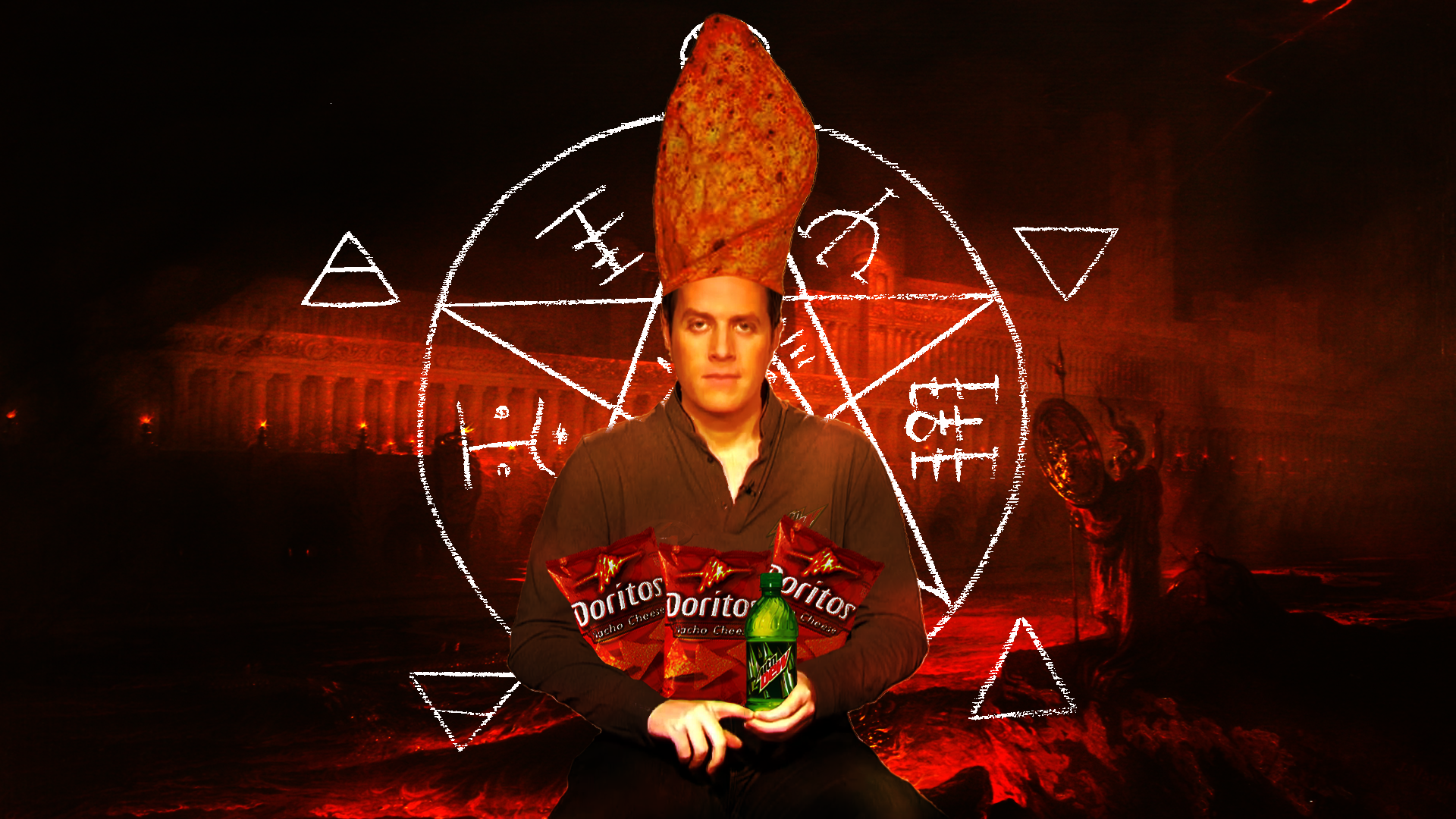
Though the sphere of games criticism has seen a million would-be Siskels and Eberts, it has no Motion Picture Academy or Palme d’Or of which to speak. It’s worth reminding you: the The Game Awards are not in any sense an “Official” event, organized by members of the video game development community proper. It is, in practice, the fabrication of one aforementioned Canadian man, a disgraced journalist in-name-only turned mouthpiece of Doritos and Mountain Dew who submits himself each year to the capricious ridicule of the internet, if only so people might keep his name in their mouth for only one week longer.

Say what you will about the fact the Oscars started as a union-busting scheme, at least one understands the basic composition of the Academy and how its votes are decided. That the Oscars are consistently way off the mark might well be attributed to its largely geriatric membership getting drunk each year and voting for what names they vaguely recognize, but hey, such is the parliamentary model!
You can look up any member of the Academy, or the jury at any festival to hold them personally to account for voting for Crash. By contrast, who decides the best game of a given year is a far more mercurial question.
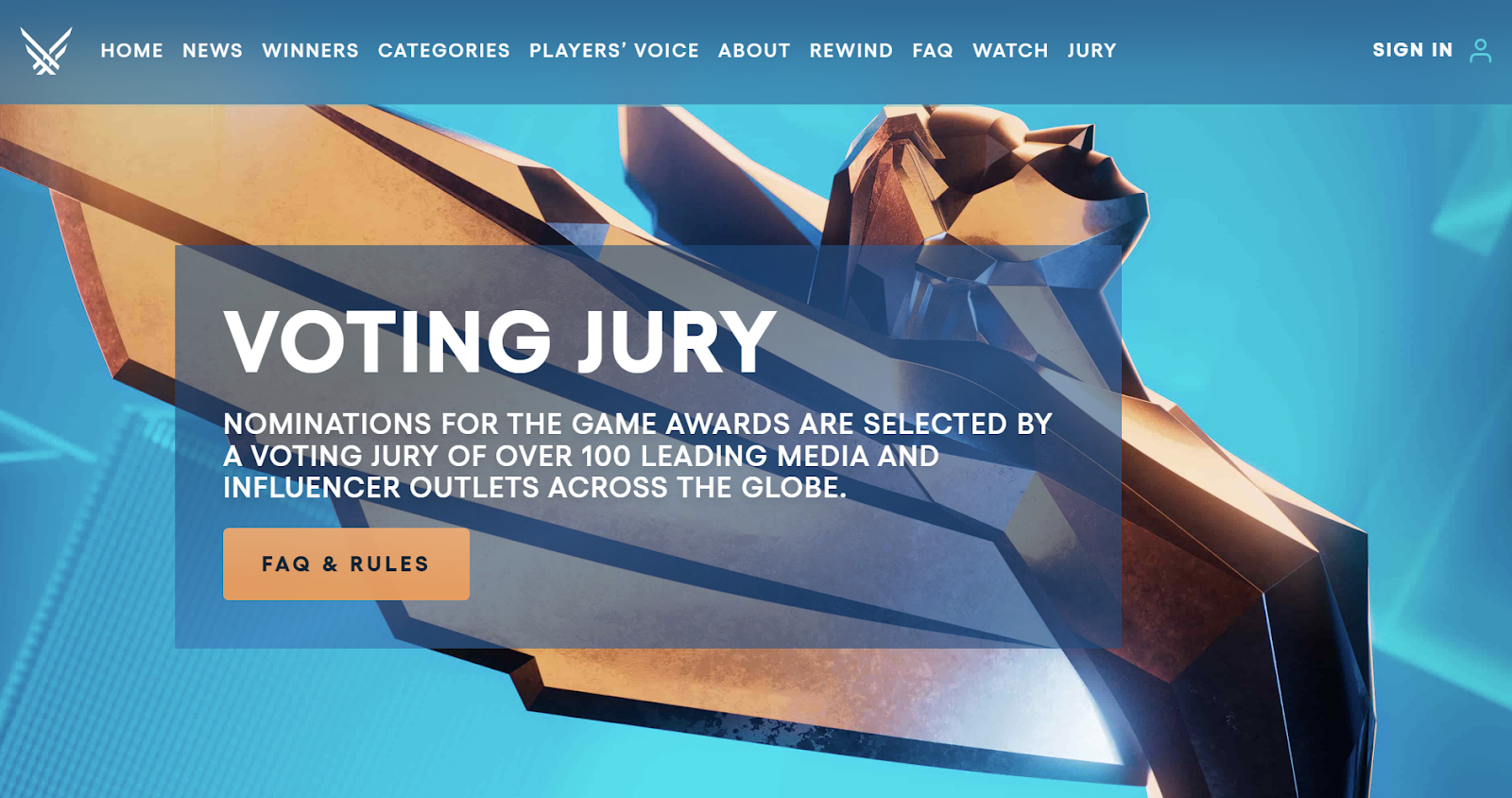
By what mechanism is a Game Award chosen? I don’t really know! Who sits on the The Game Awards jury? You’d have to ask Geoff Keighley, and even then, it remains a bit opaque.
I think this speaks to a crisis of identity at the heart of the whole endeavour, more fundamental even than the glut of ads and “World Premieres” which poison and bloat its runtime and buy winners out of time for their acceptance speeches.
It’s not just that The Game Awards can’t decide whether it wants to be an awards show. It can’t even decide what kind of awards show it might hypothetically like to be.
I’ve been nursing a theory for a little while that the principal difference between something like the Oscars and, say, the Cannes Film Festival, is that a given award nominee at the Oscars has a higher statistical likelihood of being a movie you’ve actually seen.
There are a few reasons for this. First: the Motion Picture Academy is simply less international than the festival circuit, and therefore their slate tends to be more American (or at least English-language heavy) than the stuff that does well at Cannes, Venice, or even Toronto and Sundance.
More than that, I think the Academy likes to periodically renew its cultural cache by picking something in the current zeitgeist. See, for example, Oppenheimer’s win for Best Picture over the much, much better Zone of Interest and Cannes’ Palme d’Or winner Anatomy of a Fall. The difference between the films is a box office of several million dollars, and while I think the other two are better on their own merits (even if I don’t like the latter all that much), Oppenheimer represented, I think, a sort of deference to the popular culture of the year which cemented the Academy’s quasi-relevance for at least another half-decade. (At least it would have had they not gone on to nominate Emilia Perez the year after the fact).
If you’re reading this, you’ve probably seen Oppenheimer, but have you seen Titane, Triangle of Sadness, or any of the other films which won Cannes’ highest prize in the last five years?
The difference, of course, is that while a good number of people content themselves with saying “Oh, hey, this movie I watched this year is nominated for an Oscar,” there is a different demographic who will actively seek out a movie for the sole reason being that it was first screened at Cannes.
An awarding body can be two things: important or relevant. The Oscars are relevant by virtue of being a household name. The Golden Globes are important because they serve as a bellwether for what-will-win-what come Oscars season.
Cannes, Venice, TIFF, and Sundance are all important to varying degrees, acting as microcosms of their respective years in cinema, though none are so relevant that your average person knows or cares much about them.
In essence, an awarding body can be one of two things: artistically important or culturally relevant. Rarely is one awards show both at once.
I call this “The NASH dilemma,” cribbed from the name of Canadian University Press’ annual conference at which they hold the (also annual) John H. McDonald Awards ceremony. NASH is both important and relevant because it’s the only game in town. If you’re a student journalist, you have to care about these awards (especially if you want to be employed in The Industry™), but because it needs to pick both the “Best” student journalism of a given year, as well as produce a conceivable imitation of consensus, the JHM’s historically overrepresent formally conservative stories from large, longstanding mastheads.
The result is that if you talk to someone who’s been to a few of these, or been nominated (but perhaps not won) multiple times, they might opine that they hate the JHM Awards. Unless, of course, they’re from The Ubyssey, but then the deck is ever-stacked in their favour.
This is, in effect, the divide that The Game Awards has been trying to straddle. Geoff Keighley wants to host an Award Show that everyone watches, but he also wants a degree of prestige and importance which cannot be achieved only through spotlighting games that everyone’s already played.
The Game Awards want to be the Oscars of videogames, but in a world where it is also the de-facto Cannes, it faces an existential question as to what being the Oscars of videogames actually means.
When I was in high school each year, I would have usually played at least two of the GOTY contenders. That is less the case anymore, not because I’m less in touch with the industry, but simply because I have less time. Never have I heard of a game for the first time at The Game Awards. Never has one winning the The Game Awards Game of the Year award made me want to play it more than I already had.
Flipping through the list of past winners highlights an interesting kind of flip-flopping between GOTY winners seemingly picked on their own merits and less artistic, more popular winners that represent something of a deference to the members of Twitch chat.
The Legend of Zelda: Breath of the Wild is not the best, or even the most important game which came out in 2017 (which I’m sure is not a controversial thing to say), though it's easy to understand its GOTY win as some expression of its crushing popularity.
The Last of Us Part II, meanwhile, was a massively divisive game at launch whose legacy has been tarnished by its director’s fervent Zionism and its own piss-poor HBO adaptation, but it is I think by no small measure the most important game of 2020, both as a technical accomplishment and as some sort of attempt at maturity in a time where games were largely age-regressing. Those are both worthy reasons, I think, to award it GOTY, and reasons that similarly troubled film productions (such as Apocalypse Now) were nonetheless awarded the Palme d’Or.
These are both “valid” benchmarks for Game of the Year. That isn’t the issue here. The issue is that The Game Awards routinely ping-pong between these two extremes. It’s hard to be a barometer of an industry when you can’t decide whether to recognize accomplishment or coddle fans. The Oscars are bad enough for the latter, but consider: at least most people who use Letterboxd are not “Gamers.”
Clair Obscur in many ways represents the apotheosis of this problem, because it is a game that is popular and also good. It is the Bong Joon-Ho’s Parasite of videogames, if Bong Joon-Ho was a bunch of French people who really liked Final Fantasy.
Like Parasite, Expedition 33 represents a similar confluence of quality and popularity. Like Parasite, I don’t necessarily think it’s the actual best showing in its medium that year, but I don’t begrudge it as a consensus pick.
There have been tens, if not hundreds of thousands of words written to attest the quality of Expedition 33, so I’ll not belabour the point here. Suffice it to say it is a good game by most hitherto existing metrics, and establishes new boundaries for several more.
Of course, this presents a problem for The Game Awards. When Parasite won the Palme d’Or it was a testament to its quality. When it won Best Picture, it was an expression of its consensus popularity. The Game Awards couldn’t ignore Clair Obscur, but what their attention meant was subject to interpretation.
As with anything popular in the games industry, it has drawn no small amount of derision for that fact. Despite being a game that is self-evidently worthy of recognition from any self-serious awarding body, Clair Obscur: Expedition 33 is reviled by no small part of said award show’s audience for being recognized as such.
During and in the immediate aftermath of the The Game Awards 2025, many internauts accused Expedition 33’s historic sweep as being orchestrated by the State of Israel, or otherwise accused the proceedings as being rigged or subject to the whims of Benjamin Netanyahu, the late Charlie Kirk, or Mossad.

In Twitch chat and on YouTube, viewers spammed “We are Charlie Kirk” and “I am a gamer from Israel and this is my game awards.” In the aftermath, many took to Reddit and Twitter claiming Expedition 33 shouldn’t have won the “Best Indie” and “Best Debut Indie” category because its budget was too large, despite it being comparable to that of fellow competitors in Best Indie and GOTY categories, Hades II and Hollow Knight: Silksong.
Clair Obscur is, in effect, the epitome of “qualityslop,” an unintentionally revealing 4chan neologism describing the absurd phenomenon of people reflexively despising things for the sole reason that they are generally agreed to be good.
I think part of this knee-jerk vitriol is the fault of The Game Awards being bad at communicating what exactly constitutes an “indie” game, or providing much in the way of indication as to the parameters of literally any of its categories.
The eligibility of remasters, remakes, and re-releases of games from prior years is—charitably—inconsistently policed, live service games get to sneak into categories year after year, and the same five games vie for the Best eSports Game award at each year’s ceremony. All of this serves to undermine the credibility of the event as the sole authoritative voice on excellence in the games industry. Heck, half the games that win didn’t come out in the awards’ calendar year.
Given the opacity of the decision making process and the redundancy of any number of categories (“Best Indie” and “Best Debut Indie,” for example) it’s easy to see why people might be frustrated with the results. The difference is that unlike other awards show audiences, “Gamers” are disproportionately predisposed towards conspiracy theorizing whenever trivial things do not go their way.
Speaking of which, it is also The Game Awards’ fault for giving “Gamers” the misimpression that their votes will do anything to sway the vote. 10% isn’t nothing, but it’s also not 90%, and to see the way most of the publications listed as Game Awards jurors gushed about Expedition 33 you could’ve guessed who the 90% were voting for.
No layperson goes into the Academy Awards thinking they have been able to sway them, because no one outside the Academy is permitted to vote in them. The charade of participation The Game Awards proffers each year serves only to stoke the already-volatile response from so many viewers rendered incandescent by impotent gamer rage.
If only a fraction, it still also manages to cede a portion of awards arbitration to the most vocal, engaged subset of a social group known popularly for its extreme toxicity, so on top of giving some of the worst people you know a personal, parasocial stake in the inevitable Twitter flame war, it equally undermines the weight of some percentage of votes cast by persons at least marginally more qualified than them to talk about videogames.
Granted, this sense of entitlement endemic to “Gamer” culture is not Geoff Keighley’s personal fault. It is a by-product of the “Just Asking Questions” line about “Ethics in Games Journalism” that characterized the community’s circa-2014 far-right GamerGate lurch. However it is also a fact left largely unquestioned by The Game Awards in their refusal to bar Ubisoft or Blizzard for rampant mistreatment and sexual harassment of female employees, for the Wild West moderation of their stream chat and general pandering to and coddling of the capital-G “Gamer: mentality.
The Game Awards has ensured that it cannot be an authoritative measure of excellence in videogames because it is more interested in making “Gamers” feel happy than it is considering the actual merits of the things it’s awarding. Videogames Cannes this is not. It hasn’t the authority to determine what is art.
Which begs the question as to why we should care? Awards are admittedly a trivial thing. It matters less which dev team gets to make a minute-and-thirty second speech before their rushed off stage than it does that you enjoy a game you might spend upwards of 40 hours with by comparison.
Sure, the prestige of an award win might get a studio some startup capital for their next project, though most investors surely care less about that than how many units it sells. We live in a money-run world and The Game Awards and their four instances of the same AMD ad are not exactly not testament to that fact.
If only they had a spine which couldn’t be bought in fiat currency, maybe a smaller number of people would hate them less.
I think the Metallica Sad-but-Truth of it all is that for as much as they aren’t Cannes, or the Oscars, the The Game Awards are the thing which most closely resembles them. They may have a worse track record of quality, and tenfold more ads per minute than the Golden Joysticks or even the BAFTAs, but a thing that they have in spades more than either is money.
So as in the rat race of capitalism where the fattest fuck wins, The Game Awards languish resplendent on a bed of $10,000 World Premieres and Amazon ad money. We all know that fact, and we all keep watching, in the simple hopes they might one day make the “right” call.
And therein lies the bite. Today it falls to Clair Obscur to be martyred at the pulpit of relevance, so that by kow-towing to the whims of the masses Geoff Keighley might again taste the succor of proximity to the artistic and talented.
It is by any measure the right call, but it rings hollow from the lips of an organization as unsure of itself as The Game Awards are. Eleven years and this awards show has yet to find an identity. It’s treading water trying to find itself, losing favour with each discourse cycle every year, and unless Keighley soon finds a way to help his baby grow up, it threatens to drown swathes of the industry right along with it.
I suspect a large part of the backlash from Expedition 33 is in fact misdirected anger at The Game Awards themselves. It would be easier to stomach so unilateral an awards slate from an organization who stood for something.
The Game Awards haven’t the goodwill to pull a stunt equal to Blue is the Warmest Color’s three-way Palme d’Or win. As a matter of fact, they were all of one year old when that happened. It was the 66th year of Cannes.
The irony, of course, is that the thing meant to uplift the ludic medium as an art form is the greatest thing presently undermining its claim to exactly that. The Game Awards are an embarrassment which drag everything down to their level. Each time they cut to a reaction shot of Tim Rogers while Keighley makes innuendo about fornicating with a Muppet it makes me want to pull out each of my eyelashes one at a time.
Each time they cede another minute to mindless advertisement we plunge another knife into the heart of the thing we love. “Free Chocolate Frog Fortnite back bling” is an actual sentence I had to hear spoken out loud on Thursday.
There is art to be found in this medium, and it is worthy of recognition, but The Game Awards remain the wrong venue to do it. They’ve already proven themselves incapable of recognizing the most legitimately interesting games of any given year, the kind of things that would give Toby Fox nightmares and make Hideo Kojima cry.
In absence of that, they’ve failed to be so much as the people’s choice, as they are incapable of not making people seethingly mad at them. At this point each year’s ceremony seems an exercise in tightrope walking a knife’s edge, in Weekend at Bernie’s-ing this idea that died some side of the last decade if only to keep Keighley’s empire of dirt from crumbling.
We are all made his cuckolds for watching and we do it anyway.
I was reminded, Thursday night, of the speech Larian Studios CEO Swen Vincke gave last year before announcing the 2024 Game of the Year. Before he announced to the world that Astro Bot had taken the competition out back and put a bullet in Balatro’s head, Vincke claimed an oracle had told him which game would win the 2025 Game of the Year award.
Vincke told the crowd the game would be made by a studio who “made their game because they wanted to make a game that they wanted to play themselves.”
“They didn't make it to increase market share,” he said. “They didn't have to meet arbitrary sales targets, or fear being laid off if they didn't meet those targets.”
It’s a fucking powerful speech. You should go watch it.
It’s powerful, in part, because the year prior Larian—an independent studio still run by the same people who founded it—had won GOTY for Baldur’s Gate 3. That this win followed two years marked by rampant layoffs in the games industry was what really drove it home.
I’m not a woman who believes in destiny, though it’s tempting to read a kind of symmetry into Vincke’s prediction. The game he’s describing does sound quite a bit like Expedition 33, a game made by a handful of young developers working independently who all wore mime outfits and berets to The Game Awards, and whose lead developer thanked YouTubers for programming tutorials in the team’s acceptance speech.
To those not blinded by irony and cynicism, there’s something so genuinely heartfelt about the fact the moment Guillaume Broche reveals Sandfall brought literally every person who worked on the game to the ceremony. There is something equally triumphant about when he raises the award in one hand and dedicates it “to those who come after.”
These are the kinds of moments which should define The Game Awards, and yet the shadow of discourse looms long. In a better world I’d have written an article about how deserved literally every one of those award wins were, yet their association with Geoff Keighley’s monster sours any attempt to celebrate that.









.png)
The rich text element allows you to create and format headings, paragraphs, blockquotes, images, and video all in one place instead of having to add and format them individually. Just double-click and easily create content.
A rich text element can be used with static or dynamic content. For static content, just drop it into any page and begin editing. For dynamic content, add a rich text field to any collection and then connect a rich text element to that field in the settings panel. Voila!
"Headings, paragraphs, blockquotes, figures, images, and figure captions can all be styled after a class is added to the rich text element using the "When inside of" nested selector system."
The rich text element allows you to create and format headings, paragraphs, blockquotes, images, and video all in one place instead of having to add and format them individually. Just double-click and easily create content.
A rich text element can be used with static or dynamic content. For static content, just drop it into any page and begin editing. For dynamic content, add a rich text field to any collection and then connect a rich text element to that field in the settings panel. Voila!
"Headings, paragraphs, blockquotes, figures, images, and figure captions can all be styled after a class is added to the rich text element using the "When inside of" nested selector system."

.jpg)


.JPG)
.jpg)
%20(13).png)


.jpg)
.jpg)
