.png)



It has been written before and will be repeated: The past only makes sense in the context of the present.
At the dozen strikes of the noon hour bell, I left for my lunch hour, uncentralized and with no appetite for the cup noodles that sat at the bottom of my purse. I began to walk aimlessly after something to do. On the sidewalk, other office workers with wax paper sandwiches in hand rushed on either side of me. As they marched, they slurped out of coffee cups or spoke on cell phones. I came to a stop outside my usual haunt, a coffee shop on the corner.
When I opened the door, a tall girl with crooked bangs and a Pink Floyd t-shirt, accompanied by a heavily pierced, lanky blonde with holes in his knees, pushed past me. They spoke to each other excitedly, not acknowledging me as I passed by them. Is it narcissism or nostalgia when you find yourself in the faces of strangers?
Two years before, I had made the arduous decision to live. No more pills, crushed powder, liquor, or noxious smoke to help me cope. I do not spend my weekends with heady nose bleeds in parking lots, and I do not fight the come-down king in the bathrooms of strip malls. The land of the living awaits, I told myself with intended positivity. Self-help mantras became hollow and undecipherable like cheap floral prints sold at department stores over and over and over again. I enrolled in college, packed my belongings, and retreated, far, far away.
In my first month of college, I changed my name from the kid-ish nickname I adorned back home, cut my hair with kitchen shears, and spent a fraction of my OSAP payment at Value Village. I became a responsible and studious kiss-ass. To my satisfaction, I hardly recognized myself. It was in that first month that, after much convincing, my roommates and I went to a dorm party. I did not care to go; to me, the upper/downer boogie man was behind every door. But the land of the living waits for no man.
We entered the dorm.
Standing beside a prohibited game of beer pong, and enveloped in vape smoke, was who I’d come to know as The Anarchist from Nova Scotia. He was in deep conversation with a tall, redheaded girl. The size of the crowd in the tight space squeezed any ounce of courage I had talked myself into having. I was struck by the desperate need for a quiet space, and to vomit. Unfortunately, they were blocking the thin route to the bathroom. I tucked my chin down to the floor and tried to pass by.
“I think Dark Side is way overrated. The Wall is way better. Cool shirt though,” he said. I unstuck my chin from my chest and looked up at him. A fifteen-dollar t-shirt I had since my pre-teen years had made me my first friend at college.
As I spoke with him, his beautiful internal hopefulness was radiant and infectious. He wrote bad poetry, loved the mandolin, John Prine, Kimya Dawson, and vegetarian food. His way of speaking floated around my head as a cloud. Our conversation turned from the dullness of “What are you taking?” and “Where are you from?” to the fascinating, very complicated topic of the lives we had lived up until now.
The anarchist had a way of perceiving absurdity that I never thought of; he received my nihilism with fervent optimism. When he spoke of the world’s shadows and callousness, it followed closely the spitfire of hail. As if he had more to say than oxygen to say it with. Real friendship came to me that was not chemically motivated or induced. Joy, once a stranger, became a close friend with blonde, pin-straight hair, ripped cargo pants, and delicately beaded, long hanging earrings that bounced on his cheeks as he spoke. He viewed pain as the utmost potential. I thought I left all my potential in a pool of vomit on my grandmother's bathroom tile.
In early October, we took the number six bus to downtown.
On the stained-carpet-lined seats, I was bursting with sweat; my stomach had turned to nothing but bumbling bile. I had not been in a bar since becoming sober. I did not want to be seen, I did not want to be known. To be known for who I was then would tarnish the newness I gripped between my teeth; to be known would mean conquering my fear of divulging my past.
Sometimes, if I was not paying attention, I would give myself away in tiny pieces. Preluding the real trauma, I spoke in jokes and funny tidbits, testing the water with the other person. Do we owe each other our raw truth? I felt that I owed it to them, the grim and soot. Thoughts snuck into my mind: you are living a lie, wearing a mask, deceit, liar, cheater, scammer, manipulator. The verbiage I had come to know ran like overexcited children back and forth on the walls of my mind in a demented game of tag.
From the humid air of the bus, we swung into the bustle of late-afternoon life. The terminal was crowded and alive, mothers guiding broods of children, men and women alike in mud-crusted work boots hunched over on benches, students crowding the entrance to arriving buses trying, with all their might, to make it to their evening lectures.
Hordes of office workers walked past us towards the car park, talking on their cellphones or staring blankly ahead at their destination. We walked out onto the street and back down the alleyways and saw waiters, line cooks, and waitresses smoking long cigarettes before the dinner rush. Their uniforms were covered in food byproduct. They sat on overturned crates or lawn chairs, grinning at their phones or staring at the sunset poke from the overcast.
The grey sky opened as we strolled. Cool, fast rain pelted our skin and clothes. I did not know where this bar was. I followed behind him blindly, watching his black army boots slap into puddles over the technicolor murals painted on Hunter Street.
“Here, here it’s right here!” he shouted triumphantly.
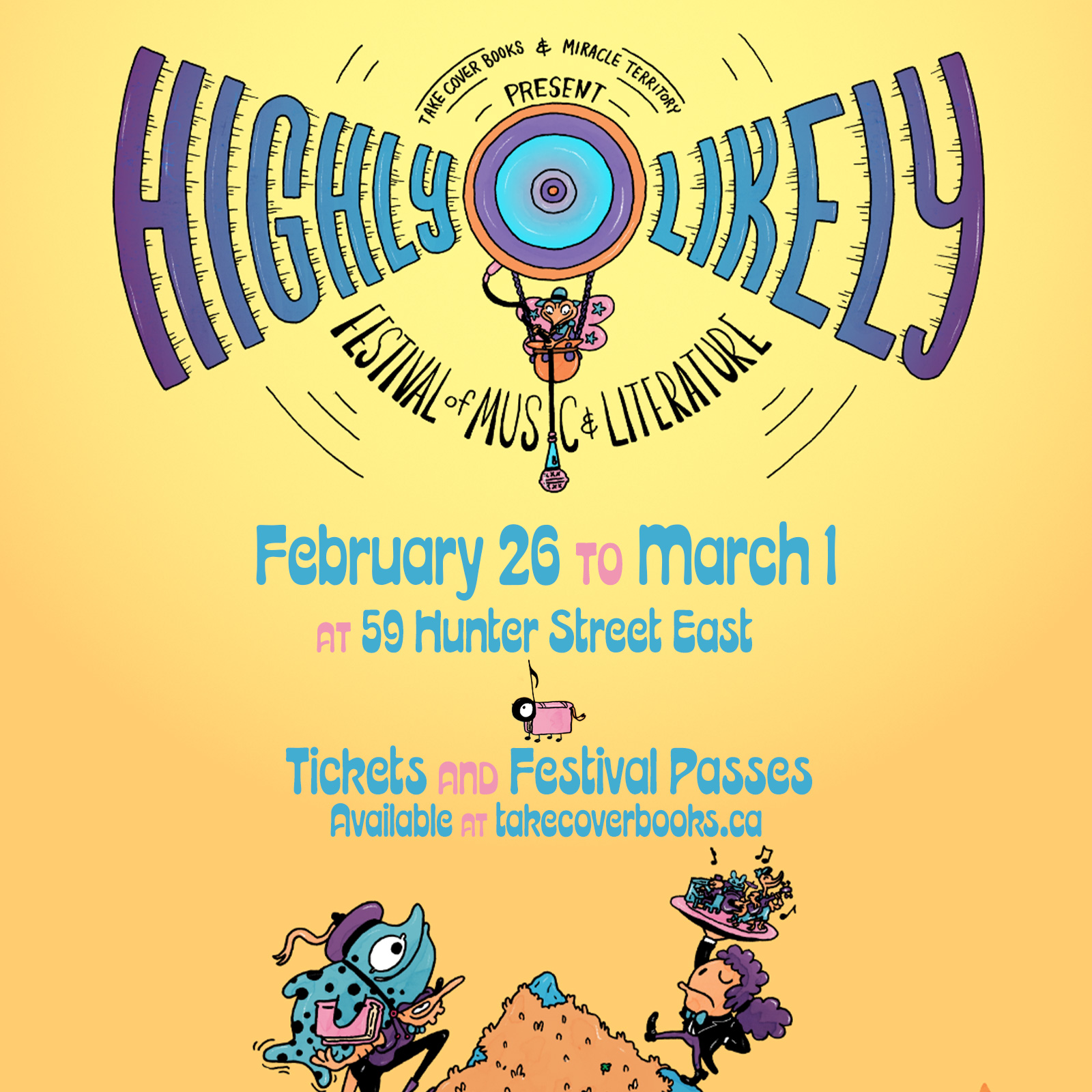
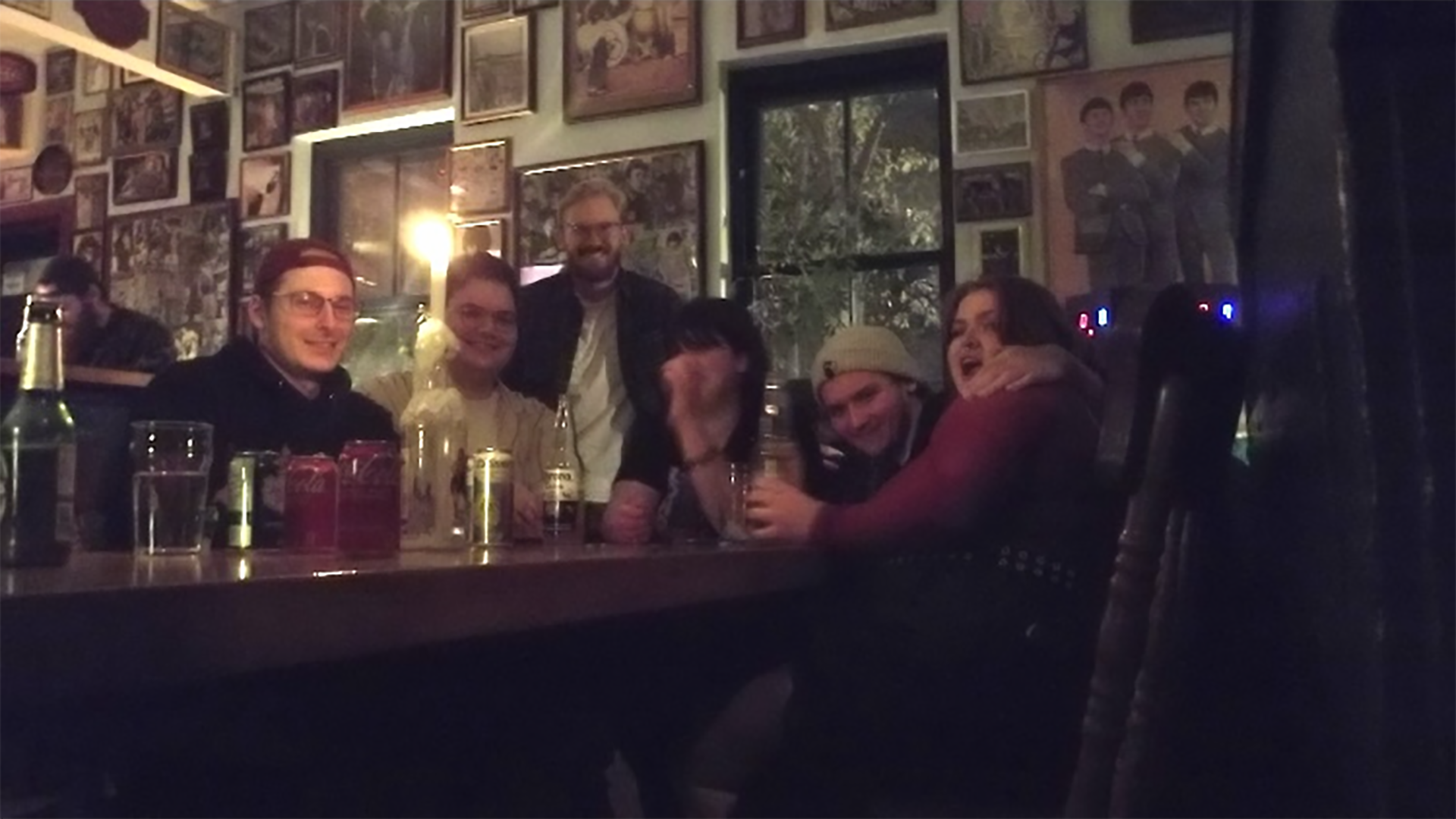
Tucked away beneath the glowing autumn trees, and hidden by a row of storefronts. I followed behind him, watching the cobblestone turn to hardwood. When I looked up, plastered on each wall were the faces of Nina Simone, McJagger, The Beatles, and more. My mouth fell agape. My eyes craved to process everything. Around us, beams of dying light floated from the windows lined with plants and old books.
The floorboards creaked, evidence of well-traveled floors. The place felt lived in; people had been here before and would continue to be for years to come. The bar ran along the right side of the room, with two-person tables following suit on the left. In the far corner, a pedestal with a round table, lit with the only overhead lighting in the place. We ordered tea from a stern-looking man with a thick, vintage moustache and tucked away at a small table by an open door. The sound of the rain moving against the exterior walls and patio stones melted with the lulling John Coltrane album playing overhead.
The anarchist recounted the story of how his parents had met here. He spoke about their relationship with pride. He was not embarrassed that his parents loved each other; My stomach twisted with devouring yearning to feel what his parents had felt decades prior. Unbeknownst to me, I would fall in love a year later at the same table, and though it did not work out, I believe that some places, some rooms, make you want to fall in love. Fall in love like Bob Dylan or Townes Van Zandt. And in that room, their bound eyes know what you want, and the ambiance begs you to play into it. That was The Only Cafe.
The surrounding patrons reminded me of being under an oak tree on a heavy summer’s day. Looking up from the ground against the pale, bleached sun, the verdant leaves moved in a breeze I could not feel. They were clad in an array of leather, denim, and had piercings I had never seen, and t-shirts of bands I would come to love. I wanted to be up there, with them, speaking of the important things.
The anarchist and I drank hot herbal tea and jabbered about what wannabe beatnik nineteen-year-olds would talk about. The fiscal disparity gap, gender, the art of sex, which both of us felt we were experts in, and our queerness. Quoting and requoting the books we had both read, but equally pretending the other person had said something bright and original.
“And so I think that maybe, if I had been born a man, I would be happier.” I chuckled at the idea, “Do you feel like a woman?” His eyes became deep, blue, and serious.
I swiftly changed the topic to the night I lost my virginity.
“Okay, come on, do you think that it all needs to be destroyed?” I challenged. “Maybe not all of it, but I think there is a beauty in the rebuild, a beauty in the destruction, if we tear it all down then we could do better. I thought you called yourself an anarchist?” He challenged back.
“I need a smoke.”
Our faces hanging over the yellow halo of the dimly lit lamps, we charged each other with our young pseudointelligence. Throwing thoughts and stories as rocks are tumbled across a riptide. As he laughed at my jokes and was entertained by my ignorance of seventeenth-century politics, I liked how my voice sounded when I spoke to him.
There, in that moment, I could be someone else, someone good. In that rhythm in which he spoke, I hung on every word, I swam beside him, upstream like an eager minnow, and begged to know everything he did. Hours passed, and he and I sat at that cramped table. People swarmed in and out. We did not notice the time as we emptied the silver teapot. It had finally stopped raining, and we scurried to find a bus. To no avail, and with both our phones dead, we had no way of getting a ride, and thus began the long march home.
The temperature had dropped about 10 degrees, and a wet haze floated through the air. My shoes squelched and choked out rainwater, and my hair stuck to my rapidly freezing cheeks. I kept pulling my black sweater over and around myself to bind in the heat. The anarchist was unfazed. A life by the ocean had made him acclimate to bitter climates. We passed cigarettes back and forth. Somehow, we still had not run out of things to tell each other.
We stumbled home, passing by half-remembered landmarks.
We passed a long vacant lot. The stars had abandoned us, and we took quick steps to each street light. I became fixated on the smell of the air, the soft hints of laughter and voices from the old, sinking homes lining each side street. Suddenly, a truck sped past and the tires sprayed us with skimmed puddle water. The anarchist opened his mouth, and the large, unabashed laugh burst into the quiet night. Echoing into the vacant space running parallel with us.
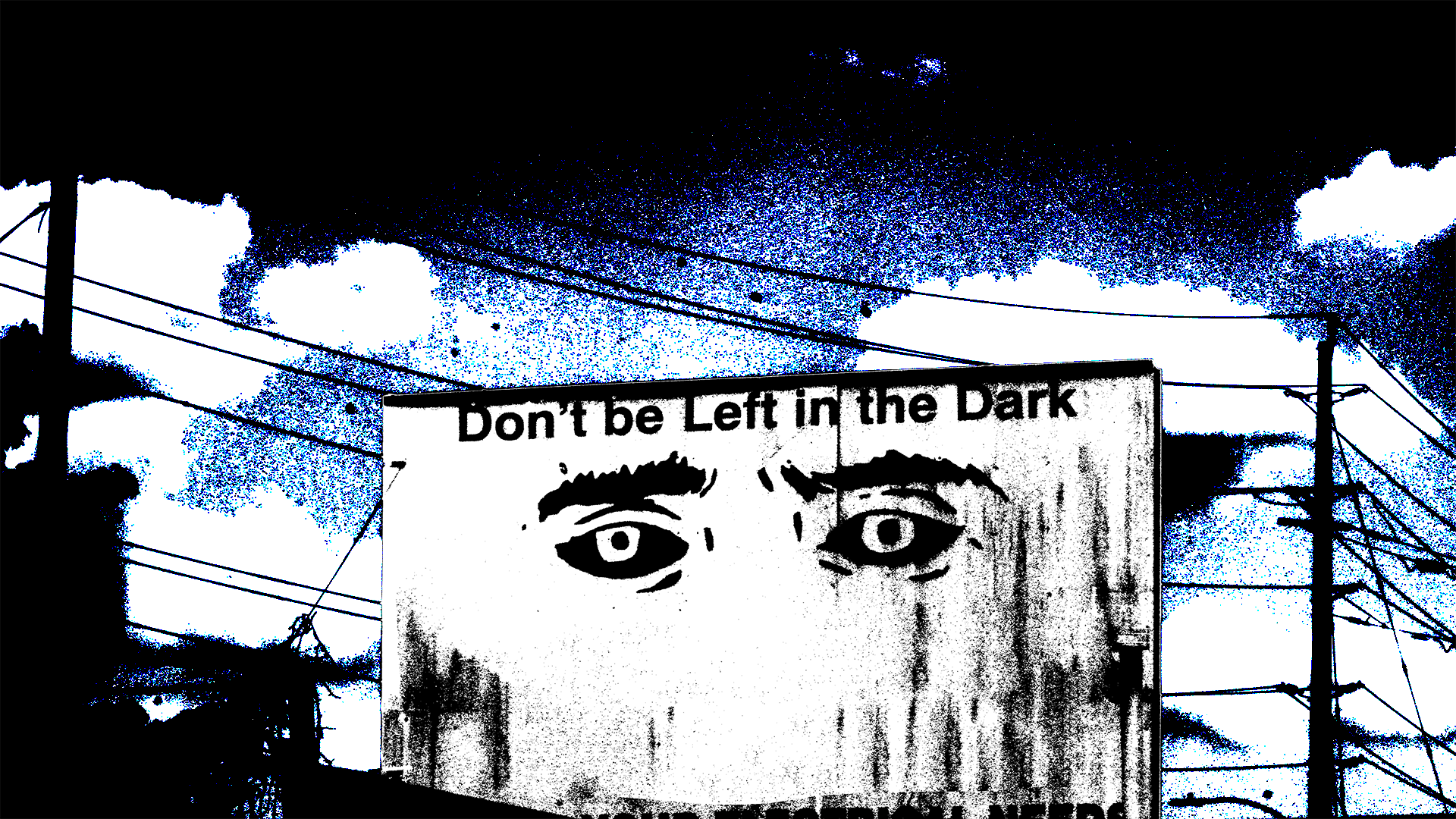
As we were about to turn the corner, my attention shifted from the dampness of my shoes and up to a glowing billboard. With two darkened eyes, the text warned:
“Don’t be left in the dark.”
The eyes were inverted. Where the pupils were meant to be black, and the irises white, there were instead glowing pupils from obsidian irises. What is the feeling that describes the middle space between comforted and disturbed? The paint peeled in many spots, indicating its long-standing status. As many young people in a new town come to think, I wondered if I was the first person to see this.
Before I could turn to him and make the obvious joke about The Great Gatsby. A voice came, soft and fast.
“Spare any change?” The man was my father’s age and not dressed for the October chill. It was then, from my small town alienation, that I felt a leap in my throat. In my softest voice, taught to placate at any cost, I choked.
“Oh, no—”
“Here you go, man, stay safe,” the anarchist reached into his green military jacket and produced a few quarters. The man nodded at him and resumed his post on the curb.
There was no second thought or hesitation about the anarchists' actions. I watched the man try in vain to pull his t-shirt in closer to himself. The anarchist moved his eyes from me to the man and back to me. Goosebumps appeared on the back of his hands as he hesitated putting his wallet away. I knew that look. The drop in the lower lip, the pupil becoming lit with recognition. The look I saw painted beneath the night sky not five minutes before, the look that whispers I see you, and I know you.
“That was kind of you,” I said. I was about to explain why I thought you should not give the unhoused change, my long-standing teaching from the finger-waving adults in my life, of, “Well, they could use it to buy drugs.” Even though, from experience, I could tell you that three-quarters would not even get you a lick of the snot dripping out of someone's nose.
“I know how cold it gets.”
When the anarchist from Nova Scotia left mid-semester to pursue his degree in social work and work part-time in the circus, I had to become the optimist in my own life. For months, he had spoken to me and sang to me about hope. When I stood in his empty room, strangely, the way he made me feel lingered. When I closed the door and then re-opened it five minutes later, having forgotten my keys, I knew that something was different. For a long time, I thought it was grief, but I realized that while grief came, the loving stayed. The interest stayed, the care remained.
People walk in and out of your life like the colourful patrons I saw that night at The Only. If you’re lucky, they’ll sit with you and begin to know you as who you could be and not as who you were. As I lay on my dorm-issued mattress that night, I thought of the void, the endlessness that we all could succumb to. I was not the authority on bad times, I was not the authority on suffering. I had been throwing myself into these walls, blindly searching, begging for something to lift me out of it.
It was true that no one was coming to save me, but maybe some people have enough light in them to spare. I never loved the city more than through his eyes. But I am trying to find that anticipation again. I promised a friend I would.
These moments in life find you, and they can mean something to you, or they won’t mean anything at all. That aforementioned faith is individual. It looks like divine intervention to some, and others, a reflection in their ongoing trajectory. As time marches on, and I am reminded of that night in the faces of strangers, I wish I had let that moment envelope me. I wish I had heeded the warning; who knows where I would be now?
Whatever the moment is, I implore you, let the absurdity mean something. Let it become your light. Let it fucking consume you, and don’t be left in the dark.




.png)
The rich text element allows you to create and format headings, paragraphs, blockquotes, images, and video all in one place instead of having to add and format them individually. Just double-click and easily create content.
A rich text element can be used with static or dynamic content. For static content, just drop it into any page and begin editing. For dynamic content, add a rich text field to any collection and then connect a rich text element to that field in the settings panel. Voila!
"Headings, paragraphs, blockquotes, figures, images, and figure captions can all be styled after a class is added to the rich text element using the "When inside of" nested selector system."
The rich text element allows you to create and format headings, paragraphs, blockquotes, images, and video all in one place instead of having to add and format them individually. Just double-click and easily create content.
A rich text element can be used with static or dynamic content. For static content, just drop it into any page and begin editing. For dynamic content, add a rich text field to any collection and then connect a rich text element to that field in the settings panel. Voila!
"Headings, paragraphs, blockquotes, figures, images, and figure captions can all be styled after a class is added to the rich text element using the "When inside of" nested selector system."

.jpg)
.jpg)