.png)



.jpg)
“We All Begin in Little Magazines” was the title of a short story by Canadian ex-pat author Norman Levine, which appeared in the July 1976 issue of The Canadian Review magazine, published in Ottawa. At that time, I was listed on the masthead as an Associate Editor, while working on a potential Canadian film-themed future issue. The business model welcomed anyone who came through the door, willing to work for “future considerations.” After the publication left the University of Ottawa’s “hot house environment” for rented premises near Elgin Street things appeared to be more businesslike on the surface, but it was the Canada Council grants which kept us afloat.
However, in time reality set in, the magazine folded, and most of the editorial staff relocated to London, England where the publishing prospects improved exponentially, and remuneration was involved. By the late 1970s, this was a well-established tradition, where Canadian writers and editors sought employment elsewhere, following their apprenticeship on Canadian literary magazines. Our Editor E. Graydon Carter decamped to New York City in 1978, becoming a reporter for Time/Life Magazine, and eventually the long-time editor of Vanity Fair and founder of Spy & Air Mail magazines.
Inevitably, someone, upon hearing the name The Canadian Review for the first time, asked me “of what?” There was an assumption that the publication was some kind of academic journal. There’s no Wikipedia entry for The Canadian Review.
While we were planning our November film issue, I considered writing an “on the set” article covering one of three Canadian feature films being shot that summer. To choose from were the National Film Board (NFB)’s One Man directed by Montreal’s Robin Spry, Who Has Seen the Wind directed by Toronto’s Allan King, and finally Ragtime Summer from UK director Allan Bridges, directed at the Lakefield College School in Ontario.
One Man (NFB production)
The One Man film was the closest location to Ottawa, and well within my travel budget, so that is where I drove to document the location filming taking place at a factory in Verdun on the Montreal waterfront. The mostly working-class neighborhood was known for producing hockey players and coaches like Dollard St. Laurent or Scotty Bowman, Quebec playwright David Fennario and jazz musician Maynard Ferguson. During WWII, it was home to a very large munitions factory where 6800 women toiled. RAF/RCAF ace fighter pilot "Buzz" Beurling was born in Verdun.
I recall a large group of neighbourhood children gathering close to the set and observing the action. One of them convinced me to send her a photo of the production when I got back to the Ottawa office. The main thread of the plot involved children being poisoned by a nearby chemical plant, and a crusading TV journalist trying to expose the industrialists who owned and operated the business.
The completed feature film had industrial pollution as a topic woven into the script, and while it seemed very earnest and newsworthy at the time, the final product now feels like just another "made-for-TV movie of the week." Shot on 16mm film with a shoestring budget, One Man managed to win seven Canadian Film Awards (predecessor of the Canadian Screen Awards). It also had a Cannes Film Festival out of competition screening plus a CBC network broadcast in August 1979. The director, Robin Spry, was a celebrated NFB documentary filmmaker who quit working for the board in 1978 and formed Telescene Film Group, producing, and directing commercial work, for television. He died prematurely in a Montreal car crash March 28, 2005, at age 65.
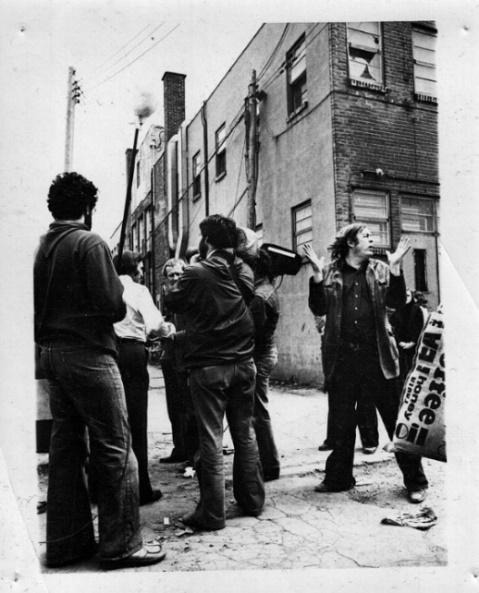
Here is one of my photos from the Verdun location (Robin Spry on the right):
Who Has Seen the Wind (Allan King Associates/Souris River Films)
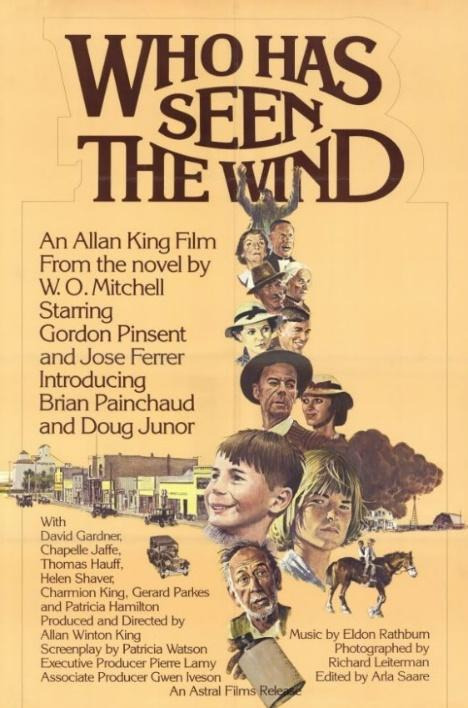
The second film on my list had the potential to become a Great Canadian Feature Film. Documentary filmmaker Allan King was undertaking his first dramatic theatrical feature by attempting to transpose the western Canadian set W. O. Mitchell novel Who Has Seen the Wind to the screen.
During my time at Canadian Review, I also undertook research into the history of Canada’s longest running private film production company, Crawley Films, which operated from 1939 to 1989. The founder F. R. “Budge” Crawley was a feature film investor and producer who was very active in the mid-1970s film industry. On March 29th, 1976, Crawley received Canada’s first Academy Award for the Best Documentary Feature The Man Who Skied Down Everest.
W. O. Mitchell and Crawley had worked together as far back as the 50th anniversary film The Face of Saskatchewan in 1955. It should not come as a surprise then that Crawley would be the producer of the proposed theatrical feature. As usual, the devil was in the details, with an assumption that W. O. Mitchell was the best person to write a screenplay based on his own successful novel. He was, after all, a major playwright and an experienced scriptwriter with a track record. Instead of going with the logical combination of players, Allan King decided to give the assignment to his wife Patricia Watson, who only had experience writing short documentary scripts for the NFB & TVO.
In addition to working at The Canadian Review, I was writing for trade journals including Motion magazine. I approached Crawley Films VP Graeme Fraser for travel expenses to the August 1976 film shoot in Arcola, Saskatchewan. On June 22nd that year, Crawley announced that he was withdrawing his funding and would not act as Executive Producer of Who Has Seen the Wind, as he did not feel confident in the Watson script and backed Mitchell as the screenwriter. That was the end of my summer movie junket.
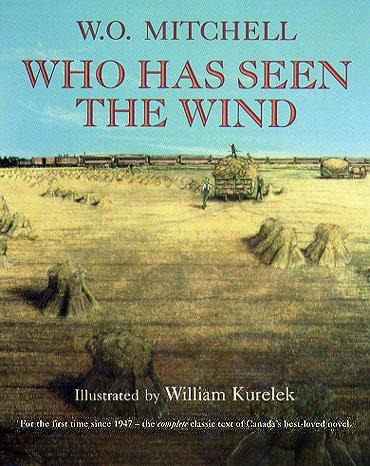
When I interviewed Budge Crawley in 1981, he mentioned, “I have an autographed copy of Who Has Seen the Wind [illustrated by Kurelek] from Bill waxing sentimental … ‘To Budge Crawley, the most honourable man I ever met.’”
On the positive side, Allan King’s film won the Golden Reel Award for the Canadian feature film with the biggest box office gross for the year 1978 ($1.2 million according to Variety). In terms of critical response, it, too, was reasonably positive, although Vincent Canby stated in the NYTs that the film had a “lack of narrative sophistication.” In terms of its reputation, it’s interesting to note that the film never made the Toronto International Film Festival Top 10 Canadian Films of All Time list.
I would recommend that you read Barbara & Orm Mitchell’s excellent 2005 biography W.O. Mitchell (2 volumes) for the details behind the production. The final word goes to W. O., who refused to watch the finished film and referred to it as, “Who Has Seen the Waltons.” The 1976 edition of the classic 1947 novel with illustrations by William Kurelek remains the best depiction of Mitchell’s novel so far. I hope that someday a Canadian producer will venture to support a new feature film of the book, more in line with the original work and W. O.’s 1976 screenplay.
Ragtime Summer/Age of Innocence (Judson Pictures Inc./Rank UK)
The final film in our trilogy had the working title Summer Rain, based on a script by Ratch Wallace who was a student at Lakefield College School from 1957 to 1961. Ratch began as an actor at the Crest Theatre Toronto and Stratford Festival before launching into a solid supporting actor film career.
According to Cinema Canada, Summer Rain was originally scheduled to begin filming in 1975 with veteran Canadian director William Davidson at the helm and a slightly different cast, including Donald Pleasance and Patricia Gage. However, Canadian Secretary of State Hugh Faulkner (who also happened to be the MP for the Peterborough riding from 1965 to 1979) signed a UK-Canada Coproduction Agreement in London, England on September 12th, 1975. It may have been this added enticement to partner with UK-based Rank Organization which forestalled the filming of Wallace’s script until 1976. The Liberal government had already increased the Capital Cost Allowance from 60% to 100% and encouraged a voluntary quota with the theatre chains to show more Canadian films.
In 1976, I associated Lakefield with Margaret Laurence, who retired there in 1973. When her novel The Diviners was published in 1974, The Canadian Review had not one but two reviews of the landmark novel. CR had an interview with Hugh Faulkner in the July 1975 issue. At that time, it seemed unlikely that we would relocate to Lakefield and live in this community for the last 35 years, including 30 years documenting the Lakefield Literary Festival.
The Canada-UK production was shot largely on the LCS campus and surrounding locations from August 8th to September 4th, 1976, with a UK crew, British director plus two well-known English actors David Warner and Honor Blackman. The supporting cast were mostly Canadian actors, including student actors portraying the young residents of the boy’s school, known locally as The Grove.
Full disclosure: I was a motorcycle rider for 45 years, so by my standards, the star of this production is a 1923 Excelsior-Henderson motorcycle, which makes an appearance in virtually every scene, except for the bedroom.
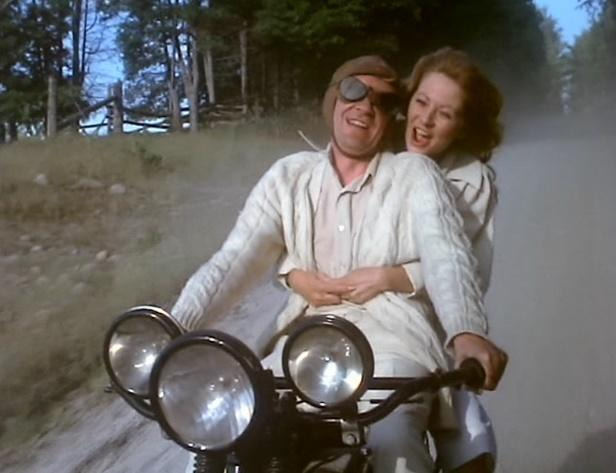
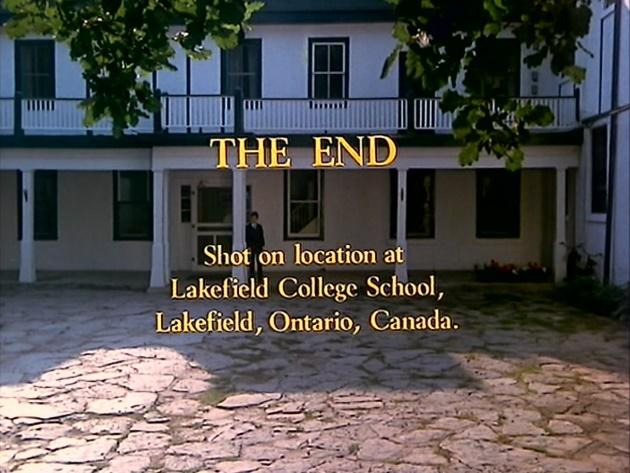
These three fictional feature films, while not examples of the best Canadian filmmaking can accomplish, do illustrate a transition going on in that period. The two Canadian directors, Robin Spry and Allan King, were both documentary filmmakers trying their hand at making their first fictional feature film. While Alan Bridges was a veteran UK television and film director who was hired to pull together an experienced technical crew and follow the script. This he did with the story of an eccentric English transplant, played by David Warner, ten years after his 1966 breakthrough role as Morgan.
All three films were made during the Tax Shelter Era (1974-1982) when the Canadian government allowed private investors in the Canadian film industry to write off any losses sustained and film producers benefitted from the increased flow of film financing available to them.
Peter Morris, Piers Handling and Ted Magdar in a Canadian Encyclopedia entry summarize the positive aspects of the CCA and Tax Shelters years:
“Some benefits did emerge from the tax shelter era. The increase in production provided valuable experience to a growing industry of craftspeople. A number of prominent producers, including Harold Greenberg, Garth Drabinsky and Robert Lantos emerged as Canada’s leading movie moguls. David Cronenberg credited his tax-shelter films … with launching his career, though he also recognized the overall scheme as a failure.”





.png)
The rich text element allows you to create and format headings, paragraphs, blockquotes, images, and video all in one place instead of having to add and format them individually. Just double-click and easily create content.
A rich text element can be used with static or dynamic content. For static content, just drop it into any page and begin editing. For dynamic content, add a rich text field to any collection and then connect a rich text element to that field in the settings panel. Voila!
"Headings, paragraphs, blockquotes, figures, images, and figure captions can all be styled after a class is added to the rich text element using the "When inside of" nested selector system."
The rich text element allows you to create and format headings, paragraphs, blockquotes, images, and video all in one place instead of having to add and format them individually. Just double-click and easily create content.
A rich text element can be used with static or dynamic content. For static content, just drop it into any page and begin editing. For dynamic content, add a rich text field to any collection and then connect a rich text element to that field in the settings panel. Voila!
"Headings, paragraphs, blockquotes, figures, images, and figure captions can all be styled after a class is added to the rich text element using the "When inside of" nested selector system."

.jpg)

%20(15).png)


.jpg)