.png)

.jpg)


FOR FANS OF: Skinny Puppy, Coil, Adam Wiltzie, Steve Reich
VERDICT: INDUSTRY STANDARD is not for the weak: it challenges you at every single turn with the allegation that you’re privy to abuses beyond your control.
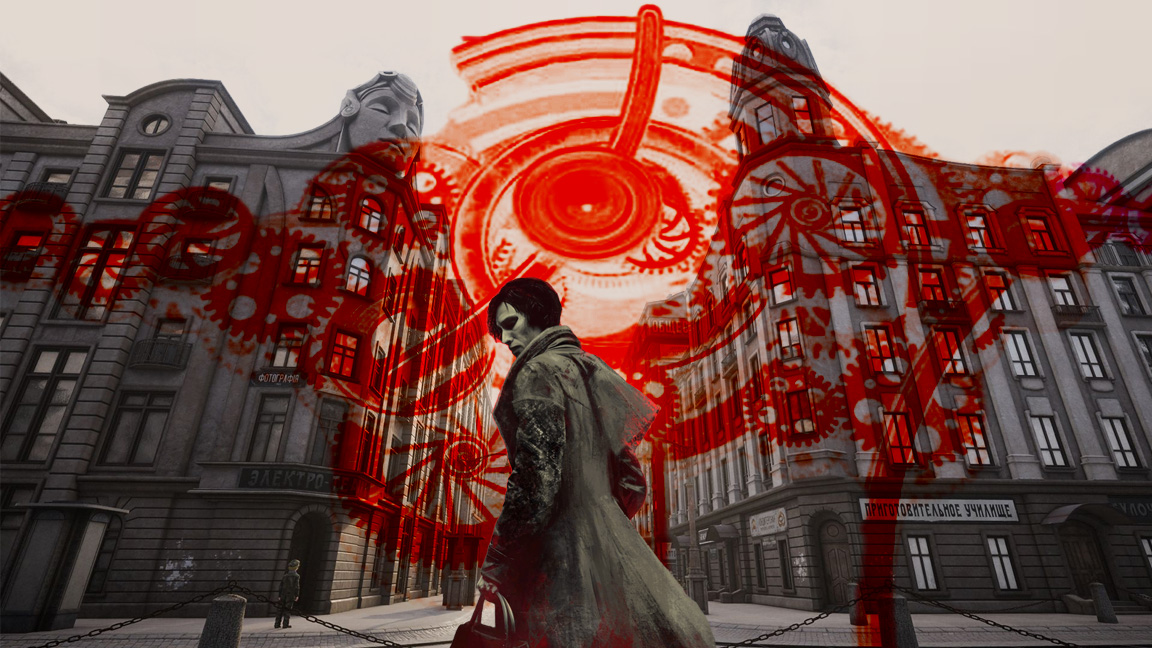
When I received an early vinyl copy of Gemunu de Silva and Gnostic Front’s latest collaboration INDUSTRY STANDARD, I had no clue what I held in my hands. I’d like to think I’m a little more on top of what karol orzechowski is up to, especially with the level of pulse I try to have on his projects as garbageface.
Since 2023 though, orzechowski has been occasionally producing electronic music live as Gnostic Front, an instrumental side project that employs a more classically industrial sound through its use of analog electronics and rampant, dissonant sampling of lectures, field recordings, interviews. You’ll periodically hear a Gnostic Front set during Peterborough’s annual Drone Day or in concert with sonically similar musicians/sound artists.
Gnostic Front is an ambitious side project for someone so involved in the Peterborough arts community, and something like Gnostic Front’s first 2024 release ALL WAR IS SPIRITUAL WAR is unforgettable in its mastery of sound collage. It’s a thrumming debut—vibrational in the worst sense of the word—that maintains a cohesive political message about impending climate disaster, a quest to accept that we live scatterbrained in the worst case scenario: anxious and poor and psyched out.
karol’s politics act as the throughline that quietly marries ALL WAR IS SPIRITUAL WAR to the rest of his discography as garbageface: there is no compromise on principle or tone when you’re confronted about a lifestyle you’ve long been a compliant, passive benefactor to. There’s something special about karol’s ability to tap into a wider social, cultural, political malaise through commanding a listener’s attention then rendering them hapless and uncomfortable through reminding them of their powerlessness.
This evolution from doomed rap to doomed soundscape feels quite natural for karol, and brings with him a body of politics that demands you engage, demands your discomfort in complacency in exchange for hearing injustices made sonic. INDUSTRY STANDARD is the second instalment to such a discography, and my God has it honed in on what ALL WAR IS SPIRITUAL WAR introduces, if not fashioned it into a weapon.
Unlike its predecessor, INDUSTRY STANDARD was only produced and composed locally in Peterborough: most of the sounds curated on the album are field recordings from dozens of countries, gathered by investigative filmmaker and Tracks Investigations co-founder Gemunu de Silva over a 30-year career in uncovering industrialized animal cruelty.
What we hear on this album are glimpses of a supply chain we truly know very little about: factory farms, slaughterhouses, animal testing laboratories, livestock transports. These sites of capture and confinement are the space where INDUSTRY STANDARD exists, haunting and dissonant and resonant until the end of the final track.
“The animals in these soundscapes have been standardised—bred for productivity, confined for efficiency, silenced by distance and infrastructure,” the liner notes read. “The environments are constructed for output, not for life.”
What hooked me from the jump was this album’s first track “Le Voyage,” a collection of field recordings, samples, and instrumentation that illustrate a live animal transport. Here we’re introduced to the sounds of such industry: the dull sound of machinery, the resonance of great concrete warehouses, the movement of animals and their noises of distress. Very little is human here, as distorted, echoing voices of investigators full of emotion punctuates the loud thrum of such a trip. As the song stumbles forward with its crunchy synth beat, the roar of machinery overtakes the foreground and commands attention when it suddenly empties out, leaving the bleats of animal noises and commotion to be contemplated rather directly by virtue of its silence.
“Dead, dying, dead, dying” repeats at the song’s climax before it assumes movement once more, all while introducing a cyclical life of birth, captivity and death, discovered through the anxiety and stress and commotion of this particular trip. It’s a bleak beginning for a listening journey into an unseen world, a drop-off into the supply chains that support everyday Western cosmopolitianism: everything from cosmetics and fashion to entertainment to food is explored in the sonic images of systemic animal abuse that INDUSTRY STANDARD confronts you with.
This arrangement of this album cannot be understated: the juxtaposition of dissonant sound forms to create a visceral image imbued with such an anxious urgency is incredibly hard to do, especially when Gnostic Front incorporates instrumentation with a range of affective quality. This album plunks its listener straight into the disperate, systemized lives of its animal subjects and in turn subjects them to environs of torture and suffering, cries of distressed primates being captured, shears plucking and clipping fur. INDUSTRY STANDARD is so direct in its violent confrontation with its listener, and doesn’t care to spare comfort while it exhibits its atrocities to bear witness to.
After a track ends on this album, the silence is especially empty, especially on a sound system or in headphones. It gives what it presents a second to breathe before drawing you back into a prescribed soundscape, knowing it will lull you in—be it with the hum of a fan, the bubbling of a nearby river, the resounding echo of an empty space—before descending back into the bedlam of a standardized death drive.
From a technical standpoint, the mastering is so supportive of the field recordings and samples curated, especially in the amplification, enveloping, and distortion of key sonic moments within a scene on a track. These choices in altering volume and sound quality drive a real sense of dread into a listener, especially when you have soundscapes that depict the outside world—big and open with distant chatter and activity—interrupted by a human intervention—chatter growing louder, unintelligible in its up-close movement with the occasional cry of a distressed animal—then juxtaposed with sites of captivity—sterile silence with little noise or outcry.
Parts of this album are indeed more industrial (like the music!) especially notable in “Lamb of God (The Sacrifice)” and its bassy journey through what sounds like a slaughterhouse, building up with a deep, commanding drumline, its climax a scuttling-about of sheep's hooves. Complete with muffled, resounding bleats and cries with a characteristic overprocessed bitcrunch, an oscillating chord—almost heavenly—fills the rest of this sound image’s duration, holding long and still while hooves still distantly clatter against a metallic floor. It’s truly a horrifying thing to end such a potent image of impending doom with, as death is framed as this welcome reprieve from a life that only knows suffering.
It’s incredibly difficult for me to convey just how affecting a work like this is. My initial listen-through of INDUSTRY STANDARD—no notes, no screens, just listening to both sides of this record—left me nauseous and harrowed with what I had heard for over 40 minutes. This album produces a listening experience I could only dream of conjuring so carefully. The meticulousness of curated detail provided by de Silva, alongside the instrumental/compositional work of Gnostic Front and the mastering courtesy of Harris Newman of Grey Market Mastering in Montreal, has left me utterly changed and disgusted by what I’ve heard.
And I think it’s intentional.
The death and destruction that surrounds this record and its various scenes is so tightly controlled that I cannot recommend an audio experience like this enough. It’s an exposition necessary to anyone that gives a shit, and I haven’t been able to stop thinking about the images INDUSTRY STANDARD leaves its listener with, especially when you buy a physical copy of this album. In the liner notes, there are carefully-selected pictures that “you were never supposed to see” provided by Tracks Investigations, applicable to the scene that each track illustrates: a tagged calf, a sow emerging from a tight dark cage, a bagged macaque struggling to escape. The sonic image is arguably more potent after referring to the liner notes, yet still has a level of staying power that I’m quite excited to see from a project like this.
For me, soundscape is all about affect: the first thing we feel before verbalizing it, an immediate sensation that precedes a tidy category of emotion. INDUSTRY STANDARD taps right into that initial feeling, leaving its listener reeling with the reality of normalized abuses against animals.
INDUSTRY STANDARD is now available via Bandcamp.




.jpg)


.png)
The rich text element allows you to create and format headings, paragraphs, blockquotes, images, and video all in one place instead of having to add and format them individually. Just double-click and easily create content.
A rich text element can be used with static or dynamic content. For static content, just drop it into any page and begin editing. For dynamic content, add a rich text field to any collection and then connect a rich text element to that field in the settings panel. Voila!
"Headings, paragraphs, blockquotes, figures, images, and figure captions can all be styled after a class is added to the rich text element using the "When inside of" nested selector system."
The rich text element allows you to create and format headings, paragraphs, blockquotes, images, and video all in one place instead of having to add and format them individually. Just double-click and easily create content.
A rich text element can be used with static or dynamic content. For static content, just drop it into any page and begin editing. For dynamic content, add a rich text field to any collection and then connect a rich text element to that field in the settings panel. Voila!
"Headings, paragraphs, blockquotes, figures, images, and figure captions can all be styled after a class is added to the rich text element using the "When inside of" nested selector system."

.jpg)
.jpg)