.png)



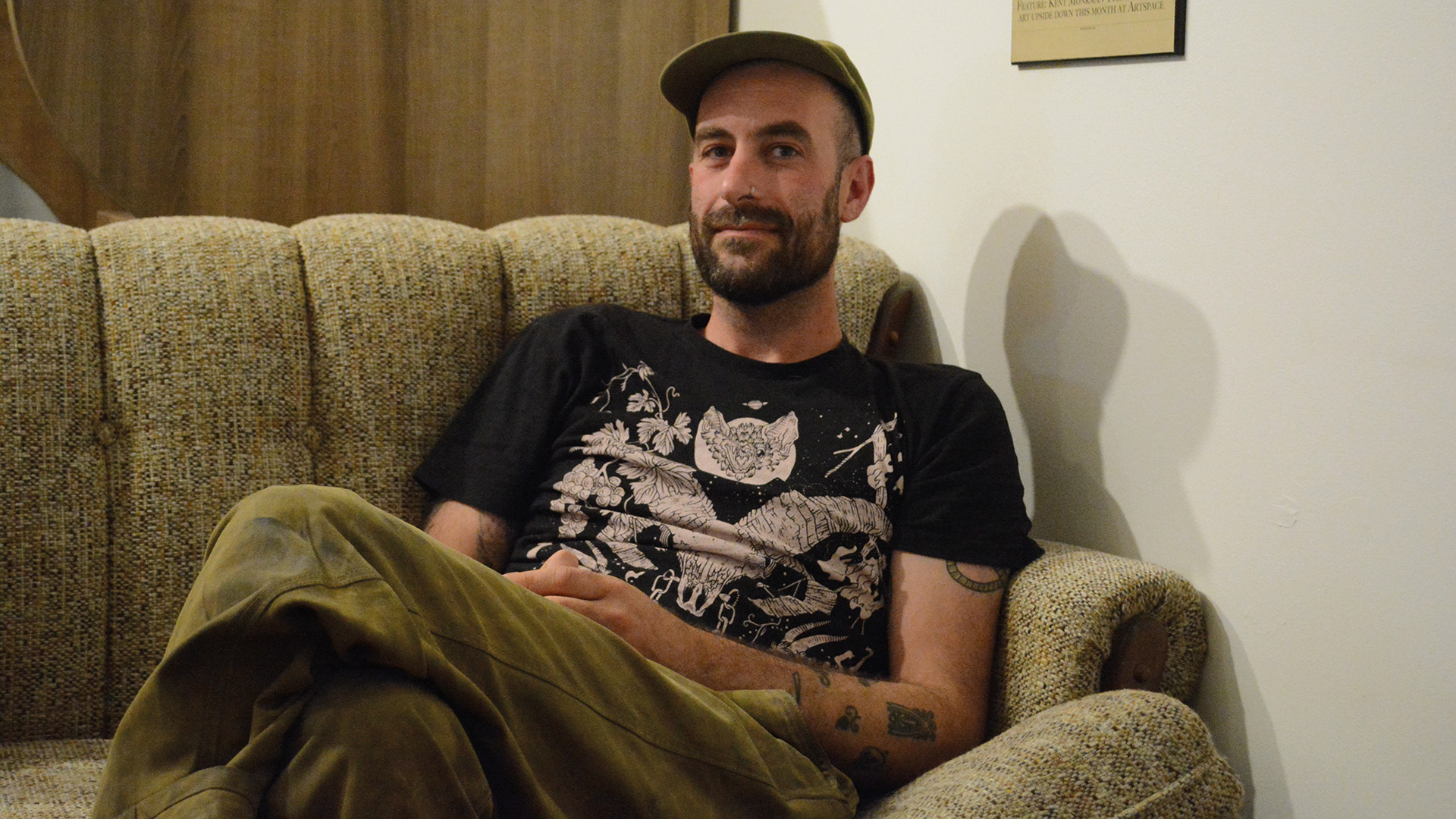
Horseman, Pass By. are a free jazz duo made up of drummer Benett Bedoukian and cellist Mark Molnar, two instrumentalists with over a decade of collaborative history. But more than that, they are a force to be reckoned with in the music world of Ontario and Canada at large.
Such a constatation comes to me from the firsthand experience of their music at a September 19th Sadleir House show, where they shared the stage with multidisciplinary wind instrumentalist Connor Bennett for what I can only faithfully describe as one of the most intense aesthetic experiences I’ve ever been privy to.
Try as I may to provide a factual account of that night without resorting to flowery descriptions of pure affect, it is a matter of fact that what they do is indescribable by any other means than poetry.
In so many words, I am urging you to go see them.
Molnar’s meticulous stringed wails will tell you a story in a language you’ll never know if you understand. It will leave you in awe, waiting with baited breath for an answer to his last line.
The ascending beat of Bedoukian’s percussion instruments—drums, then bowls affixed atop his drums, then drums again, like the overarching slower rhythm of his often explosive play—will appear in a matter of instants to have responded, spoken over, and overridden Molnar’s melody, only for Molnar to respond with an intensity which only reveals the pair’s total communion in play.
They will show you a kind of musical storytelling you’ll see refractions of in every work of art you’ll ever see again, but which you’ll never experience again in itself—probably not even at their next show. I know I’ll be there to test that hypothesis.
In my native french, I would call the performance I saw éblouissante, a word which translates roughly to dazzling. But that roughness is the inexactitude of the translation; dazzling refers to the shine or sparkle of a light-refracting object like the surface of a lake at sunset. Éblouissante refers to the source of light itself. Therein lies the difference between the experience of Horse Man, Pass By.’s play and any written account thereof.
When he isn’t drumming éblouissance itself at a $20 show, Bennett Bedoukian runs O! Underworld Press, a personal letterprint focusing on “printing short run books and ephemera” (per its website) and releases solo music under the name Cold Eye.
Despite being based out of Havelock, Bedoukian’s name is nigh-omnipresent in Peterborough’s music scene, where he involves himself in promoting local artistry at just about every level. His role in nurturing a place for left-field cultural production in the Electric City was the second reason I invited him to the Arthur office for an interview about everything from free jazz to the Jack Reacher novel series.
Louanne Morin: We’re here to talk about Horse Man, Pass By.—talk to me about the band, what you do as part of it, as a musician in general.
Bennett Bedoukian: We’re like a free jazz or improviser group.
Mark and I have been playing together and improvising together for about 10 years, and both of us are trained as improvisers, which is a thing. It’s not like jam. That’s one of the few things that I would be a hardass about.
We’re not jamming, it’s out of a tradition with a long, relatively global history.
LM: I want to ask you how one comes about becoming a trained improvisational musician, and that tradition you draw from.
BB: Most music historically has been improvised music. We’re given this idea that music is written down as a Western tradition, but even if we’re talking about oral history of storytelling, there’s always some improvisation in it.
Along with that, you have musical histories. I’m Armenian and Mark is Roma, both of which have their own musical histories. You have melodies, but nothing is written down about who plays what, and everybody is playing around the melody.
None of this is written down. Nobody has agreed anything like there’s melodies that are central to the piece, but they’re not referred to as the soul of it. The more Western and codified music gets, you start to have distinctions in jazz music. You have big band and swing, and then bebop from there. Those are all centered around a bunch of mutually agreed upon harmonic structures, rhythm changes, these kinds of things.
And then you get musicians who operate outside of that. The first real records that are like the birth of free jazz, if one could say that, would be two Ornette Coleman albums. One’s called The Shape of Jazz to Come, the other one is called Free Jazz, which is where we get the term free jazz from.
A couple years later in Europe, you start to get people like Derek Bailey moving away from session playing to working out various improvisation strategies and techniques with his peers. That becomes a different thing. It’s far less jazz-influenced. Despite the fact that they might all be jazz players, it has its own tradition and its own sound.
LM: How do you fit within that tradition?
BB: I got into this music in high school. I was a guitar player, I played in the jazz band. I had a really great teacher named Doug Friesen, who is a wonderful person, still a good friend of mine. Doug comes from a history of playing improvised music as well. We got to go to New York with him through the school and he had arranged workshops and master classes with various musicians that were astounding things to do and be a part of when I was 17.
I’m very fortunate—because now I live in the woods—that I’m not a part of a scene. There are sounds from places, and if you don’t play that sound, it’s harder to get involved in that scene. A lot of the improvisers I know in other scenes and communities are doing things as a part of that scene and community, which doesn’t really interest me. Parts of it might, but there are some places where the improvising is all just delicate moments. And I love delicacy, but I also love noise.
Mark and I can do pretty much whatever we want, which is great from an artistic perspective.
LM: How do you accommodate not wanting to be tethered to the sound of the specific location that you’re in and trying to situate yourself within that genre tradition?
BB: I don’t take myself seriously at all. I take my craft very seriously. I take the work I produce seriously. But I also expect nobody to say ‘That was really good.’
We’re pulling from all of the things we listen to always. It’s just the way in which we operate. We have ears, and that’s what we’re hearing, and so we’re representing what we’re hearing through our own lens.
There are things that I wouldn’t do because it just gets disrespectful—I’m not gonna start playing a one-drop reggae feel, but I think if you listen to enough of my playing, you’ll hear that that’s in there. I love New Orleans second line music. I’m not playing second line music, but it is in my play.
LM: There’s so much in that history that you pull from, and that is naturally conducive to creating new patterns of sound in a way that can sometimes be influenced by your repertoire.
BB: Sometimes I’ll hear ‘It just sounds like you guys are screaming at each other.’ Even the idea that it’s a conversation doesn’t entirely encapsulate the thing. A conversation is a listen and response rather than a simultaneous expression.
There are a lot of little pieces at play. There’s a group in Europe called the Instant Composers Pool, long before Insane Clown Posse was ICP, and that’s a great way of describing it: you’re mutually composing simultaneously.
I have little bits and bobs that I play with, like broken singing bowls and cymbals and it has reached the point where I’m very careful about when I put them down, because that is still a sound that is being heard. As I’m setting up or rearranging the pieces, all of that sound is a part of the piece.
That becomes a thing that I can either play with, play against, play under or play over. We’re continually and mutually agreeing on—whether or not we know it—how we’re relating to each other.
LM: The kind of music you make is very grounded in its current environment, in the current situation. When you talk about instant composers at a Horseman, Pass By. show, who are the composers?
BB: The artist has a responsibility to the audience, and the audience has a responsibility to the artist. Whether or not people are honoring those responsibilities is a different question.
Let’s say we're playing a three-band bill, and we’re on second, and I don’t know the first band, but I know who’s playing after us. Even if we don’t mean to, we are playing in response to what the first band did. We’re either ignoring it or we’re choosing to continue the arc of the evening. We’re also in response to how the audience is engaging with us.
How we negotiate that is different, depending on the room, the feeling, if I know who the third band is and what they’re doing. I have a hard time not thinking about the whole night as the piece.
LM: Are you avoiding coming in with an idea of what you’re about to make?
BB: I wouldn’t say that I’m avoiding it. There are times when we say ‘How are we going to start?,’ but at this point, we’ve been playing long enough that I don't feel the need to even ask that question. Let’s say I decided to start really quiet, and Mark decides to start really loud. We can both, in that first second, decide how we’re going to respond to that first instance of noise, and I trust completely that it will work.
He can play a note, and I know what will happen—not what he will play next, but I know where he’s thinking about going, and he will know ‘If I do this thing, it will cue Bennett to respond in this way.’ These are things that we’ve unconsciously negotiated with each other.
LM: What draws you to make music with Mark and to be in this instant composer relationship?
BB: I can tell you the story from his perspective: he came over for dinner and on my stairs up to my room was a movie he loved and a record he loved. We very quickly trusted each other.
Right before we played a bunch of shows together for the first time, I was waiting for him to pick me up, and I was sitting outside reading a Jack Reacher book. I was like, ‘I can’t let him see me reading this. He’s an English teacher and it’s pulp fiction!’
I was so engrossed in it, I didn’t hear him pull up. He was like, ‘Hey, what are you reading?’ And I was like, ‘Lee Child.’ And he was like ‘Oh, which one? I love those books.’
Horse Man, Pass By.’s debut album All Curses Are Mirrors is available for download on Bandcamp. LPs and CDs are also available through Black Bough Records.
This interview has been edited for clarity and concision.






.png)
The rich text element allows you to create and format headings, paragraphs, blockquotes, images, and video all in one place instead of having to add and format them individually. Just double-click and easily create content.
A rich text element can be used with static or dynamic content. For static content, just drop it into any page and begin editing. For dynamic content, add a rich text field to any collection and then connect a rich text element to that field in the settings panel. Voila!
"Headings, paragraphs, blockquotes, figures, images, and figure captions can all be styled after a class is added to the rich text element using the "When inside of" nested selector system."
The rich text element allows you to create and format headings, paragraphs, blockquotes, images, and video all in one place instead of having to add and format them individually. Just double-click and easily create content.
A rich text element can be used with static or dynamic content. For static content, just drop it into any page and begin editing. For dynamic content, add a rich text field to any collection and then connect a rich text element to that field in the settings panel. Voila!
"Headings, paragraphs, blockquotes, figures, images, and figure captions can all be styled after a class is added to the rich text element using the "When inside of" nested selector system."

.jpg)
.png)


.png)