




.png)



In the summer of 2020, then-editors Nicky Taylor and Bea Gaffney-Knox visited the exhibition of Company Town at Artspace: a series of fibre, textile, and paper works mapping the legacy of the General Electric (GE) factory in Peterborough. Exhibited during the height of a COVID summer, Nicky’s recount of the exhibition through their feature “Mapping Memories of a Company Town” maintains its solemn reflection on the aftermath of industrial disease and the Peterborough cancer cluster.
“The story of GE in Peterborough is one that I have become acquainted with slowly during my time here. It includes a manufacturing powerhouse that once employed 6,000 people, corporate negligence and consistent, daily exposure to over 3,000 toxic chemicals, countless subsequent diagnoses of various types of cancer and other illnesses linked to this exposure,” Nicky writes.
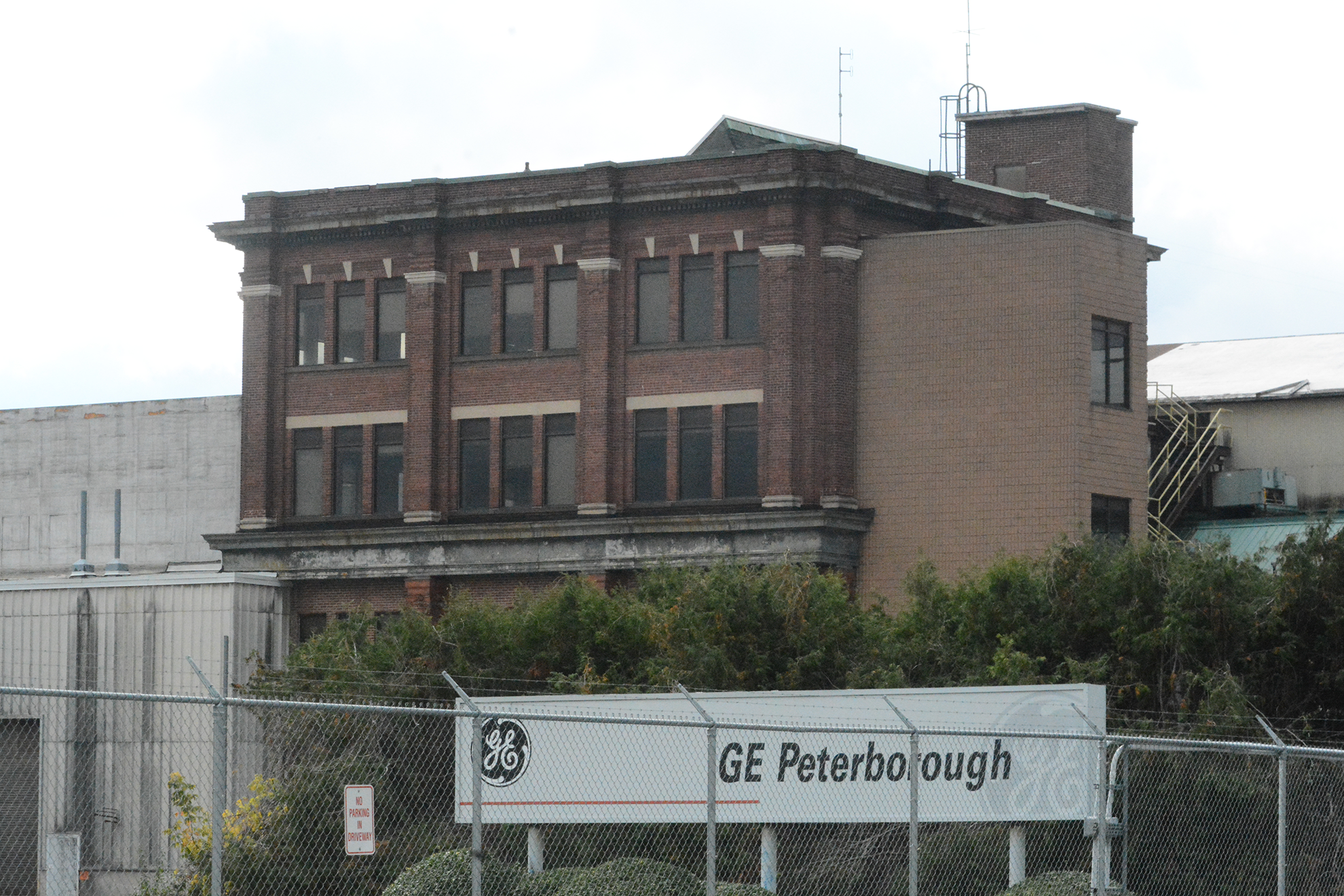
“I have walked and biked past this abandoned factory on Park St. more times than I can count, often remarking that it resembles a prison, with its tall, barbed-wire enclosure,” they recount. “But I am wholly unfamiliar with this other layer of space - the one that exists in memory and in the act of remembering.”
Five years later, I drove myself, Evan Robins and Ian Vansegbrook out to that very same strip of Park St. It was another August scorcher with grey overcast, and we went out to take fresh pictures of the Lancer Electric eyes for a recent submission.
For those uninitiated, the Lancer Electric eyes refer to an old billboard in a median strip between the two parallel one-ways that make up Park and Rubidge Streets. To most in-town dwellers, the Lancer eyes have always been there, much like the GE campus directly across the street. They’re regarded with a similar reverence found in F. Scott Fitzgerald’s The Great Gatsby, where the Dr. T.J. Eckleberg’s eyes gaze over the valley of the ashes.
Juxtaposed with the GE complex only three lanes over, the Lancer eyes retain a downcast look of guilt, looking away from what remains of industrial heyday: a contaminated brownfield, crumbling into further disrepair.
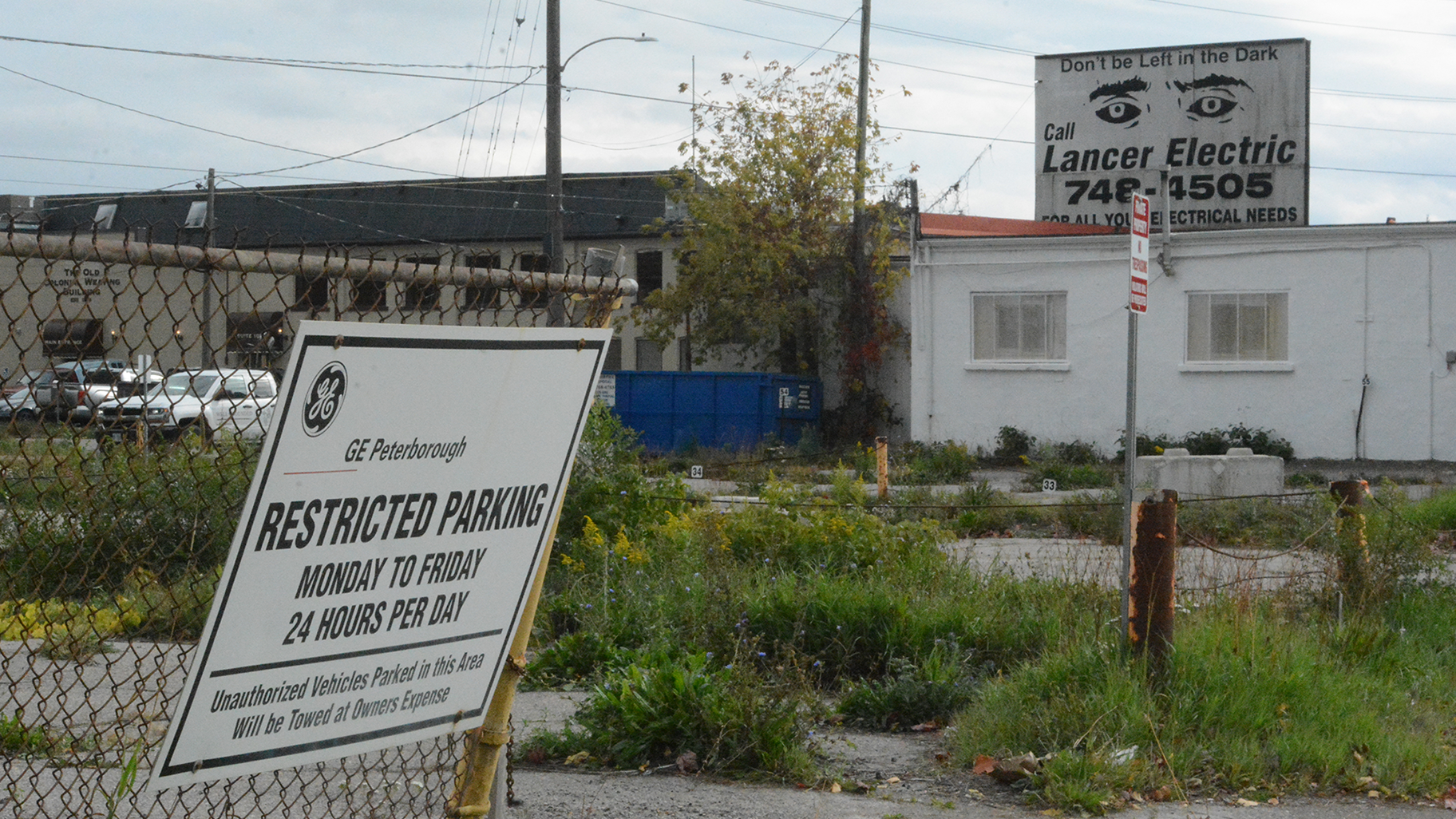
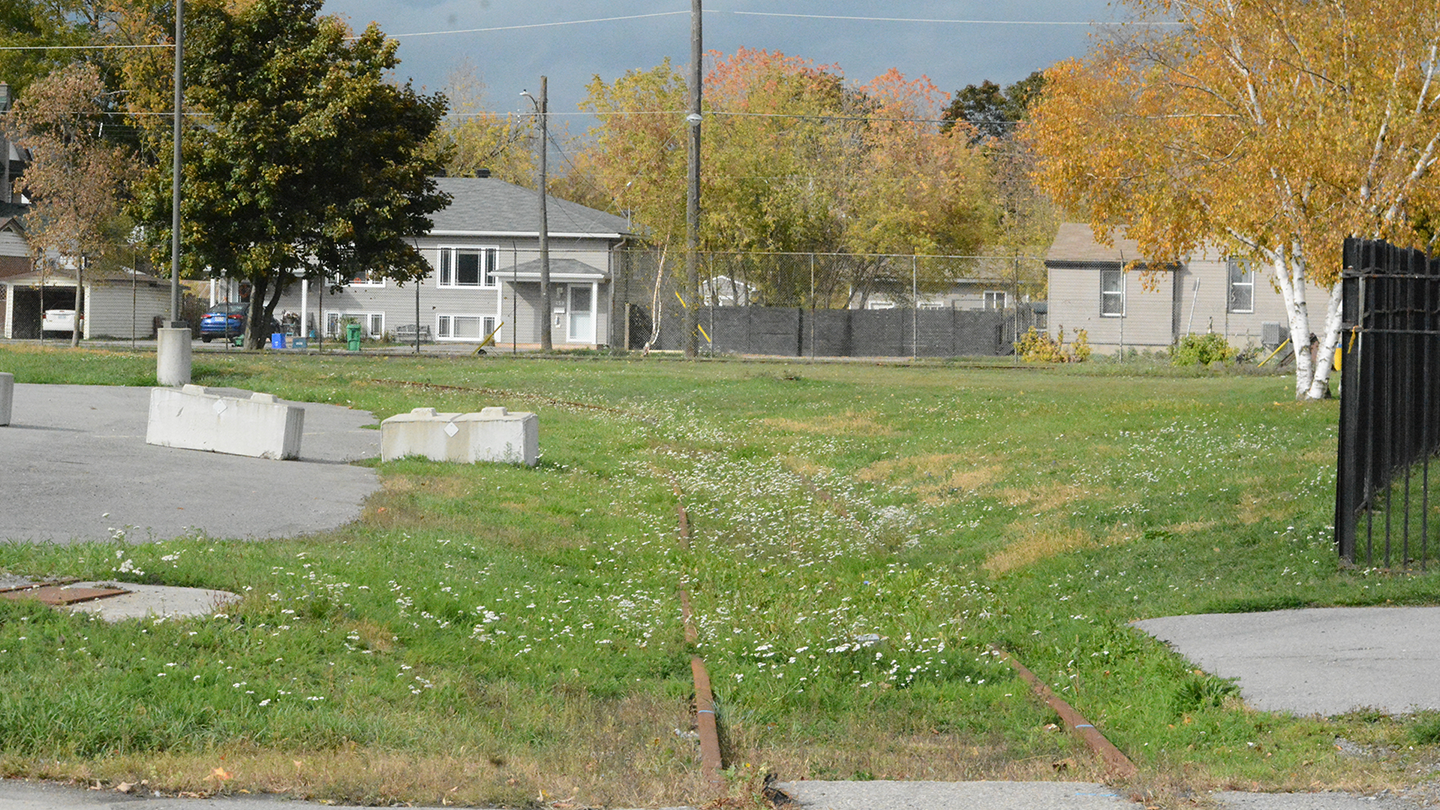
The billboard isn’t far from the legacy of such a vivid history: the Eyes are atop a little repair shop and its backlot—an old parking lot proximal to the extensive groundwater monitoring program GE manages in light of the contamination of the 107 Park St. N., 1160, 1063, 1091 Monaghan Road, 297 Rink St., and 107 Rubidge St. properties.
An amended Director’s Order from the Ministry of the Environment, Conservation and Parks from 2024 illustrates the extent of environmental monitoring still continuing at these sites, even after manufacturing operations ceased on the GE campus in 2018.
“Through various industrial and related activities that occurred over time at the Site, contamination of soil and groundwater resulted, including [polychlorinated biphenyls] PCBs and [trichloroethylene] TCE,” the order states.
The main manufacturing plant at Park St. and the undeveloped parcel of parking lots on Monaghan Road remain “the subject of ongoing environmental monitoring/sampling, assessment and remedial/mitigative activities” in order for GE “to manage these contamination issues and to mitigate contaminant discharges and potential adverse effects,” according to the site’s description in the order.
This is not the first remedial measure we know of in relation to this area: GE has previously offered to remediate homes with asbestos derived from the Peterborough plant, according to a CBC/Toronto Star joint investigation in 2019, yet GE communications with the journalists involved skillfully denied the manufacturer ever offloaded the processed material to residents despite worker testimony.
In early September, GE Vernova—one of the three remaining publicly-traded vestiges of the old General Electric—sent out 4,500 letters to surrounding residents around the Park St. N. campus, letting them know that its subsidiary GEPR Canada had submitted a notice of intent to partially demolish most of its buildings.
GE Vernova states on their website that they’re working to “stabilize, conserve, and maintain eight buildings that are architecturally important and represent meaningful time periods in the history of the site.” Aside from maintaining the long-term lease BWXT holds on four buildings and the two buildings for a team of GE engineers, it’s unclear what the plans are for the two remaining buildings beyond their earmarked heritage value.
Only a month later when the notice appeared before Peterborough City Council did the public begin to bristle at GE coming back into the picture, especially after the public delegations to council’s acknowledgement of the demolition notice and dealing with the heritage aspect of the Park St. factory.
Among these delegations were those involved with the Peterborough Occupational Disease Action Committee (PODAC), namely Robert and Dale DeMatteo, two occupational health researchers involved with the 2017 Report of the Advisory Committee on Retrospective Exposure Profiling of the Production Processes at the General Electric Production Facility in Peterborough, Ontario prepared for UNIFOR regarding the occupational hazards within the GE complex between 1945 and 2000.
The UNIFOR report is one of the most harrowing reads I’ve ever embarked upon as a journalist. It illustrates an unbelievable level of chemical exposure, detailing a series of closed-in production areas with extensive exposure profiles rife with hazard. The conditions of the GE Peterborough site described in this document are appalling in the strongest sense of the word, and nothing I write in this will do justice to the scale of health catastrophe inflicted upon GE workers and their families in the 55 years detailed in the UNIFOR report.
What prompted the Advisory Commitee report was an uptick in cancer and occupational-related disease in the area, best documented by an intake clinic facilitated by the Canadian Auto Workers (CAW) union local beginning in 2004. In the 20 years since then, the magnitude of the exposure—both occupationally and proximally to the GE site—has dominated the conversations around the GE Peterborough legacy.
I don’t think a lot of people are prepared to deal with the complexity of GE Peterborough’s legacy, especially benefactors of that legacy, like students at Trent University who still benefit from the 100 acres of land CGE donated to the university in 1962 and the $300,000 (nearly $500,000 in today’s dollars) CGE workers raised for its founding in 1963. During the factory’s peak, CGE workers were an integral part of the social make-up of Peterborough: they fundraised massive sums for local initiatives like the United Way of Peterborough, provided volunteers for many local committees, and even facilitated English and math classes for GE workers at Kenner Collegiate.
It’s extremely difficult to take GE out of Peterborough, as it is heavily interwoven in the very fabric of Peterborough’s cultural and economic history. Yet when we consider what’s left—disease, denial, and disenfranchisement—I completely understand the lack of public trust in GE Vernova’s intentions to move forward.
Peterborough is no longer the company town that GE helped build. It is a living graveyard with a lake full of PCBs and a brownfield at its centre, and it is undeniable that GE has a big role to play in the nightmare we must now grapple with.
After all, a league of retired workers and families are still fighting to hold GE accountable for the death and disease linked to decades of mass chemical exposure. The legacy that GE Vernova is currently promoting is so utterly different from that reality: even their website prompts visitors to “share their memories” of GE Peterborough, as GE has “long been part of the fabric of the community, with deep roots set down over decades.”
On the whole, this situation reillustrates the loss of trust people have in most institutions—their governments, health authorities, and the mechanisms that should’ve protected these employees from the utter disaster we’re now face-to-face with again. As early as the 1920s and 1930s, GE officials in the U.S. were advised of both the hazards of asbestos in their U.S. operations and the conditions of their Canadian plants, yet GE Peterborough continued to use asbestos well beyond that point to insulate nearly every electrical aspect of both production and product at the plant.
This was never by GE’s admission, though: The burden of proof was always on the workers affected by industrial disease and their families. It took the revelations of the 2017 UNIFOR report and renewed community urging for WSIB to reevaluate dozens of denied claims relating to GE Peterborough. The report finally made a critical link the community always knew: that the prolonged exposure to the working environment of GE Peterborough was linked to an uptick in mesothelioma, asbestosis, COPD, and other respiratory diseases in former GE workers.
The core revelation, though, was how GE Peterborough had provided wrong or incomplete information to WSIB and failed to truly illustrate the levels of workplace exposure occurring with those in its employ through its years of dealing with both employment records and their relation to occupational illness claims.
To this day, there has never been an admission from GE of what went wrong with GE Peterborough. Only quiet moves to remediate and monitor what is going on. I don’t know if we’ll ever get that admission, because what’s happening isn’t unique to Peterborough, but is also happening in dozens of other places where long-departed industrial manufacturing has left its contaminated, heavy-metal mark on the Canadian landscape, especially in First Nations across the country like Serpent River and Grassy Narrows First Nations.
I don’t know what the partial demolition of the GE complex will do for healing this great, open wound that the people of Peterborough all seem to be touched by. Frankly, I think that remediating the site and its brownfield is a step in the right direction, and if left untouched it will cause more problems than what has already been contaminated.
I don’t think people are ready to trust a company—now worth $163 billion off of the backs of their community—with a task of such momentous importance to that very same community. The distrust evidently plays out in the local discourse surrounding the GE question and the trepidation of allowing GE to even partially demolish key evidence to a decades-long issue.
In her conclusion to her October 14th delegation to Peterborough City Council, researcher Dale DeMatteo posited that GE’s intention to demolish is mostly based in seeking a reduction in its current property tax.
“Given the massive scale of toxic contamination in the plant and the fact that the demolition is requested primarily to decrease GE’s municipal tax burden, it is our view that GE is not positioned to safely and ethically handle a demolition of this scale and complexity,” DeMatteo told council.
“Our view is that GE has a responsibility to clean up the contaminated aftermath of a very prosperous 100 year enterprise,” DeMatteo added. “In stating up front that their demolition request is to reduce GE's tax burden, the company, in effect, will shift long term responsibility for the proposed cleanup to local taxpayers.”
“GE's financial and moral obligations to the municipality of Peterborough should be established prior to making any decisions.”
In a conversation meant to be about a heritage designation, the notice of intent to demolish parts of the GE complex jumped into the forefront of most public delegations that evening because of not only the issue of contaminants in the area and its proximity to arterial residential and commercial areas, but also thanks to an estimated $283,000 reduction in the municipal tax base, quietly shifting that financial burden unto the Peterborough taxpayer through a foreseen 0.13% property tax increase, according to an analysis of the $17M property in Peterborough Currents.
In all likelihood, it will cost millions of dollars to demolish and remediate the GE property out of nearly 130 years of manufacturing contamination. I should acknowledge that this is not the first expenditure of its kind for GE, whose billion-dollar commitment to dredging dumped PCBs from the Upper Hudson River in Upstate New York is now entering its third five-year term under the supervision of the U.S. Environmental Protection Agency (EPA). For a subsidiary company worth billions, though, this cost is a drop in the bucket of doing business.
Remediation is not unfeasible for the GE Peterborough site, but the extent of its feasibility is not yet public knowledge. I see how the public is right to balk at how that remediation falls into the hands of institutions that have failed Peterborough before, though. The length of chemical exposure and its scale of contamination has only been addressed through tacit, small gestures, not through an ongoing process of open reconciliation. GE will co-operate, like it has with WSIB claims, the Ministry of Environment, and the City of Peterborough, but it will not admit fault in all of this.
The reality is that the good memories of the GE company town coexist with the reality of what GE workers were exposed to. That is why GE should openly acknowledge its darker history: No amount of sanitizing PR or skilful letters or press releases will expunge that from the collective memory that Peterborough holds of its GE glory days. Workers and families died unnecessary deaths in the pursuit and maintenence of ever-expanding capital, and that will always be remembered for what it is by the residents of Peterborough: social murder.
An acknowledgement from GE goes beyond any legal and economic obligation to Peterborough, yet it is the right thing to do, a social responsibility that a company that was once a community pillar should take on.
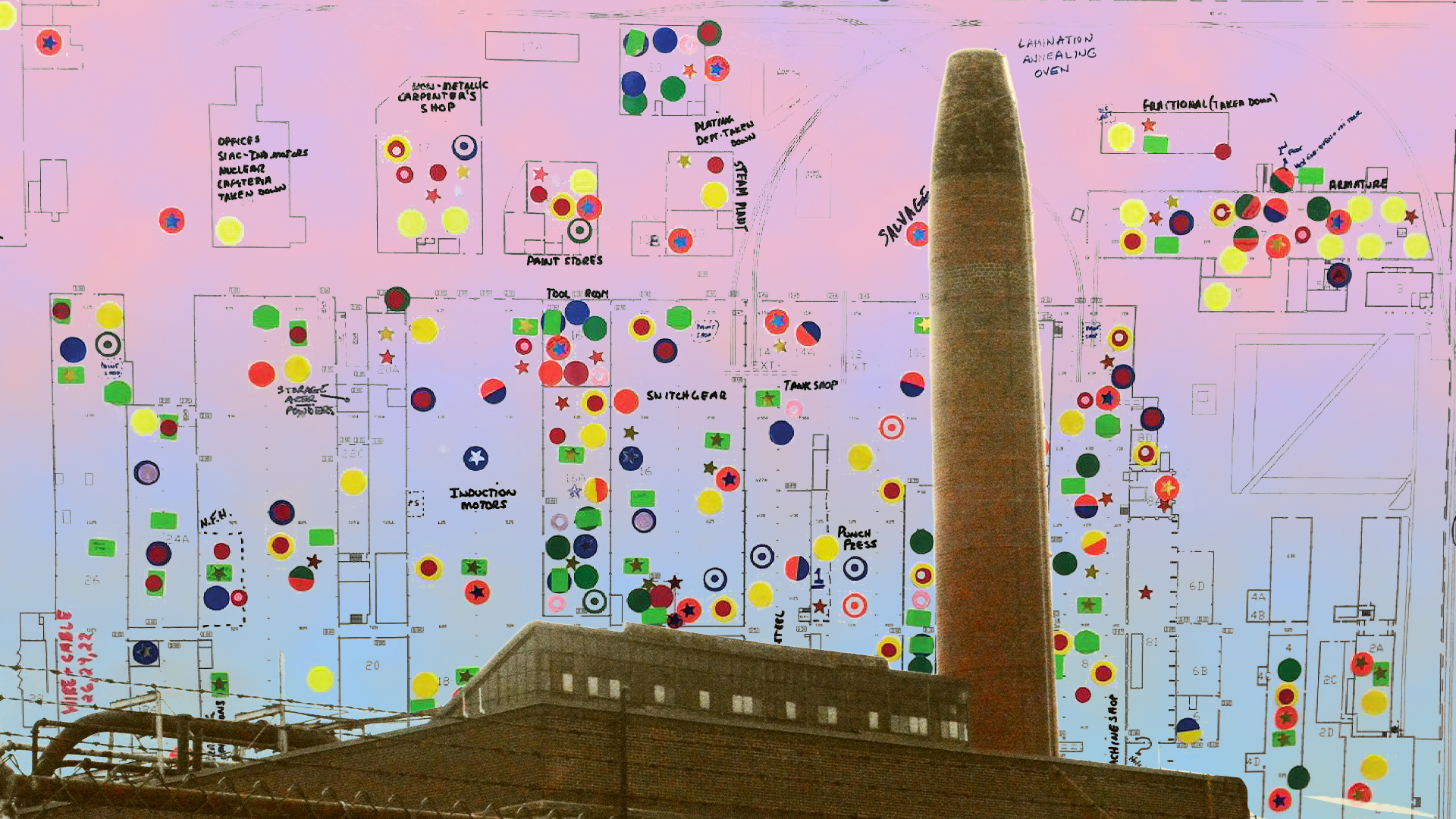
This article’s graphic is by David King, with his own photos of the GE site. This feature also uses the 2014 Intake Clinic Hazard Map from the 2017 GE Advisory Committee report for UNIFOR. The stickers on the Hazard Map correspond to a chemical or hazard workers were exposed to in certain production areas within the GE Peterborough plant from 1945 to 2000, including but not limited to: arsenic; asbestos; beryllium; cadmium; chronium VI; nickel; silica, uranium; MOCA and other epoxy resins; fibreglass; mercury; paint thinners and solvents; degreasers; as well as areas of PCB and TCE use.








.png)
The rich text element allows you to create and format headings, paragraphs, blockquotes, images, and video all in one place instead of having to add and format them individually. Just double-click and easily create content.
A rich text element can be used with static or dynamic content. For static content, just drop it into any page and begin editing. For dynamic content, add a rich text field to any collection and then connect a rich text element to that field in the settings panel. Voila!
"Headings, paragraphs, blockquotes, figures, images, and figure captions can all be styled after a class is added to the rich text element using the "When inside of" nested selector system."
The rich text element allows you to create and format headings, paragraphs, blockquotes, images, and video all in one place instead of having to add and format them individually. Just double-click and easily create content.
A rich text element can be used with static or dynamic content. For static content, just drop it into any page and begin editing. For dynamic content, add a rich text field to any collection and then connect a rich text element to that field in the settings panel. Voila!
"Headings, paragraphs, blockquotes, figures, images, and figure captions can all be styled after a class is added to the rich text element using the "When inside of" nested selector system."

.jpg)
.jpg)



.jpg)
.png)


