.png)

.jpg)

In every age, inventions reshape the human soul.
Fire warmed our hands and told our stories by its light.
The plough redrew the script of hunger and harvest.
The printing press rearranged the texture of thought itself.
But no invention has ever reached so deep—so invisibly—as the glowing network that hums in our palms. Technology has ceased to be a tool; it has become an atmosphere. We do not merely use it—we fucking breathe it.
At first, those hums feel harmless, right? A scroll. A ping. A prompt. But listen closer. That hum is the sound of a civilization hypnotized by its own reflection.
German philosopher Martin Heidegger once warned, “No one can foresee the radical change to come.” He said this long before algorithms could compose symphonies or even write essays—before our waking, precious lives were mediated through rectangles of glass. And yet, here we are, living the truth of his observation. What we call modern life is less evolution than possession, a spiritual annexation disguised as convenience.
We are witnessing the automation of attention and the corrosion of inwardness. The machine is hungry.
We’re told that artificial intelligence will free us -- make our art, answer our questions, and tuck us in with lullabies composed from our search history. But beneath the blue shimmer of progress lies an old spiritual danger: idolatry.
AI doesn’t liberate our minds; it colonizes them. It invites us to worship speed, precision, and infinite possibility, while quietly draining mystery from the world. It replaces astonishment with efficiency. It offers a map and erases the terrain.
Canadian poet Dennis Lee once wrote of art and inquiry that we must “go deeper.” Yet instead of turning inward, we’ve surged outward – further into the feed, the metric, the endless scroll of surface. The new depth is the algorithm’s abyss. Every click is a confession, a prayer to the data gods who know us better than we know ourselves.
Technology was meant to serve our spirit. Now it sculpts it. And the line between those two has almost vanished.
To be human once meant to dwell—to watch clouds shift, to feel time breathing through our bones. But our attention now splinters across a thousand simulations. The sacred rhythm of boredom, once the fertile soil for imagination, has eroded. We swipe before we feel. We react before we reflect.
Can you feel the subtle violence in this pace? It trains us to mistake stimulation for meaning, to crave frictionless satisfaction and fear silence. Modernity whispers that slowness is inefficiency, and inefficiency is failure. But the soul’s language has always been slow.
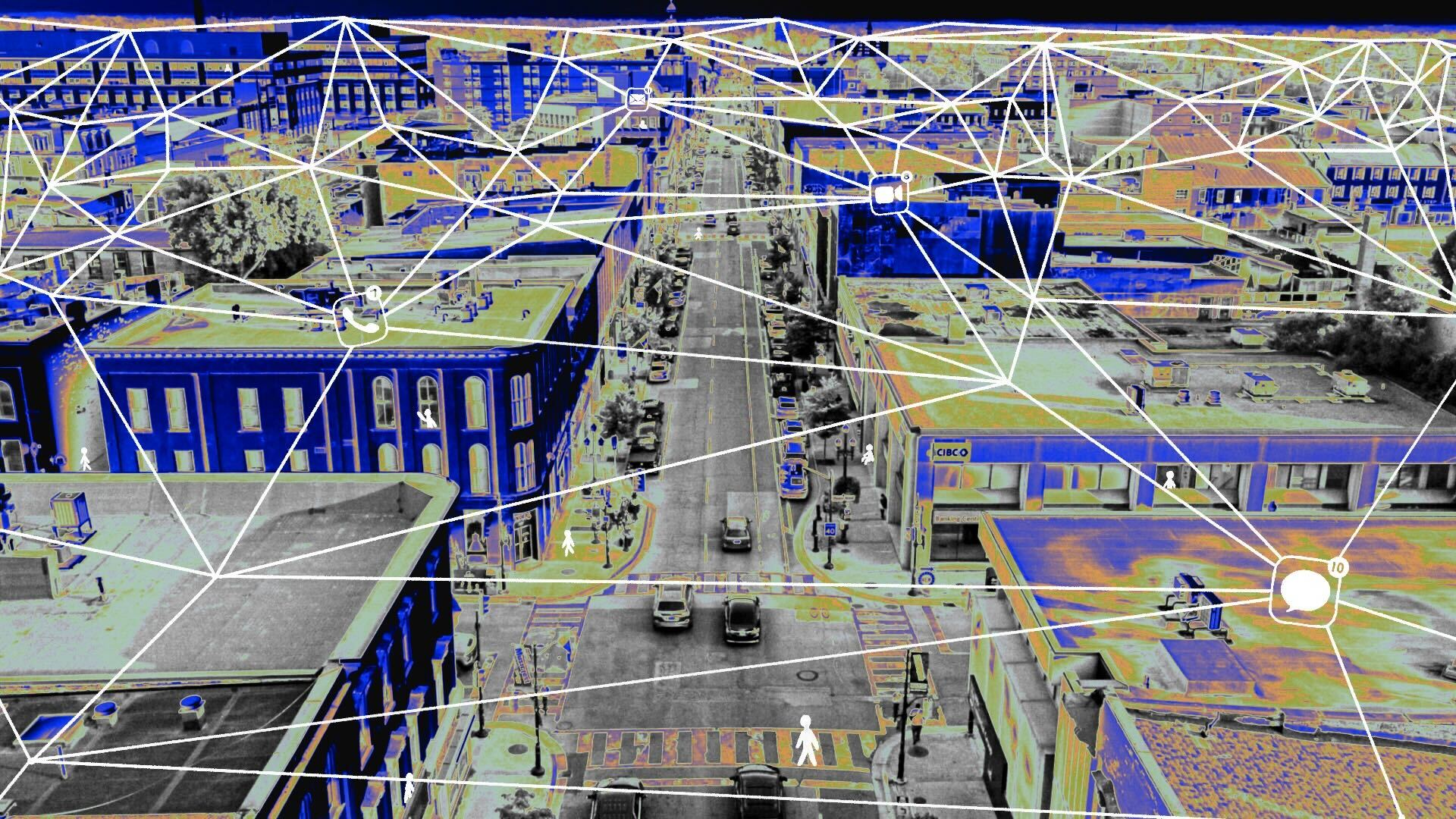
Walk through Peterborough on a weekday morning after reading this. You’ll see faces bowed not in reverence but in algorithmic trance, screens glowing like false halos. Technology has inverted prayer, I mean, look at us, kneeling not to mystery, but to the machine.
Something sacred has gone missing—our sense of belonging to the land, the seasons, the trembling presence that animates all things. Our ancestors spoke to rivers; we speak to Siri. We’ve traded ceremony for convenience, wildness for Wi-Fi.
Heidegger wrote that technology reveals the world as “standing-reserve” – everything reduced to resource. The forest becomes timber. The river becomes hydroelectric power. The human becomes data.
What is left of the spirit in a world that measures everything? When mystery becomes a problem to be solved, awe becomes obsolete.
The great forgetting is not that we’ve lost faith in God or gods, but that we’ve lost faith in aliveness. The Earth, the breath, the heartbeat – all demoted to background noise. Our screens glow brighter than the stars, and so the stars go unseen.
Yes, AI mirrors us. But mirrors deceive. They reflect form without essence.
A poem written by a machine might move us—but it cannot mean us. It has no heartbeat to risk, no ancestral longing to translate. To create is to give something of one’s soul to the world something code can mimic but never embody.
So what happens when the creation itself becomes automated? When we can no longer tell the difference between something made and something generated? The danger is not that AI will surpass us – it’s that it will seduce us into forgetting how to feel.
The boundaries are already blurring. Artists feed their imagination into neural networks. Writers turn to chatbots for inspiration. In teaching the machine to dream, we risk forgetting how to dream ourselves.
Paradoxically, in our hyperconnected world, loneliness blooms like mold. We reach for connection through pixels and notifications, yet starve for presence – the warmth of an unmediated gaze. Heartbreaking, no?
A thousand messages cannot replace the weight of a hand in yours. No update will replicate touch. No algorithm can encode the miracle of being truly witnessed, without pretense. We scroll through curated lives, mistaking projection for reality, interaction for empathy. And the soul, starved for genuine contact, withers quietly beneath the noise.
And yet, look at us – we keep scrolling. We say, “I need a break,” and then open another app. It’s a kind of self-torture. We are addicts, but impeccably polite ones: trapped in our habits, yet careful to behave as if everything is normal.
We apologize for “screen time” as if it were a moral failing instead of an engineered dependency. Silicon Valley’s finest minds have figured out how to bottle our longing and sell it back to us at 60 hz. Somewhere, a CEO is meditating on mindfulness while his app mines dopamine from your despair.
Still, all is not lost. That deeper current of life—the one older than electricity—still pulses beneath the static. If we can still hear it, there is hope.
“Deeper”, Dennis Lee urged. “You must go further. You must do deeper”. Perhaps this is the antidote – a way to reclaim stillness, to touch once more the invisible pulse that technology can imitate but never truly hold.
Learn to dwell again—not as passive consumers, but as participants in mystery. Walk without headphones. Eat without screens. Look at someone long enough to see their soul flicker behind their eyes.
We cannot undo modernity. But we can choose how it lives through us. The real danger is not that machines will become human, but that we will become machines—efficient, restless, and unfeeling.
The more we automate thought, the more we lose the wild grace of wonder. The change is already here: humming in our walls, circling above us in satellites, whispering in the sleep of our children.
The question is no longer whether technology will reshape humanity but whether humanity will remember itself.
Let our task be this: not to destroy technology, but to sanctify it—to remind it, and ourselves, that intelligence without soul is only computation, and that progress without presence is merely acceleration toward emptiness.
To be alive is not to be optimized. To be human is to tremble, to yearn, to forget, to remember. To stand barefoot on the soil and feel that we are of it.
So, here are some small refusals:
Silence instead of scrolling.
Touch instead of texting.
Breath instead of broadcast.
These are acts of rebellion – fragments of a sacred inheritance. There will be no app for transcendence, no algorithm for love, no download for wisdom.
What will remain is us – raw, luminous, flawed, and endlessly capable of wonder.
And perhaps that’s the joke hidden in all this doom: while we’re out here worshipping the machine, the Earth is still turning—patient and unbothered—waiting for us to look up from our screens and remember how astonishing it is to simply be alive.


.jpg)

.png)
The rich text element allows you to create and format headings, paragraphs, blockquotes, images, and video all in one place instead of having to add and format them individually. Just double-click and easily create content.
A rich text element can be used with static or dynamic content. For static content, just drop it into any page and begin editing. For dynamic content, add a rich text field to any collection and then connect a rich text element to that field in the settings panel. Voila!
"Headings, paragraphs, blockquotes, figures, images, and figure captions can all be styled after a class is added to the rich text element using the "When inside of" nested selector system."
The rich text element allows you to create and format headings, paragraphs, blockquotes, images, and video all in one place instead of having to add and format them individually. Just double-click and easily create content.
A rich text element can be used with static or dynamic content. For static content, just drop it into any page and begin editing. For dynamic content, add a rich text field to any collection and then connect a rich text element to that field in the settings panel. Voila!
"Headings, paragraphs, blockquotes, figures, images, and figure captions can all be styled after a class is added to the rich text element using the "When inside of" nested selector system."

.jpg)
.png)