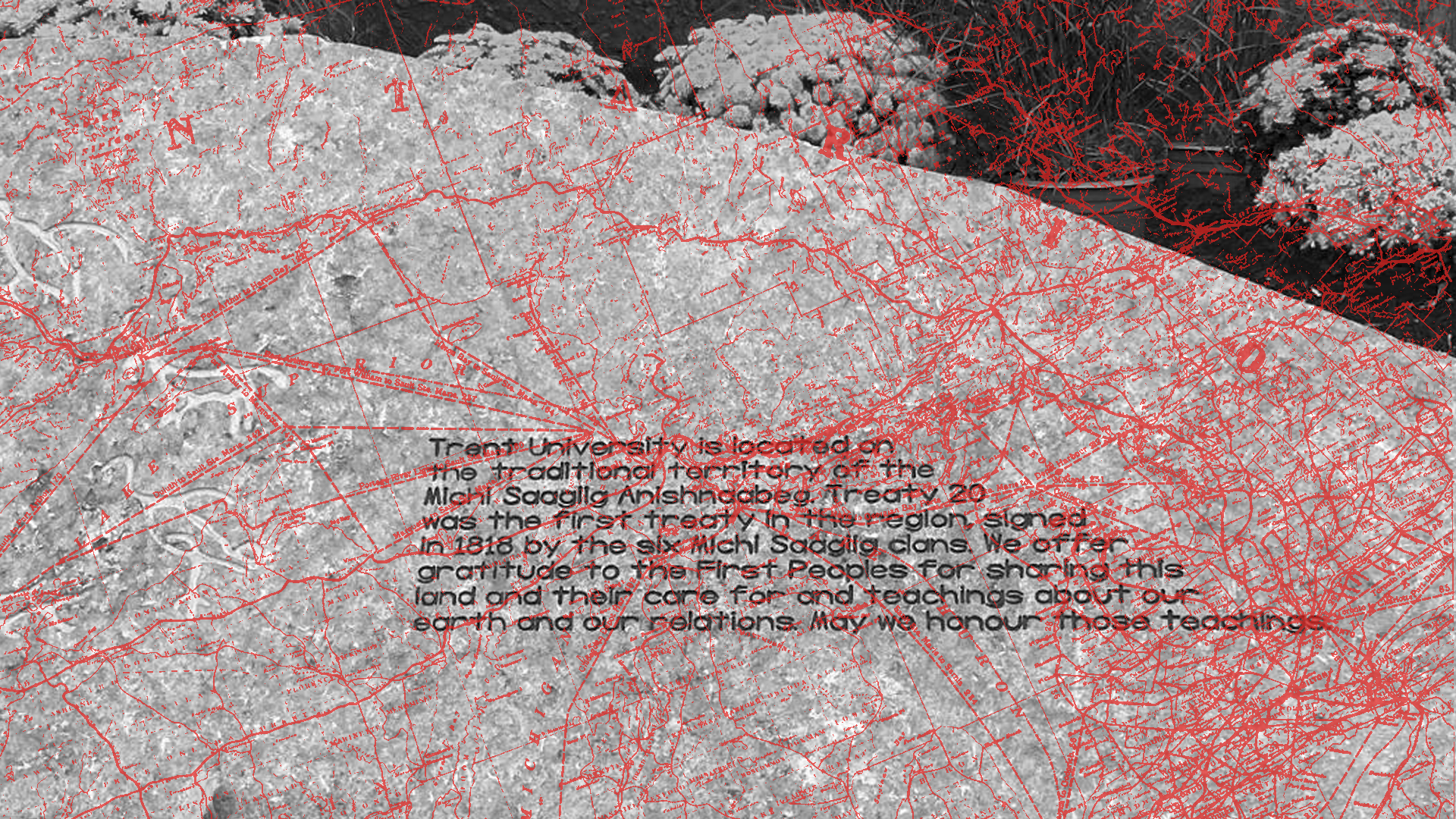
.png)



.png)
I first learned to recognize an old-growth tree not by its size, but by its stillness.
It was a white pine set back from the trail, its crown uneven, its bark thick and furrowed like folded skin. The forest around it felt calm—not empty, just attentive. The air carried resin and damp earth. My steps slowed without my asking them to. Later, science would give me language for what I was sensing: intact structure, deep soil carbon, fungal networks, time layered upon time. But in that moment, all I knew was that I was standing beside something that had been paying attention for a very long time.
Peterborough is often described as a city shaped by water—the Otonabee River, its wetlands, and the limestone spine beneath our feet. But is it just as deeply shaped by trees. Long before roads and subdivisions, this region was part of a vast forest mosaic dominated by Eastern White pine, Eastern Hemlock, Sugar Maples, Yellow Birch, Oak, and Cedar. Some of those trees were already hundreds of years old before a single survey line was drawn.
By the mid-1800s, much of that forest was dismantled.
Historical records from Upper Canada show that central Ontario’s White Pine was among the most valuable exports of the colonial economy. Massive pines—some over thirty metres tall and more than a meter in diameter—were felled and floated downriver to fuel shipbuilding, railways, and imperial expansion. In many watersheds, over 90% of the original forest cover was cleared within decades. What took centuries to assemble was removed in a handful of human lifetimes.
What remains today—small pockets of old growth scattered through ravines, parks, and forgotten edges of the city—is not simply rare. It’s actually astonishing.
Nowhere is this more palpable than in Jackson Park.
Jackson Park is often described as “wild” by city standards, but that word barely captures what is happening beneath its canopy. Tucked into the ravine along Jackson Creek are giant Hemlocks –trees whose lives began in the mid-1700s, long before European settlement reached this region in the early 1820s, and before the political upheavals reshaped the continent. Ecological surveys and tree-ring estimates place some of these Hemlocks to be 250 years old or more, making them living witnesses to a landscape shaped by Indigenous stewardship, seasonal fire, and ecological reciprocity rather than extraction.
Hemlocks are slow-growing, shade-tolerant, and deeply patient. Their dense, evergreen canopies cool the forest floor, creating a stable, moist microclimate where mosses, fungi, salamanders, and moisture-loving plants thrive. Walk beneath them on a summer afternoon, and the temperature drops noticeably.
This is not incidental: it is an ecological engineering refined by centuries.
Scientifically, old-growth hemlock stands are known for their distinctive soil chemistry and hydrology. Their needle litter decomposes slowly, building thick organic layers that store carbon and retain water. These soils reduce erosion, moderate stream flow, and regulate runoff during intense rain events—an increasingly critical function as climate change brings heavier storms to Ontario.
But numbers alone cannot explain the feeling of standing among them.
There is a cathedral quality to those hemlocks in Jackson Park. Their trunks rise straight and solemn, their bark deeply ridged, roots gripping the ravine walls like hands refusing to let go. These trees are not just relics or museum pieces. They are living beings whose lives began in a fundamentally different world—and have continued, uninterrupted, into ours.
Just east of there, near Armour Hill, another story needs to be told—one written in oak.
Old oaks, with their broad crowns and deeply furrowed bark, are witnesses to disturbance and survival. Oaks evolved alongside fire and grazing, and their presence signals continuity through change. The mature oaks near Armour Hill likely germinated in open woodland conditions long before surrounding landscapes were fragmented by roads and development.
Ecologically, oaks are keystone species. A single mature oak can support hundreds of insect species – caterpillars, beetles, and pollinators that in turn feed birds, bats, and small mammals. Research shows that oak-dominated systems support greater biodiversity than many other temperate forest types. When an old oak is lost, we do not simply lose a tree—we undo entire food webs.
Then there are the maples.
Across Peterborough stand sugar maples older than the country itself—trees that were already mature when Confederation was declared in 1867. Old-growth sugar maples are structurally complex: hollow trunks, sprawling limbs, cavities that shelter birds and mammals. Below ground, they are deeply integrated into mycorrhizal networks—fungal partnerships that move nutrients, water, and carbon through the soil.
Dendrochronology—the study of tree rings—shows that these maples record droughts, cold snaps, and warm periods stretching back centuries. Their wood is a literal living climate archive. When one of these trees is cut, that archive disappears.
From a climate perspective, old-growth forests are among the most effective carbon stores on land. Large, old trees continue to sequester carbon at high rates, and the loss of even a few can dramatically reduce a forest’s capacity to regulate climate. Replacement saplings cannot replicate that function for generations—if ever.
Old-growth forests also confer resilience. Their uneven age structure, genetic diversity, and intact soil communities make them better able to withstand pests, disease, and climatic extremes. In a rapidly changing climate, these forests are not liabilities. They are blueprints for endurance.
However, there is a deeper conversation at hand here—one that science increasingly echoes, but alas, does not own.
Indigenous worldviews across this region emphasize relationship and reciprocity with the land. Humans are understood not as masters of ecosystems, but as participants within them. Old-growth forests embody this ethic. They exist because countless relationships—between trees, fungi, animals, water, and time—have been allowed to continue.
Walk beneath the Standing Ones, and you are not just moving through space—you are moving through continuity. Beneath your feet, fungal threads weave tree to tree, redistributing nutrients and buffering stress. What appears as stillness is, in truth, deep cooperation.
Standing among these trees, time stretches. The urgency of modern life softens—emails, meetings, and even traffic on Water Street lose their grip. These beings have outlived political eras, economic booms, and countless human plants. They will outlast many more—if we let them.
The question they ask us is simple and maybe even enduring:
Will we be remembered as careful ancestors—or careless ones?
Old-growth trees are not asking for admiration; they are asking for restraint. They are asking us patiently to recognize that in a world obsessed with growth, the most radical act may be to let something ancient continue to live.






.png)
The rich text element allows you to create and format headings, paragraphs, blockquotes, images, and video all in one place instead of having to add and format them individually. Just double-click and easily create content.
A rich text element can be used with static or dynamic content. For static content, just drop it into any page and begin editing. For dynamic content, add a rich text field to any collection and then connect a rich text element to that field in the settings panel. Voila!
"Headings, paragraphs, blockquotes, figures, images, and figure captions can all be styled after a class is added to the rich text element using the "When inside of" nested selector system."
The rich text element allows you to create and format headings, paragraphs, blockquotes, images, and video all in one place instead of having to add and format them individually. Just double-click and easily create content.
A rich text element can be used with static or dynamic content. For static content, just drop it into any page and begin editing. For dynamic content, add a rich text field to any collection and then connect a rich text element to that field in the settings panel. Voila!
"Headings, paragraphs, blockquotes, figures, images, and figure captions can all be styled after a class is added to the rich text element using the "When inside of" nested selector system."

.jpg)



.jpg)