.png)



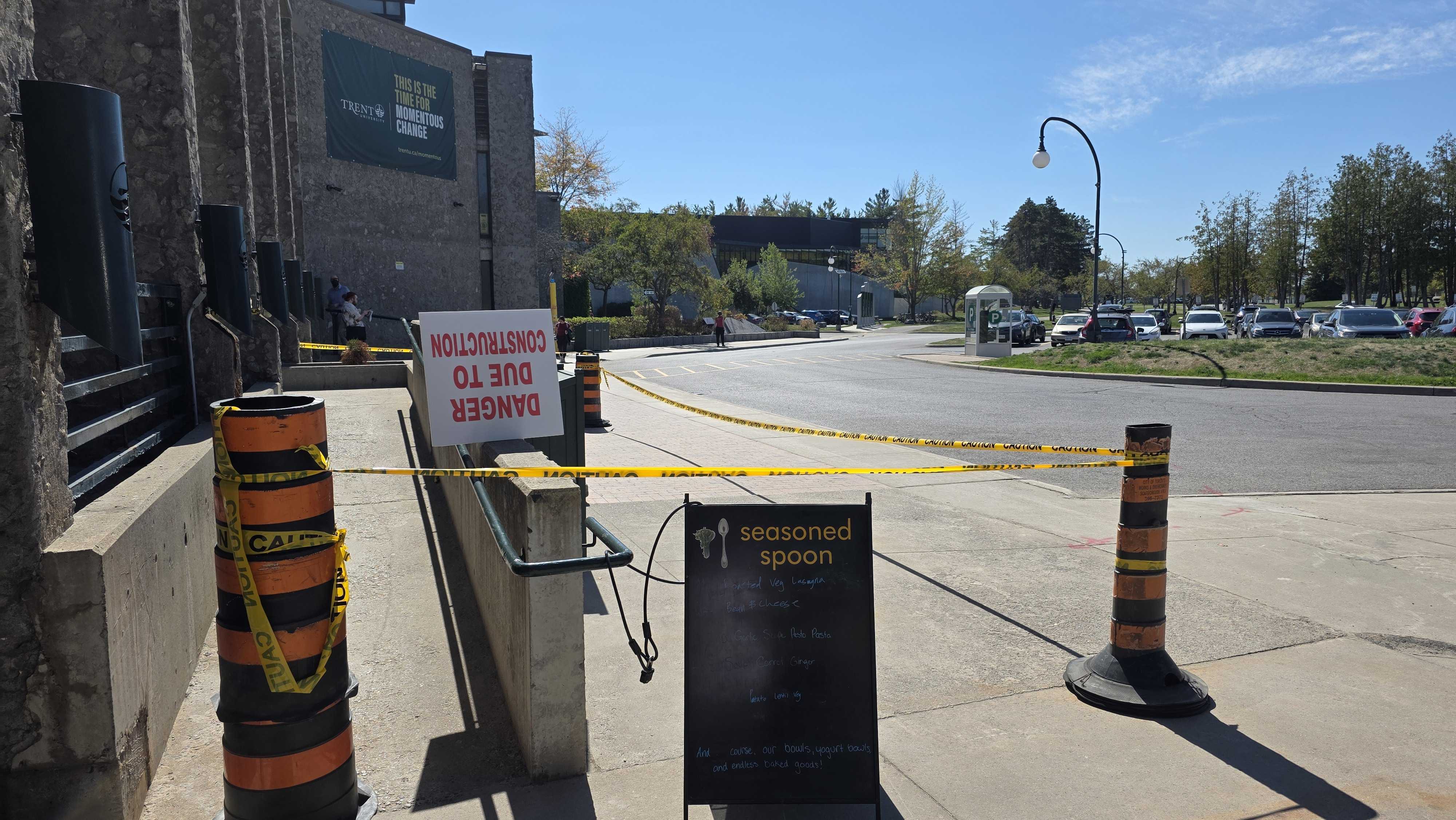
On the morning of Tuesday September 16th, students, faculty and staff arriving at Bata Library found that all accessible routes to the building were closed.

This posed a significant roadblock for disabled people travelling on campus, who were forced to use inaccessible stairways if they wished to enter.
“I use a cane,” a faculty member told Arthur. “So this is the only entrance to get into Bata, that doesn’t involve some form of stairs.”
“I had to walk up the stairs, and then back down the stairs. There was easy access to railing. And I was worried—I’m having a bad hip day—about falling.”
“There was nothing warning us before we got here that that’s what was going to happen. I need a day’s notice so I can make alternative walking arrangements so that I can get in safely and not worry. Because if I fall again, I’m looking at months of knee surgery and recuperation, and I won’t be able to work for a semester. That’s a real problem when there’s no communication,” they said.
“My big concern isn’t that they’re doing the work, it’s that there’s not enough communication about changes on campus. And for those of us who are disabled, it means reorganizing our whole work route. I have to rethink: How am I going to get to class with the minimum amount of physical stress?”
Arthur reached out to Trent for comment, and was told that “The construction work in question was scheduled, and a bulletin was posted on myTrent to notify the community.”

According to the bulletin in question “an accessible route will be available through the Champlain Bookstore entrance,” a claim which failed to materialize.
None of the students and faculty Arthur spoke to had seen the bulletin, with one person sarcastically replying “Oh yes, because I check myTrent before going to school every morning.”
Many community members Arthur spoke with commented that the construction notice should’ve been given in advance, and that it should have been communicated through email.
“I think it’s key to look at the attitudinal barriers that are happening at Trent,” Disability and Gender Studies instructor Dr. Derek Newman-Stille said. “Literally every accessible entrance was closed down, so there was [no way] to get in or out of the library without walking up stairs.”
“I think this reveals a lot about the university’s attitude towards accessibility and shows that we need to not consider disability as an afterthought,” they continued. “We need to consider it as a forethought, so that before these things happen, people think to themselves: ‘How is it going to impact students? How is it going to impact faculty? How’s it going to impact staff?’”
Newman-Stille was able to access the library only because their partner is a library staffer and brought them in through their key card access, something Newman-Stille noted students couldn’t do.
“I think this is a pattern of most of our society, not just Trent. There’s a general social pattern of ignoring disabled folks and disabled folks’ needs.” Dr. Newman-Stille said. “This is a central hub at Trent: It’s not just a place to access books. There’s also classes taking place [in the library], there’s events taking place here—that people wouldn’t be able to get to.”
“I just want to personally thank the library staff themselves for responding immediately to this issue and finding a solution that worked. It’s not something library staff should have to do, it’s not their job, but it’s great they were willing to give the time and energy,” Newman-Stille told Arthur.
The barriers to entry were removed before 12:50 PM after complaints from the library staff and community members.
“The accessibility ramp at Bata was not intended to be closed as part of this work, and Facilities Management has since followed up with the contractor to ensure it remains open. The University regrets the disruption and appreciates the community’s attention to accessibility,” Trent Communications told Arthur in a statement.
Another major issue caused by this construction is a lack of accessible parking spots. The ongoing construction of Gidigaa Migizi College and the Otonabee residence expansion has also shut down Otonabee’s parking lot, and therein the accessible parking spots that were dedicated to Otonabee College.
The impacts of construction on the student body have been a constant source of complaint, but among the disabled community it is a serious barrier. Since Otonabee’s parking lot closure, the parking around Gzowski College has been a battleground for students trying not to park in the new R and S lots, located beside the DNA building.
“The University has added three accessible parking spots to Lot U,” a statement from Trent to Arthur reads.
“Two additional accessible spots will be added to Lot U by September 26. Work is also underway to add more accessible parking spaces in Lot X on East Bank.”
While Bata Library’s construction has since been completed, Gidigaa Migizi College’s construction isn’t expected to conclude until 2028.
As of a 2017 Accessibility Policy, “The University is committed to meeting the needs of people with disabilities in a timely manner, and will do so by preventing and removing barriers to accessibility and meeting accessibility requirements under the Accessibility for Ontarians with Disabilities Act (AODA).”




.png)
The rich text element allows you to create and format headings, paragraphs, blockquotes, images, and video all in one place instead of having to add and format them individually. Just double-click and easily create content.
A rich text element can be used with static or dynamic content. For static content, just drop it into any page and begin editing. For dynamic content, add a rich text field to any collection and then connect a rich text element to that field in the settings panel. Voila!
"Headings, paragraphs, blockquotes, figures, images, and figure captions can all be styled after a class is added to the rich text element using the "When inside of" nested selector system."
The rich text element allows you to create and format headings, paragraphs, blockquotes, images, and video all in one place instead of having to add and format them individually. Just double-click and easily create content.
A rich text element can be used with static or dynamic content. For static content, just drop it into any page and begin editing. For dynamic content, add a rich text field to any collection and then connect a rich text element to that field in the settings panel. Voila!
"Headings, paragraphs, blockquotes, figures, images, and figure captions can all be styled after a class is added to the rich text element using the "When inside of" nested selector system."

.jpg)
%20(13).png)