.png)

.jpg)


At a meeting on July 2nd, 2025, Peterborough City Council elected to discontinue funding for OneCity, which operates the Trinity Community Centre on Reid Street—the only low-barrier overnight shelter accessible to Peterborough’s unhoused residents. At the start of November, they were forced to face the music: OneCity are the only people in town fit to provide this crucial service.
With our municipal elections poised for 2026, we need to heed this lesson.
In the time since David, Ian and myself first took on the editorship of this masthead, we’ve observed the utter failure of an attempted pivot on homelessness on the part of our municipal government: tangible solutions to our ongoing homelessness crisis were time and time again met with opposition for the simple reason of their imperfection, because they failed to speak to two demographics with quite opposite dispositions.
These demographics were, on one hand, homeless people bearing the weight of societal abandonment to this day and the social service organizations trying to care for them, and on the other, “concerned citizens,” whose main gripe with the city’s approach to rising homelessness was its ostensible failure to consider whether the physical presence of homeless persons “fits” within the already-existing social life of their neighborhoods.
Let me present this to you in more tangible terms.
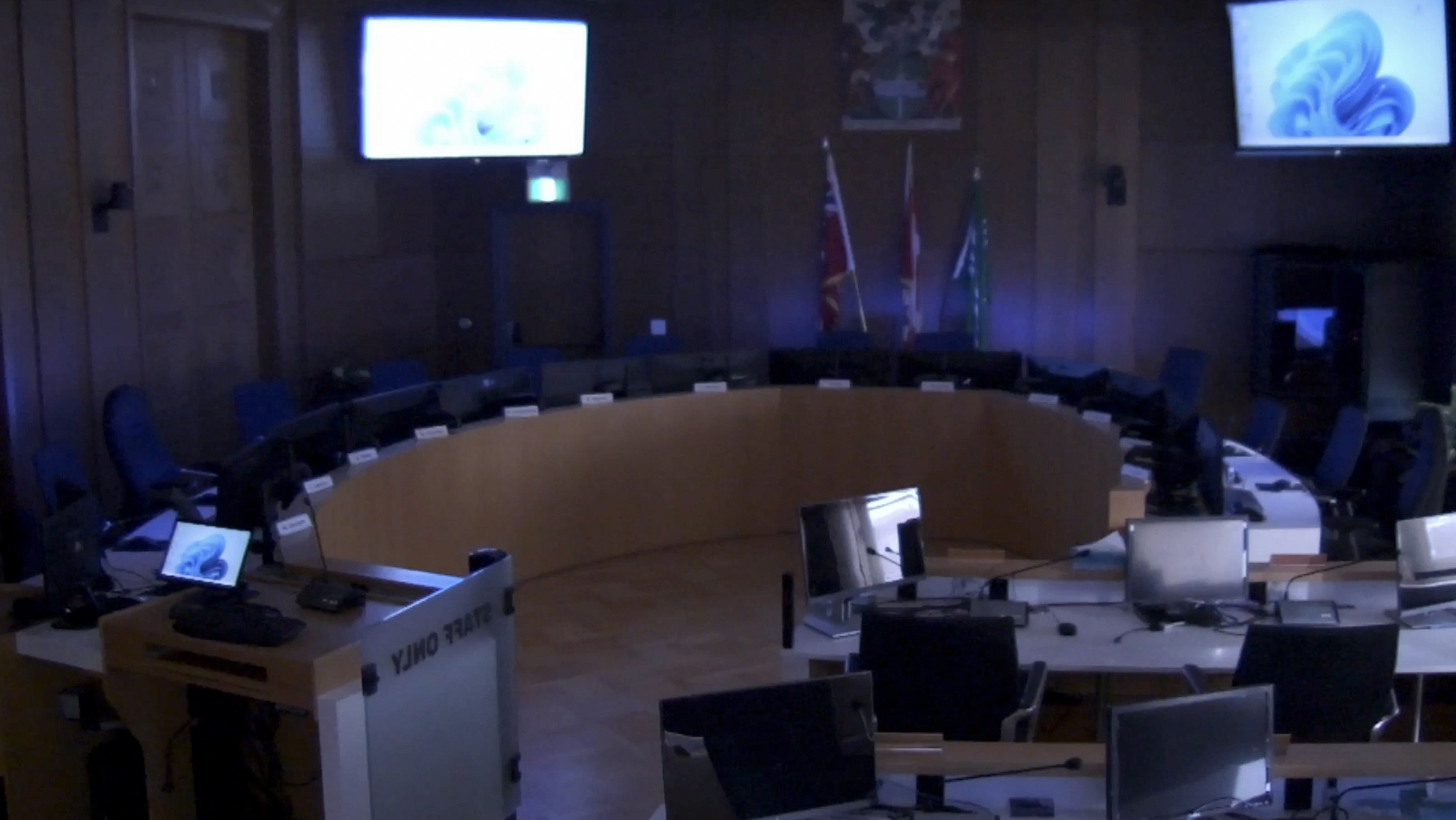
Imagine for a second that you are this tired reporter, attending the July 2nd meeting where council decided to discontinue OneCity’s operating funding for Trinity shelter—that is, $269, 000 that would have gone to fund its overnight drop-in program and $244,00 to maintain the hours of its daytime program to 9AM-7PM as opposed to dropping them to 1PM-5PM, all starting January 1st, 2026.
You’ve heard 14 delegations, you’ve been in City Hall for five hours covering discussions that were supposed to happen almost a week prior, but were delayed due to a power outage.
You might say you feel a little bit insane.
You’re hearing one side of the debate talk about how OneCity has failed to be a “good neighbour” (in the words of Northcrest Ward Councillor Andew Beamer) and compare allowing intoxicated homeless people to access shelter without any requirement of sobriety to letting one’s grandmother with Alzheimer’s stumble into the street (from his wardmate, Councillor Dave Haacke).
You’re reporting Councillor Haacke’s words—“for some reason, we’re okay as a community to allow people that can’t make informed decisions for themselves out on the street,” he tells the horseshoe—and you can’t quite figure out what he and his ilk want out of OneCity.
The most obvious answer is forceful medicalization—if we’re to treat unhoused people living with addiction as we do people with Alzheimer’s, they will necessarily lose a lot of the autonomy they have right now. The problem is, these people aren’t alone. Their addictions aren’t a simple case of individual pathology so much as they come from a wide range of social conditions in large part concurrent with their societal abandonment, and moreover, they have people relying on them.
Ontario is already considering following Alberta with the creation of legislation which would permit family members, healthcare workers and police officers to commit persons living with addiction involuntarily, but the Canadian Centre on Substance Use and Addiction has found this treatment style is based on very little scientific basis and studies on it “often lack rigorous comparisons” to other rehabilitation treatments.
So it’s hard for you, at that City Council meeting, to forget that this isn’t about science or better treatment, it’s about the removal of one contingent of people from public life, because another contingent thinks they’re not pleasing to look at.
You’ll get to see this firsthand in the months to come, as you mature into your position.
The other side of the July 2nd debate prones a much simpler rhetoric.
“We’ve identified at least 47 individuals over the three years from [the fourth quarter of 2021 to the fourth quarter of 2024] who have died and [were] experiencing homelessness,” says Dr. Thomas Piggott, Medical Officer of Health and CEO of Peterborough Public Health.
These people die from overdoses which cannot be treated in due time by medical professionals; they die from exposure, often because they didn’t have a better place to go; they die from long standing medical and mental health problems which thrive on their social abandonment—the provision of services like OneCity’s is obviously a crucial step in preventing their deaths.
But ultimately, OneCity will be indicted to the tune of hundreds of thousands of dollars tonight for having failed to respond to both of these problems: it did not simultaneously forcefully remove unhoused people from public life, where they’re perceived to be a nuisance largely by homeowners and mitigate the widespread social abandonment they face, probably because these are mutually exclusive demands.
Kidnapping people on the street does not solve their social abandonment if they are ripped off from their existing care networks, because a trip to rehab does nothing to address the problems that naturally come from not having a support system.
If you’ve imagined yourself in my shoes thus far, it would make sense for you, as I did at the time, to think to yourself: “I’ve just watched our municipal government sign off on the deaths of dozens of people, at the very least.”
The cruelty beneath the surface of such a measure would make itself more apparent as the City took on a wave of encampment sweeps in the end of the summer, where enforcement officers would joke about “the tippee police” when Indigenous homeless people protested the thrashing of all of their belongings, or yet bulldoze over a memorial for a resident of one encampment who passed away.
The more I researched the legal environment of these measures—the way the City opens largely-inaccessible shelters to meet the requirements of the “adequate shelter” standard set by a past Ontario Superior Court decisions as a necessary condition for any encampment sweeps in a city—the more it all felt so, so cynical.
It’s hard not to see this as a system more interested in protecting the City from litigation as it attacks the public life of its unhoused citizens than genuinely offering them the services they need.
It’s also hard, as we see a last-ditch effort from July 2nd’s council meeting to find a replacement for OneCity to operate the Trinity shelter lead to the rehiring of OneCity for the provision of the same services months later in November, to not feel a glint of hope and think: “God, they finally got it.”
“Finally,” except that at that July 2nd meeting, Ashburnham Ward’s Gary Baldwin was among the councillors asking what would happen if OneCity ended up the only adequate applicant, and Town Ward’s Alex Bierk outright told his colleagues any other application would likely be far more costly than OneCity’s. Maybe it just took our council that long to catch up to the possibility that their ideal shelter operator did not exist, and that OneCity was the best thing around.
Or maybe this could’ve been avoided.
Our city council could have recognized the value of the service provided by OneCity and avoided upending its operations until it was confronted with the reality of a lack of better options. But they didn’t.
While I’m not convinced they ever needed to “realize” the temporary shelters the City opened while destroying people’s living places would welcome only single digits of people in their first weeks—this was, as stated, more of a cynical legal defense than a genuine effort at supporting the most vulnerable in our community—our council could have genuinely tried to help these people.
Indeed, many like Northcrest Councillor Beamer think we too quickly forget that, even as we defund the services our neighbours need to live, “many residents in the community…are very compassionate, but they have a limit.”
And what a limit fast reached, as is catalyzed by the writings of Trent professor Christopher Dummitt, where he referred to our unhoused neighbours as “zombies,” and asserted that “just like in any zombie movie, the zombies aren’t the only ones getting hurt.”
The hateful bile that so many stains on the name of editorship have enabled Dummitt to pass off as “opinion writing” is only the most overtly objectionable wing of a wider rhetoric of self-victimization on the part of people who have never in their lives spent a night on the street. There’s nary a public forum in Peterborough where one doesn’t hear the tales of what my co-editor David King likes to call “the poop and needles mythology.”
The back and forth between this rhetoric and that of oh, I don’t know, “People are dying and we should help them” makes for a quite unproductive public discourse on homelessness.
It’s my contention that this is the very natural result of having listened to concerns that are—and I’m aware this framing is dismissive, because I intend for it to be—not real, or at least not in the same order of reality as the daily life of our homeless neighbours.
The solution to this stagnant state of discourse is quite straightforward, but it requires the gut to outright dismiss the voices of actors like Dummitt and his ilk from this political discourse and to face their inevitable backlash head-on.
Too much time has been accorded to hearing out concerns about homeless people that can easily be solved by viewing them as normal people living in this city instead of an invasive nuisance.
The polls where you’ll vote in our next municipal election in 2026 are one place to keep this in mind. We need representatives that are willing to stand up for our homeless neighbours and those supporting them, no matter the backlash they might face.
But elections are never the end of political action. We could do so much more for the most vulnerable living in our community, and the first step towards that is to establish wherever possible that not everyone’s problems can be equally real: some of us are just going to have to get into the habit of living around our neighbours, whether we like it or not.


.jpg)

.png)
The rich text element allows you to create and format headings, paragraphs, blockquotes, images, and video all in one place instead of having to add and format them individually. Just double-click and easily create content.
A rich text element can be used with static or dynamic content. For static content, just drop it into any page and begin editing. For dynamic content, add a rich text field to any collection and then connect a rich text element to that field in the settings panel. Voila!
"Headings, paragraphs, blockquotes, figures, images, and figure captions can all be styled after a class is added to the rich text element using the "When inside of" nested selector system."
The rich text element allows you to create and format headings, paragraphs, blockquotes, images, and video all in one place instead of having to add and format them individually. Just double-click and easily create content.
A rich text element can be used with static or dynamic content. For static content, just drop it into any page and begin editing. For dynamic content, add a rich text field to any collection and then connect a rich text element to that field in the settings panel. Voila!
"Headings, paragraphs, blockquotes, figures, images, and figure captions can all be styled after a class is added to the rich text element using the "When inside of" nested selector system."

.jpg)
.jpg)