




.png)



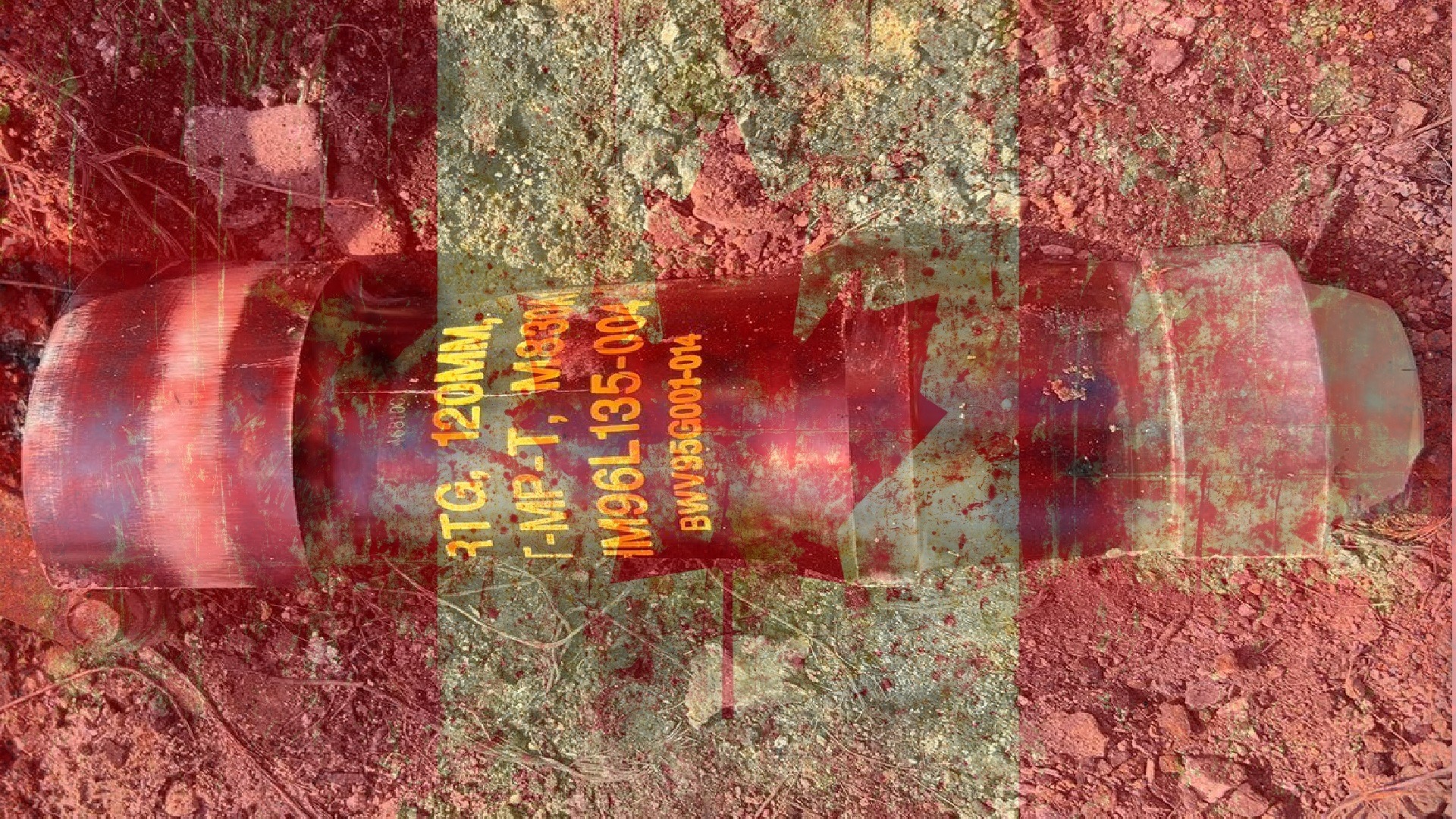
In November of 2025, a comprehensive report published by Arms Embargo Now incriminated Canada as a key player in aiding weapons distribution between the United States and Israel. The findings in the report contradict the Canadian government’s statement that it has stopped all export of arms to Israel, contradictions which the government has vehemently denied since a similar report was released in July.
Arms Embargo Now is a coalition of groups that includes the Palestinian Youth Movement, World Beyond War, and Canadians for Justice and Peace in the Middle East, among others. They are primarily focused on pressuring the Canadian government to halt its support of Israel through the arms it provides.
The report, titled “Exposing The US Loophole,” highlights the ways Canada has continued to supply weapons to the Israeli Defensive Forces (IDF) through the manufacture and shipping of weapon components, which are then passed on to the United States.
Some of the manufacturing parts Canada sells to the United States are used to make the F-35 Lightning II, a fighter jet built by Lockheed Martin and used by the IDF to complete thousands of bombing runs on Gaza. According to the report, these jets have been used by the IDF at a higher rate than any other group or nation since October 2023, logging over 15,000 flight hours from October 2023 to March 2025.
The parts are manufactured in plants across Canada, including Laval’s Heroux Devtek, Mississauga’s Honeywell Aerospace, and Kitchener’s Magellan Aerospace. They are then shipped out as cargo from Montreal by FedEx, or on American passenger flights from airports like Toronto Pearson.
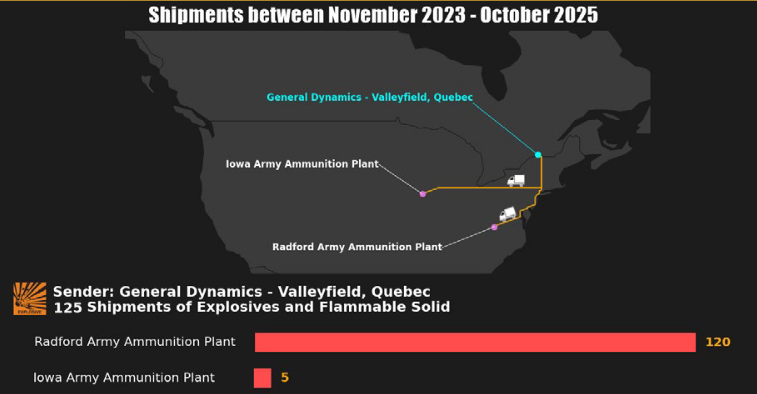
Another crucial player in the weapons corridor between Canada, the United States, and Israel are the General Dynamics facilities in Québec, which have sent 150 shipments of Canadian explosives and flammable materials to U.S. Army ammunition plants since October 2023. These materials are used to create the 2,000-pound explosives and tank rounds the IDF employs in their occupation of Gaza.
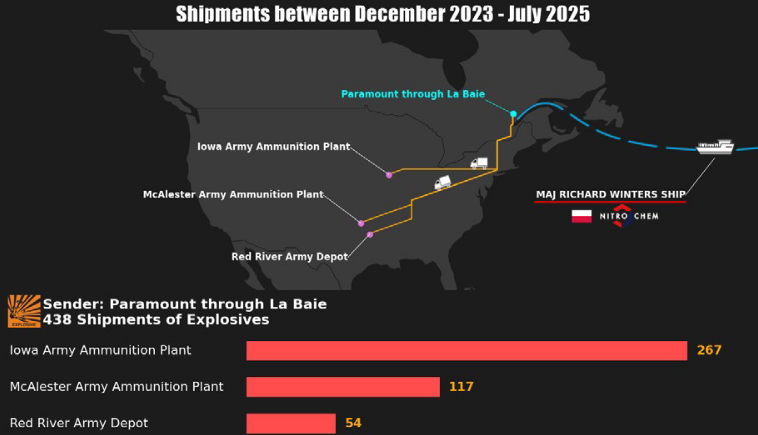
The report also details the shipping of internationally-sourced ammunition through Canadian ports, primarily Port Saguenay in Labae, Québec. 583 shipments through continental trade corridors by truck are listed, with many of them containing TNT from a Nitro-Chem plant in Poland.
As the report summarizes, “By deliberately exempting U.S.-bound arms from export regulation and allowing Canadian infrastructure to transport weapons, Canada is circumventing its obligations under international law.”
While Canada has firm restrictions on what weapons and manufacturing parts it can export to other countries, over 100 Canadian arms manufacturers—including Apex Industries, Asco Canada, Centra Industries, and Magellan Aerospace—continue to sell their goods to the United States, which are then funnelled to Israel through the American military industry.
Does this hold water legally? The answer lies in the various diplomatic agreements Canada and the United States have made as close trade partners. Under the current Export and Import Permits Act (1989), the United States is exempt from most restrictions and oversight from Global Affairs Canada. Some restricted items, such as nuclear material, require a permit, but the vast majority of military dealings between the United States and Canada are in a legal blind spot.
Dr. Kirsten Francescone, who teaches at Trent University in the Global Justice and Development Studies program, discussed the loophole allowing Canadian weapons to be imported to the United States unregulated.
“As of right now, we don’t have any way of controlling [where weapons end up], and it’s a substantial amount of weapons, as you see from the report,” said Francescone. “It’s a billion [U.S.] dollars worth of goods that’s flowing through the U.S. What people don’t realise is that the Department of Defence in the U.S. actually considers Canada to be part of its territory, and this is why there’s no regulatory mechanisms set up. [It’s] all considered to be this weird third country space, where Canada and the United States—when it comes to weapons—are one and the same.”
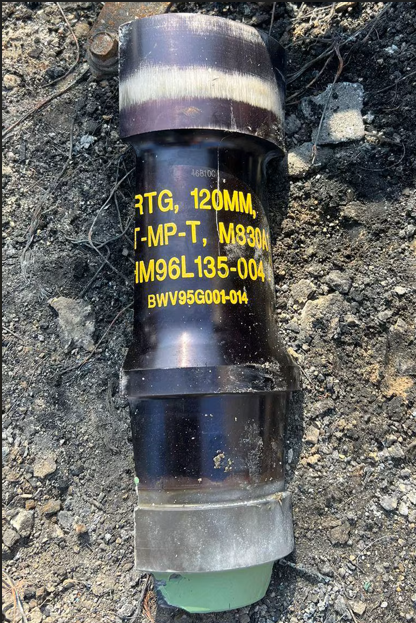
As the report states, “The International Court of Justice found plausible evidence of genocide in Gaza and recommended that all third party states cease the transfer of arms to Israel. Despite these provisional orders from the ICJ, Canada continued producing and shipping of F-35 components, exporting of explosives, and facilitating the transit of TNT, thus directly enabling Israel’s genocide.”
Dr. Francescone’s colleague in the Gender and Social Justice Department at Trent, Dr. Ann De Shalit, weighed in on the subject of Canadians’ willful ignorance.
“I think the dominant narrative on Israel-Palestine is still quite strong,” said De Shalit. “And even if people are interested in learning more, and understanding Canada’s role, either they may be afraid to go further into it because they see some of the consequences, and so they stop themselves from doing that, or it’s just an easy out—knowing that there could be consequences from learning more about this, and [refusing to become] entangled in it.”
De Shalit also explained why she thinks many Canadians refuse to take action. “A lot of times in Canada…[people think], ‘Well, those are problems for someone else, and the more we get involved in those problems for other people, the less attention we have on the problems we are facing as Canadians,’” she said.
This assumption ignores the steep price of Canada’s involvement in the US military and IDF. The report from Arms Embargo Now states that Canada contributes approximately $2.3 billion USD worth of parts to Lockheed Martin’s construction of F-35 fighter jets alone.
To rectify the issues outlined in their report, Arms Embargo Now proposes several demands of the Canadian government. They call on Minister of Foreign Affairs Anita Anand to use the Special Economic Measures Act (1992) to impose a two-way arms embargo, preventing weapons from directly or indirectly reaching Israel. All export permits that result in the transfer of arms to Israel should be suspended or cancelled.
Arms Embargo Now urges Anand to sponsor Bill C-233, the No More Loopholes Act—a private member’s bill proposed by Member of Parliament Jenny Kwan.










.png)
The rich text element allows you to create and format headings, paragraphs, blockquotes, images, and video all in one place instead of having to add and format them individually. Just double-click and easily create content.
A rich text element can be used with static or dynamic content. For static content, just drop it into any page and begin editing. For dynamic content, add a rich text field to any collection and then connect a rich text element to that field in the settings panel. Voila!
"Headings, paragraphs, blockquotes, figures, images, and figure captions can all be styled after a class is added to the rich text element using the "When inside of" nested selector system."
The rich text element allows you to create and format headings, paragraphs, blockquotes, images, and video all in one place instead of having to add and format them individually. Just double-click and easily create content.
A rich text element can be used with static or dynamic content. For static content, just drop it into any page and begin editing. For dynamic content, add a rich text field to any collection and then connect a rich text element to that field in the settings panel. Voila!
"Headings, paragraphs, blockquotes, figures, images, and figure captions can all be styled after a class is added to the rich text element using the "When inside of" nested selector system."

.jpg)


.png)



.jpg)

