.png)

.jpg)

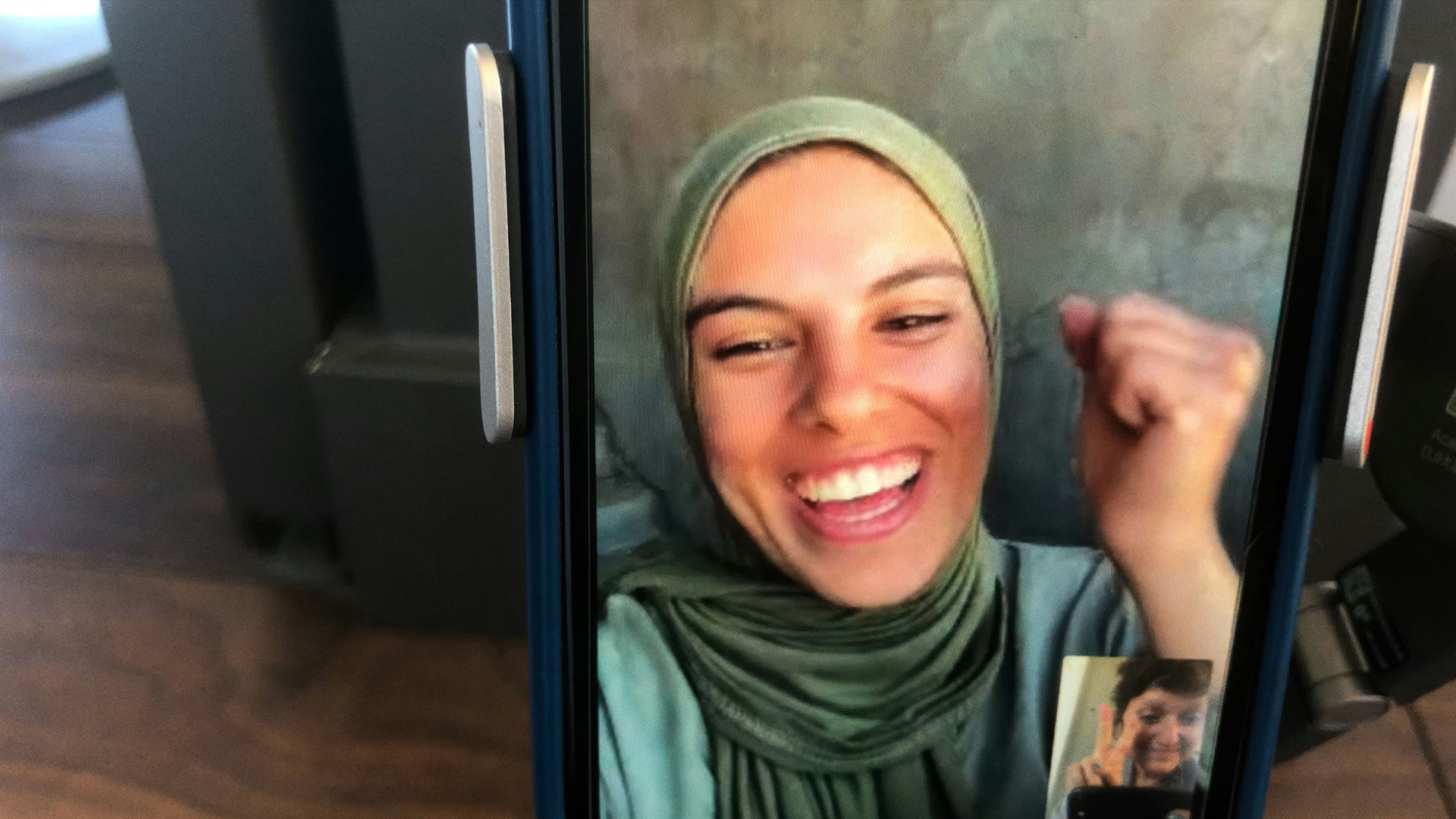
Do you think you could hold a smile for 112 minutes?
I don’t think I could. I’m not much of a smiler, and my facial muscles start to hurt if I do it for more than a few minutes at a time.
There’s an attitude that comes with a nearly two-hour smile like Fatma Hassouna’s in the Sepideh Farsi film Put Your Soul On Your Hand and Walk. I don’t think I could support the emotional weight of the world like she does, or at least not for quite that long.
Put Your Soul On Your Hand and Walk, at least as much as it’s about the mundane reality of Fatma’s life in Gaza, told in snapshot conversations with Sepideh, is about being a smiler.
Over the full length of the documentary, she looks straight at Sepideh, and digs her own dimples deeper and deeper as she chronicles her life in the midst of the genocide of her people. The more it hurts, the more creases root out of her eyes with the widening of her pliant smile.
I’ve often heard talk of the stories written in the wrinkles of the elderly, and the hot, red poetry of a face lived in. Never have I noticed it written into a face in so short a time as the single year Fatma spent conversing with Sepideh.
Put Your Soul On Your Hand and Walk is Sepideh’s arduous account of that year. The bombings recorded first by Al Jazeera journalists in Gaza, then Sepideh’s trembling hands in Paris aimed at a TV screen. Or those photographed and filmed by Fatma’s comparably confident grip, meters away. The buffering Whatsapp calls where Fatma stops and starts a demi-dozen times before she can tell Sepideh that one day, she wants to visit Rome.
Fatma sobs brightly, and a grinning mouth explains that she must detail what is happening around her.
Fatma’s stories, interspliced with readings of her poems, displays of her photography, and clips of her songs, aren’t always necessarily about Gaza. She dances out and back into the ambient despair in much the same way Sepideh does, though without any looming worry about appropriateness.
For Fatma, there is no question about whether a story about a film she watched is in its right place right after a description of the low-flying IDF planes surrounding her neighbourhood because both are simply her life. Both bring the same smile to her face: one for a memory that brings her life and another for a display of that vivid force.
This is an animating determination, one which truly gives body to the phrase “life goes on” both for Sepideh—careful, controlled, yet manifestly moved by the bubbling Fatma—and for the audience. Even without the formidable determination which cements Fatma’s glowing expression even as a bomb strike takes out an entire building a few blocks away, we’ve still become smilers of our own sort by, say, minute twenty of Put Your Soul On Your Hand and Walk.
I find myself, you will find yourself—we find ourselves entranced in a conversation which takes us into the despair of Gaza, in the geographical sense of the term: we bear witness to despair dropped by the kiloton from Apache helicopters. Emotional despair is there, too, but only one thread in a tapestry of feeling.
By the end, when comes the so-evitable, what brings me, you, us to heaving sobs isn’t just despair. It’s the overcoming feeling that we’ve lost someone incalculable: it is, itself, as incalculable as grief always is.
I don’t know if film can make you a better person, but I know it can make you a smiler. It can, inasmuch as my red-stained eyes and knot of heart sickness are the surface of that incalculable human quantity, show you how a smiler grieves.
Please, let it.


.jpg)


.png)
The rich text element allows you to create and format headings, paragraphs, blockquotes, images, and video all in one place instead of having to add and format them individually. Just double-click and easily create content.
A rich text element can be used with static or dynamic content. For static content, just drop it into any page and begin editing. For dynamic content, add a rich text field to any collection and then connect a rich text element to that field in the settings panel. Voila!
"Headings, paragraphs, blockquotes, figures, images, and figure captions can all be styled after a class is added to the rich text element using the "When inside of" nested selector system."
The rich text element allows you to create and format headings, paragraphs, blockquotes, images, and video all in one place instead of having to add and format them individually. Just double-click and easily create content.
A rich text element can be used with static or dynamic content. For static content, just drop it into any page and begin editing. For dynamic content, add a rich text field to any collection and then connect a rich text element to that field in the settings panel. Voila!
"Headings, paragraphs, blockquotes, figures, images, and figure captions can all be styled after a class is added to the rich text element using the "When inside of" nested selector system."

.jpg)
.jpg)
%20-%20Louane%20Morin.jpg)