.png)

.jpg)


For the past few months, I’ve experienced how an international documentary film festival operates in preparation for its grand opening, learning about the extensive technical and creative processes that go into its production. I’ve had the pleasure of working alongside the brilliant members of the ReFrame team and engaging with its welcoming community at a number of events, meetings, and film screenings.
My journey with ReFrame thus far has been an insightful and exciting one, filled with endless valuable learning experiences and perspectives from filmmakers, artists, and their evocative stories. As a dedicated film enthusiast, I was more than pleased to discuss and watch films for work.
I value my experience with ReFrame not only for how it has guided my personal pursuits and interests, but also because the festival itself is an exceptional exhibition of films, stories, and people. It is a space where issues in social and environmental justice can be punctuated and passionate voices can be elevated.
A majority of the responsibilities I have undertaken at ReFrame were assigned in preparation for the upcoming festival in late January and early February, and the extensive workload initially surprised me. Yes, who would’ve thought a full-scale community film festival would actually involve a considerable amount of work? Not me, apparently.
I was introduced to many obligations and legal measures I was unfamiliar with in terms of what exactly went into organizing a film festival. Prior to my experience, I had never imagined that film festivals were so intricately systematized and required a considerable amount of planning. I suppose that demonstrates the importance of meticulous behind-the-scenes work: without it, there wouldn’t be a festival to begin with. It all felt like a brand-new, complex world, but I was ready to learn and gain a better understanding of my role as an intern.
One of my main tasks was to conduct film quality assurance tests, which entailed a close review of the final film files to ensure that there were no issues with their audio, subtitles, or video. Of course, my cinephile self had no issue undertaking this endeavour. I was also tasked with cataloguing press kit information, helping to arrange the festival’s schedule and overseeing budget management as well as some creative decisions, like the final festival art theme and the film selection process. I was certainly never bored at ReFrame, that’s for sure!
Heading into this internship, one of my first objectives was to actively contribute to this organization in any way that I could. ReFrame created a productive learning environment where I could steadily adapt and expand my knowledge, which was vital in my efforts to assist with the festival‘s development and refine my own skillset.
Eryn Lidster, my supervisor and the Creative Director of ReFrame, however, was an incredible source of support, guidance, and inspiration. They walked me through every responsibility with consideration and wisdom, always helpfully answering my questions. Eryn’s patience was reassuring as they mentored me on the specific goals of ReFrame, and I found myself attuning to a positive view of my work ethic. Though I’m currently still trying to improve, my confidence was substantially restored because of Eryn’s direct counsel, and they are an example of what also makes ReFrame so special: its fantastic people.
I have come to treat my internship with ReFrame as more than just a simple university credit or period of volunteer work. My experience has contributed immensely to my own growth and the direction of where exactly I want to head in life. It has taught me how to be a more productive student and has equally inspired me to pursue a career in filmmaking or film production, as daunting as that may seem.
Ever since my first day with ReFrame, I’ve encountered a diverse collection of powerful stories framed by the documentary genre, and every film—no matter what length or subject matter—was evidently crafted by a dedicated storyteller. I see myself in those filmmakers, those writers, those artists, and those narrators, and I hope to apply what I’ve learned with ReFrame as a future filmmaker chronicling untold stories, just as they do. In pursuit of my passions, I’ve always partially joked that I would be one of those names listed in the end-credits of an acclaimed film.
Now, perhaps I’m one small step closer to fulfilling that ambition.
Fellow Arthur reader: whether you’re a film buff, or an adamant art enjoyer, or even neither, I highly recommend you check out the ReFrame Film Festival, as it is an engaging community event for all. ReFrame presents an opportunity for alternative perspectives of our world to be emphasized and explored through film and art. ReFrame is also a local, non-profit organization that fosters a strong relationship with its community, encouraging its members to think about social justice concerns that connect us. This festival does more than just showcase films, for it actively promotes new, local, or recurring artists and filmmakers along with their original work.
The folks at ReFrame and all the community members, artists, filmmakers, contributors, and partners have put a great deal of time, energy, and passionate effort into making this event a reality for the Peterborough locale. ReFrame affirms that documentary film exhibits more than just a genre or style of cinema: it conveys an untold message, a true story that is waiting for its turn in the spotlight. The impact of such films is much greater than we realize. I can assure you that experiencing the festival first-hand this year will be an occasion that you won’t forget.
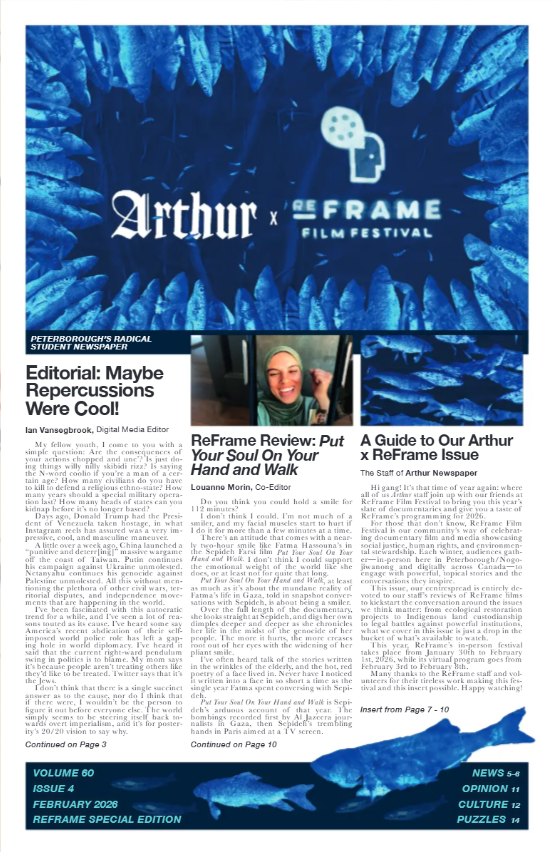
This introduction kicks off Arthur's annual coverage of ReFrame Film Festival. This year, ReFrame’s in-person festival takes place from January 30th to February 1st, 2026, while its virtual program is from February 3rd to February 8th, 2026. For more information on ReFrame's programming and film line-up this year, visit the ReFrame website for details on passes, showings, and other events.

.jpg)

.png)
The rich text element allows you to create and format headings, paragraphs, blockquotes, images, and video all in one place instead of having to add and format them individually. Just double-click and easily create content.
A rich text element can be used with static or dynamic content. For static content, just drop it into any page and begin editing. For dynamic content, add a rich text field to any collection and then connect a rich text element to that field in the settings panel. Voila!
"Headings, paragraphs, blockquotes, figures, images, and figure captions can all be styled after a class is added to the rich text element using the "When inside of" nested selector system."
The rich text element allows you to create and format headings, paragraphs, blockquotes, images, and video all in one place instead of having to add and format them individually. Just double-click and easily create content.
A rich text element can be used with static or dynamic content. For static content, just drop it into any page and begin editing. For dynamic content, add a rich text field to any collection and then connect a rich text element to that field in the settings panel. Voila!
"Headings, paragraphs, blockquotes, figures, images, and figure captions can all be styled after a class is added to the rich text element using the "When inside of" nested selector system."

.jpg)


.png)
.jpg)