.png)



.jpg)
On the night of September 12th, local gallery Artspace welcomed Hamilton multidisciplinary artist Adrien Crossman for the opening night of their exhibition Babe, yr my religion, which will remain in Peterborough until November 22nd.
The exhibition features a series of paintings, sculptures and found object installations from Crossman, each exploring their own queer iconography: from a table adorned with cigarettes and an ashtray stamped with the name of a fictional bar from Leslie Feinberg’s Stone Butch Blues, all imagined to have belonged to Feinberg, to three enframed bottles of Double Scorpio poppers.
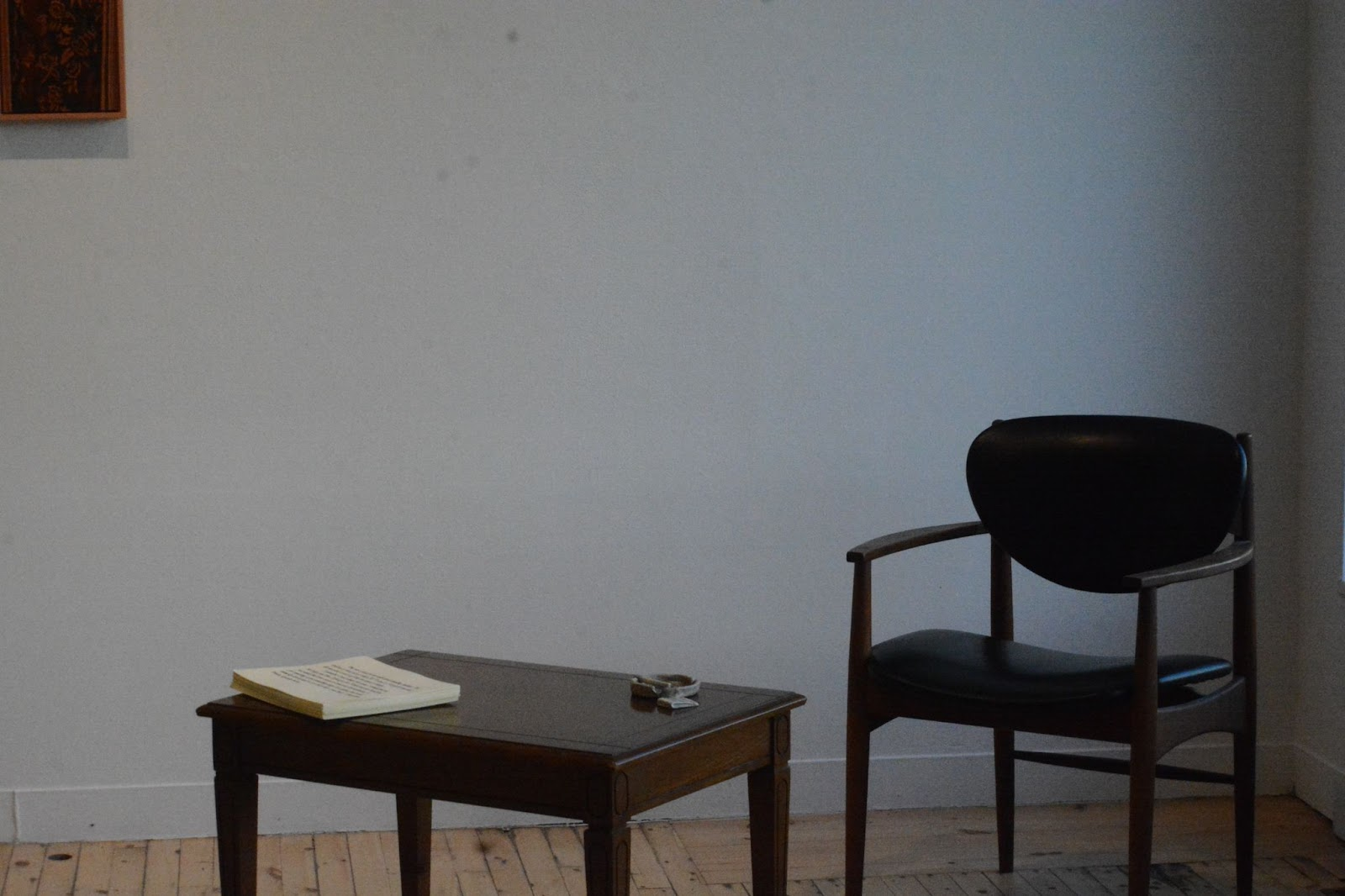
For Babe, yr my religion, Crossman adorns the main room of Artspace with a series of their paintings and installations, paying homage to gay trans activist Lou Sullivan, lesbian archivist filmmaker Cheryl Dunye, and the ever-ubiquitous Leslie Feinberg as well as fixtures of their own queer canon; films like My Own Private Idaho, Desert Hearts, The Watermelon Woman, and of course, novels like Stone Butch Blues.
Beyond the main space lies the dark room, giving sense to the exhibition’s ethos of “exploring the gay bar as sacred space.” Between it and the main room, a series of fliers for fictional rope parties and dyke dungeons blur the line between the fiction and history which convene in Crossman’s queer pantheon.
Inside the room, one struggles not to imagine the occurrence of these rope parties and dyke power-play sessions—a wheelchair-accessible ramp leads up to a platform cut off by a glory hole wall sporting smiley-faced-shaped holes in lieu of the usual circles.
This irreverent, outright silly approach to accessible design was one of the topics of conversation when Arthur co-editor Louanne Morin sat down with Adrien Crossman on the night of September 12th, as their exhibition opened its doors for the first time in Peterborough.
Louanne Morin: Your show here today is called Babe, yr my religion, and my understanding is a lot of it is based on queer icons, queer culture; blending queer history and queer iconography together to build a common queer remembrance.
Adrien Crossman: I’d say it’s thinking about the gay bar as a holy space and thinking of queerness as a kind of religion.
I have a lot of work that references gay bars and representations of queerness in media. But then I also have an altar to Leslie Feinberg from Stone Butch Blues, riffing off of a religious altar, but to someone that I look up to in a similar way.
LM: So, Leslie Feinberg, other figures such as Cheryl Dunye—what does it mean to you to sanctify them like this? What does it represent for us to have queer Saints?
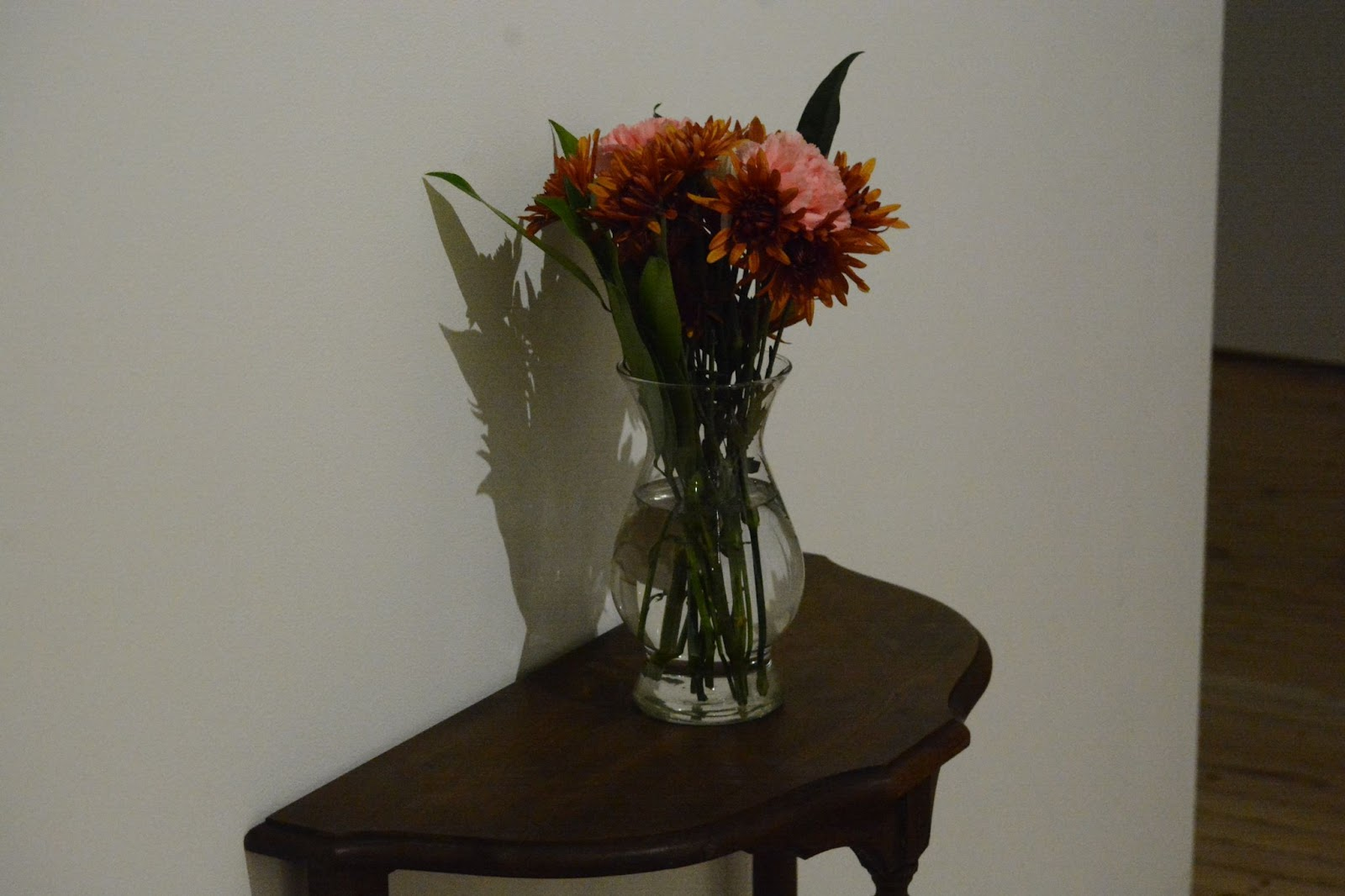
AC: I have an altar to Leslie Feinberg, and the piece with the flowers that’s for Lou Sullivan. I know his edited diaries came out, but he’s been a slightly forgotten trans figure. It’s to elevate these people and to be in cross-historical dialogue with them.
It’s paying homage to them, but also acknowledging the ways that I have learned from them and the way they’ve paved the way for me to exist. I’m trying to blend temporal space and exist in a parallel lineage to them.
LM: It seems to me part of that process of remembrance is acknowledging that a lot of these gay bars that you speak of exist in our memory, in the same capacity as queer media, because we’ve lost them to gentrification. Would you say this is an exercise in trying to acknowledge the crisis of our gay bars?
AC: I’ve been working with these ideas for over five years. It is topical and now—especially politically—it feels more urgent. In a way, it’s about referencing the crisis, but I think for me, it’s more about referencing a yearning and a longing for a space I can’t go to.
I’m thinking less about a crisis and more about sharing a yearning now, in my adulthood, of spaces I can’t go to, which felt like a similar yearning to when I was a closeted teen and the only spaces I had were the spaces in movies and TV.
LM: There’s an issue of timing: as a child, you feel like you’re too young to be like the characters in The Watermelon Woman, Brokeback Mountain, or Stone Butch Blues. Now, as an adult, you feel like it’s too late, and so many of these spaces that you could have gone to have disappeared.
AC: Yeah, I did miss the boat in a way. There was more of a heyday for queer bars. I think we’re in a time when things are shifting. In Hamilton, where I live, there’s a lot of queer events. In Toronto too. There are some new gay bars popping up in Toronto. But I guess it is like feeling a stuckness. I had a yearning, and now I’ve arrived, and a lot of those spaces aren’t there.
LM: What does your take on a queer religiosity have to say to the religiosity that’s on the rise today?
AC: As a young queer person, I had a big rejection of religion because I was like, “This isn't for me as a queer person and a trans person,” but I got introduced to queerness and kink as the place that felt like it served a similar place in my life to how other people are drawn to religion.
With queer folks, there’s a similar thing with family. There’s your blood family, and then there’s the family that you find. I think I’m trying to bring up that parallel. You can worship what you want. Your family can be the people that you want. A sacred space can be a gay bar. A sacred space can be your home.
A sacred space doesn’t have to be decided by an institution or a patriarchal system. It’s like a queering of where one can worship and what one can be devoted to.
LM: In Babe, yr my religion, there’s an embracing of much more pleasure, shedding the asceticism of our more traditional conceptions of religion. Would you say that this is a more hedonistic space?
AC: I didn’t think about it as hedonistic, but I guess it’s very aesthetically seductive. I think of it as an affect, a feeling of queerness.
I think more about creating a space where queer folks feel like they belong through an intangible kind of “What does queerness feel like?” How can you articulate what queerness feels like through color and light and form?
LM: I’d love to talk a little bit about your icons that you’re bringing into this religious space, the significance of figures like Lou Sullivan and Leslie Feinberg. What does it mean to you to have Leslie Feinberg, for example, as one of the Saints of your church?
AC: I was pretty late to reading Stone Butch Blues. I’ve never felt so seen in a piece of literature. I think someone like Leslie was just such an important person, because not only were they a queer icon, a trans icon and a lesbian icon, but they were also a working class icon, and they always did a lot of activism for Palestine.
They’ve always been a radical political person who’s been on the right side of things, whether it was popular or not. Leslie’s someone I think deserves a lot of recognition.
Lou Sullivan was also very brave. There was no social or historical context for being a gay trans man, and so to have the balls to talk to doctors, and run these groups, and be out there…
He would cruise. He’d go to gay men’s cruising places and be stealth. That’s terrifying. You’re putting your life in your hands.
Then there’s Cheryl Dunye, who is a black lesbian who directed an incredible movie [The Watermelon Woman] in the mid-90s. To be a female director at that time was almost impossible and to be a black lesbian director… It’s one of the best movies ever.
LM: I also would love to ask you about these strangely shaped glory holes. In the introductory essay to this exhibition, they’re spoken of as implying the possibility both for a more accessible queer space and also different futuristic queer bodies. Would you say you have an eye turned towards the future of a more inclusive gay space?
AC: Leah Lakshmi Piepzna-Samarasinha wrote an article for Xtra called ‘A Slurp Ramp of our Own,’ which was about the lesbian cruising scene in Toronto. I think it was after the only lesbian bath house called the Pussy Palace got raided. After it got shut down, it was like, ‘Where do sapphic people cruise?’
Cis gay men have all of these spaces. If you go on Church Street in Toronto right now, it's almost exclusively bars for men and they have all this infrastructure for cruising. That essay was starting to imagine this cruising architecture that often exists in the back of a gay bar for men and what it would be like to incorporate a ramp.
What would it be like to have different fun shaped holes at different sizes for someone who’s in a wheelchair, people who have different heights, people who have different abilities? What would it be like to invent a space that imagines different ways that you could interact, that’s fun and doesn’t exclude anyone?
LM: It's making a sculpture out of accessible architecture, in a sense.
AC: One thing I will say is it’s definitely speculative. It could be used, but it's moreso nodding to a potential.
LM: You talk about this missed timing and I have to wonder if what happened is just a question of accessibility. How many young queer adults might not feel like they missed their timing for being part of a gay scene if that gay scene had been able to welcome them in their bodies?
AC: Yes, that’s a huge part of it. The other part is, the more mainstream queerness became, the less there was a need for these secret spaces. If queer people can go to any bar—not always, but if it’s more acceptable now—then these spaces aren’t as necessary. So they disappear, and you lose the safety of those spaces.
I also just had a thought which does relate to a thing you asked me earlier. Have you read or watched The Miseducation of Cameron Post?
LM: I know what it is, but I’ve not seen it.
AC: There’s a line in the book about the TV as a religious object. I think a lot about the way that for me, as a teenager who was closeted, the TV in my bedroom was my one entryway to queerness.
The first time I saw But I'm a Cheerleader, it was on a cable channel, and I recorded it on VHS, but I was so secretive of it. If you think about the paintings that I made, it’s like the screen as a holy object of religion. In a way, it grants us access to all this stuff, but then we’re very attached to it, and it disconnects us.
This interview has been edited for clarity and concision.


.png)
The rich text element allows you to create and format headings, paragraphs, blockquotes, images, and video all in one place instead of having to add and format them individually. Just double-click and easily create content.
A rich text element can be used with static or dynamic content. For static content, just drop it into any page and begin editing. For dynamic content, add a rich text field to any collection and then connect a rich text element to that field in the settings panel. Voila!
"Headings, paragraphs, blockquotes, figures, images, and figure captions can all be styled after a class is added to the rich text element using the "When inside of" nested selector system."
The rich text element allows you to create and format headings, paragraphs, blockquotes, images, and video all in one place instead of having to add and format them individually. Just double-click and easily create content.
A rich text element can be used with static or dynamic content. For static content, just drop it into any page and begin editing. For dynamic content, add a rich text field to any collection and then connect a rich text element to that field in the settings panel. Voila!
"Headings, paragraphs, blockquotes, figures, images, and figure captions can all be styled after a class is added to the rich text element using the "When inside of" nested selector system."

.jpg)
.png)