




.png)



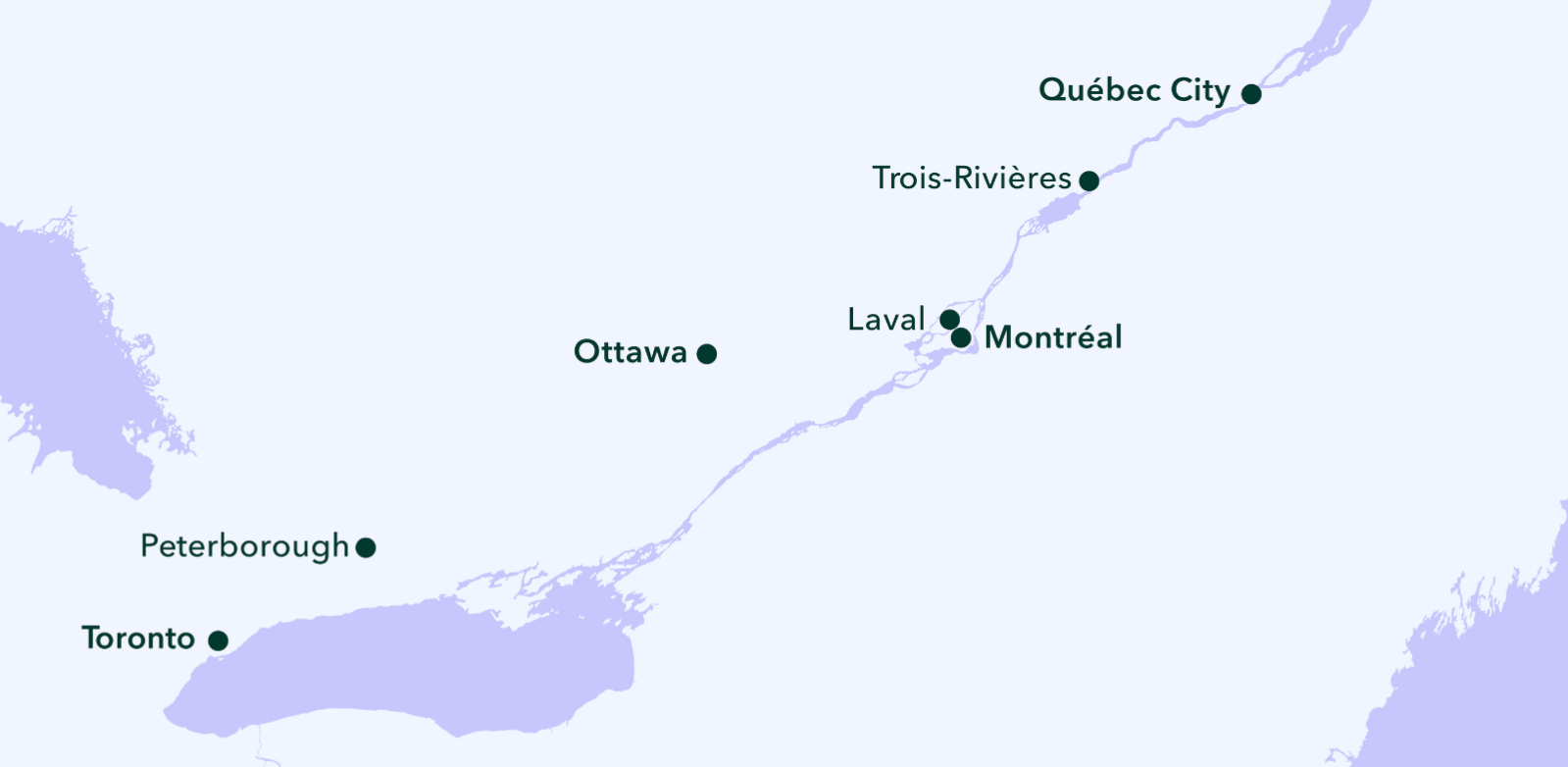
On the evening of October 27th, Peterborough City Council received an update from agents of Alto, the crown corporation responsible for a forthcoming high-speed rail project of the same name. Alto seeks to create an intercity rail corridor from Toronto to Quebec City, which would include proposed stops in Peterborough and other urban centres like Ottawa, Laval, Montréal, and Trois-Rivières.
This is the first time the municipality has received a presentation about the proposed stop since its reveal in February of this year, when former prime minister Justin Trudeau announced the $3.9-billion development plan that would take place over six years.
Alto’s Senior Director of Government and Public Relations Peter Paz presented the update to provide more concrete statistics and challenges behind a project of this scale and its timeline beyond its initial development.
Despite facing increasing costs of transportation, congestion in major urban corridors and their surrounding areas, and isolated communities, the long-term financial benefits of the Alto stop are hard to turn down for the City, with a predicted increase 1.1% in GDP and “up to $35 billion in economic uplift annually,” according to Paz.
“That's broken down into productivity, increased workforce participation and tourism. We're [also] looking at about $800 million in tourism … The provincial tourism association—both in Ontario and Quebec—fully endorse the project, and they see the incredible opportunity it has for people visiting our country and for Canadians visiting their own country,” Paz detailed.
The construction period of Alto, whose first leg will span over six to eight years for a total 12-14 years of construction, will also create over 51,000 jobs solely through its construction, which will require over 4,000km of steel track—or 300,000 tons of steel.
“When delivering a project of this magnitude, we also want to make sure that we minimize financial costs to taxpayers… that every dollar that we spend on delivering this project is $1 that comes from hard working Canadians,” Paz continued.
The Alto line would run on its own dedicated track at 300-350km/h, which is distinct from other rail lines in Ontario.
“The challenges that VIA Rail, for example, faces is they're running service on freight traffic,” Paz said, “where having our own dedicated track creates certainty…that certainty has the opportunity to create frequency.”
“So although we're still in the early phases of developing our service concept, the idea of providing service every 20, 30, 45 minutes means you don't need a timetable. You just show up and a train is going to come, and that is a key attribute to increasing ridership.”
Despite Alto’s service model being in its early stages, Paz stressed that Alto would be bringing “European standards” of public transit to the Ontario-Québec corridor with significantly reduced travel times. A trip on the Alto line between Toronto and Peterborough would only last an estimated 40 minutes, 45% faster than the average car commute of an hour and a half. Usually a five and a half hour trip, a commute from Montréal to Toronto would take just over three hours.
Paz impressed that the community would be involved in all aspects of the project’s consultation, especially the 150 Indigenous communities the corridor would run through in Ontario and Québec.
“We talked about ‘Made in Canada’ for Canadians with Canadian goods,” Paz said. “But we also want to make sure that equity-deserving groups, economically-disadvantaged individuals and local communities directly benefit from the project as well, and that is making sure we set the appropriate targets on workforce participation, local and social procurements as well as neighbourhood enhancement.”
“So how can we be better neighbours? Being good neighbours and leaving communities better off than they were before we got there is a critical component for us.”
Starting in January, Alto will also kick off an extensive public consultation process with the communities it plans to stop within, angling to conduct open houses and online consultation in Peterborough around mid-February.
According to Paz, the Alto line will also become gradually operational as its construction and safety testing completes.
“...Once a segment is done and in operation, we aren't going to wait for a segment to be complete before we start another segment. They'll be staggered,” Paz told council. “So when a milestone is done on segment one, the next segment will start that first phase of work.”
When asked about the potential abandonment of the railway by future governments, Paz was confident that the “nonpartisan” nature of the project would prevent such a fate.
“This project benefits everyone, and we like to think that the train’s left the station,” Paz replied. “The development is in full phase, full steam. But we will continue to work with elected officials, regardless of political stripe, to ensure that they see the benefits of the project as do their constituents.”
However, many Eastern Ontario leaders disagree with Alto’s limited scope in terms of regional stops.
An October 23rd letter from Eastern Ontario Wardens’ Caucus (EOWC) chaired by Peterborough County Warden Bonnie Clark, raises concerns about the significant lack of stops in Eastern Ontario, save for Peterborough. While the County is supportive of the project and also received a presentation from Alto in September, the letter raises concerns about the project's purview.
“While the EOWC supports transportation expansion across rural and small-urban communities as a long-standing priority, if built, this project will cut through our region’s communities without bringing benefits to local businesses, trail systems, tourist destinations, or our 800,000+ residents,” the letter says.
The EOWC also urged Alto's President and CEO Martin Imbleau to consider expanding the Eastern regional reach of the 1,000 km corridor through adding stops in other rural and remote municipalities, despite Imbleau’s desire not to, stated to the Peterborough Examiner back in March.
“The EOWC region is about the same geographical size as the province of Nova Scotia (approximately 50,000 square kilometres),” the letter states. “Although we recognize that a stop is planned in Peterborough, overall, the train network will still have little to no benefit for the region as a whole.”
Editor's Note: This article has been corrected to both clarify that Mayor Jeff Leal is not a co-signer but was rather CC'd on this letter from EOWC and to better illustrate the County of Peterborough's position on the Alto project. This was also later corrected to clarify the total years the Alto line's construction will take based on Alto CEO Martin Imbleau's assessment of the project post-development.






.png)
The rich text element allows you to create and format headings, paragraphs, blockquotes, images, and video all in one place instead of having to add and format them individually. Just double-click and easily create content.
A rich text element can be used with static or dynamic content. For static content, just drop it into any page and begin editing. For dynamic content, add a rich text field to any collection and then connect a rich text element to that field in the settings panel. Voila!
"Headings, paragraphs, blockquotes, figures, images, and figure captions can all be styled after a class is added to the rich text element using the "When inside of" nested selector system."
The rich text element allows you to create and format headings, paragraphs, blockquotes, images, and video all in one place instead of having to add and format them individually. Just double-click and easily create content.
A rich text element can be used with static or dynamic content. For static content, just drop it into any page and begin editing. For dynamic content, add a rich text field to any collection and then connect a rich text element to that field in the settings panel. Voila!
"Headings, paragraphs, blockquotes, figures, images, and figure captions can all be styled after a class is added to the rich text element using the "When inside of" nested selector system."

.jpg)



.jpg)

