.png)



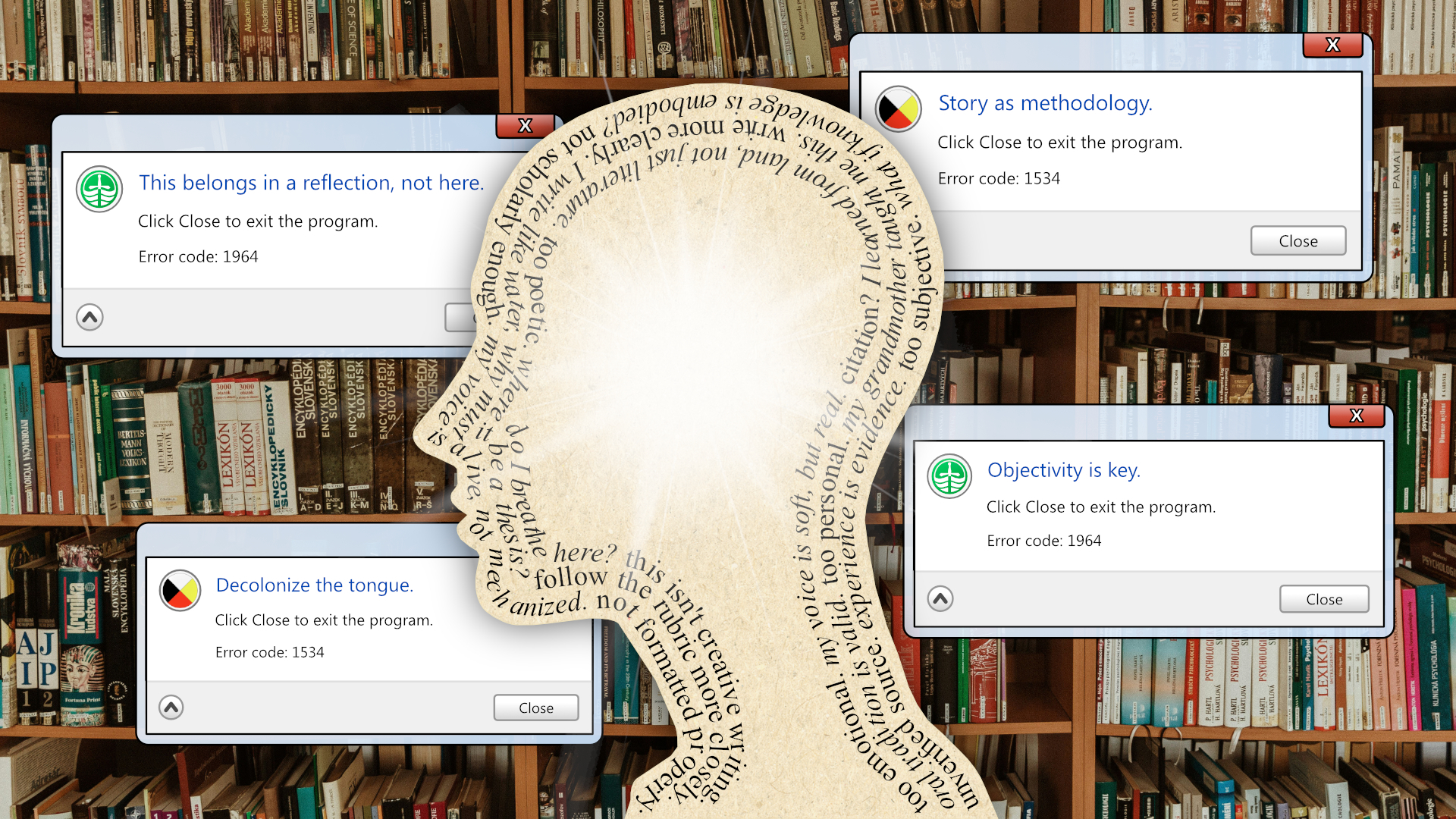
Let us begin with the confrontation:
What if the institution you trust to expand your mind is quietly narrowing your soul? What if the education you work so hard for is training you to distrust the deepest parts of yourself? And what if the voice you use now — precise, articulate, academically polished — is not actually yours?
This is not an anti-intellectual argument.
It is a philosophical one.
A spiritual one; a human one.
Because every institution, no matter how noble its mission, operates through a set of hidden logics — unspoken rules about which ways of knowing count, and which must be dismissed. The first step toward reclaiming yourself is admitting you’ve been shaped by forces you never consciously agreed to.
I. What Does it Mean to Think Freely?
Let us push into the uncomfortable.
Before we talk about voice, we must talk about questioning – because voice does not begin with speaking. It begins with the questions you allow yourself to ask, and the ones you were taught not to.
Most of us assume we choose our questions. But do we? Or do they arrive pre-filtered – pre-sanitized – by classrooms, rubrics, citation styles, peer review, job markets?
I remember sitting in a seminar once – bright overhead lights, desks aligned like obedient teeth – when a student asked why grief is rarely cited as methodology. The room shifted. Not a loud shift, more like the tightening of a collar. The professor paused, smiled politely, and redirected us back to the reading list. Valid question, but not today.
It struck me then: the boundary was not intellectual, but emotional. The discomfort was not about logic, but about permission. The question didn't misfit the academy – it simply refused to behave.
What if the questions that feel “irrelevant” were never irrelevant at all, only ungovernable? What if the questions that feel “unacademic” are actually the ones that could lead you back to yourself? What if the discomfort is not intuition, but conditioning – quiet, inherited, polite?
Institutions teach you which questions are respectable, fundable, “appropriate.” More dangerously, they teach you which questions might unravel the room if spoken aloud. Not because they are wrong, but because they open a window where a door was designed.
A free question is feral. It slips past methodology. It arrives through the gut, the dream, the moment you notice moss on old brick and feel a pull you can’t footnote.
Free questions do not ask to be justified – they demand to be lived.
The tragedy is not that free questions disappear; they never do – they lurk under your skin. The tragedy is learning to silence them before they even shape – pruning your wonder to fit the garden bed of approval.
The first wound is not the loss of voice – it is the loss of your right to wonder on your own terms.
II. How much of Your Voice is Actually Yours?
Sit with this.
When you speak, who is speaking?
The voice carved into your bones by lineage, Land, memory – or the voice ironed smooth for syllabi and employability?
I didn't notice my voice changing at first. It was subtle – like slowly tightening a belt loop each semester. A professor once circled a paragraph of mine in red and wrote: “Beautiful, but too emotional. Consider a more neutral tone.”
Neutral — as though neutrality were not an emotion sanctioned by power.
I rewrote the piece. Removed the ache. Removed the Land. It earned an A. But reading it felt like wearing clothes borrowed from a body that wasn’t mine. This is how discipline works – not with force – but with praise.
Language is never neutral.
Every sentence draws a border around what is real and credible. When tone is corrected, ontology is corrected – what can exist on the page shrinks.
And here is the danger:
Once your voice has been domesticated, your thinking follows. Once your thinking follows, your sense of self contracts. You stop asking, What is true? And begin asking, What will be accepted?
This isn't stylistic – it’s existential.
An institutional voice doubts its own origin story. It apologizes for its intensity. It amputates feeling from thought, Land from knowledge, body from mind.
At that point, voice becomes costume – a stranger performing for you.
The tragedy isn't that the voice is wrong – it's that it's no longer yours.
III. Whose Knowledge Survives Academic Filtering?
Let’s be blunt.
If your voice can be disciplined, a way of knowing can be erased.
Knowledge survives not because it is true – but because it is permitted.
Universities function like filtration systems: what flows through becomes research; what gets caught becomes anecdote, folklore, “unverified.”
Not for lack of intelligence – but because it refuses to travel without its roots.
Academia is fluent in extraction. It loves data once it's bled of context. It loves forests as board feet. Plants as medicine only once divorced from ceremony. Indigenous knowledge only once cited, severed from the people who lived it.
But what academia fails to legitimize, we can learn to defend.
Instead of begging acceptance, we must ask:
How do we write in ways that cannot be filtered without losing meaning?
How do we cite the river without extracting it from its watershed?
Perhaps the task isn't to fit alternative epistemologies into the academy – but to make scholarship porous enough for the land to breathe through it.
Because if truth is only that which can be measured, the immeasurable dies. If wisdom requires dissections, the organism dries out on the table. If clarity demands detachment, then relations become collateral damage.
The question is no longer what knowledge is excluded, but how we refuse to let it disappear.
IV. What if Silence Is Not a Lack of Words but a Form of Control?
After your questions are filtered and your voice disciplined, comes silence. Not absence – conditioning.
Silence as reward.
Silence as the gentle pat on the head that says you are being professional, appropriate, objective.
Slowly, without anyone needing to name them outright, you learn the rules:
Do not speak from your pain. Do not speak from your Land. Do not speak from your intuitive knowing. Do not speak from your culture unless translated into academic grammar.
It doesn't feel like censorship at first. It feels like maturity, like progress. Like you’re getting closer to being taken seriously. You stop writing in the voice that trembles with memory. You edit out the sentence that your grandmother would have recognized. You exchange the river for “riparian environment.” You replace the body with methodology. You learn to speak about the world from just behind the glass.
This is not education – this is spiritual behaviour training.
The tragedy isn’t compliance – the tragedy is amnesia.
You forget you ever had more to say. Silence becomes comfort. Respectability. Safety. A coat you didn't realize was tightened around your lungs. And perhaps the deepest violence an institution commits is not that it tells you to hush – but believing that hushing yourself is wisdom.
When did erasing yourself become normal? When did quiet start masquerading as intelligence? Who profits from your silence?
V. Objectivity as a Mask for Power
Objectivity is treated as holy in academic spaces – a clean white lab coat for the mind.
But objectivity is a lens pretending to be a window. A way of seeing that claims to see from nowhere – but only those aligned with institutional defaults disappear behind it.
White, Western, masculine, secular, empirical, literate, published, funded.
Objectivity does not eliminate bias – it canonizes one. It elevates detachment as the highest form of intelligence, while disqualifying forms of knowing tied to body, Land, lineage, emotion, and spirit.
A professor citing data is rigorous. A student citing her grandmother is anecdotal. Both are knowledge – only one is permitted to count.
This is what objectivity often means in practice: your truth is allowed only if it can wear an institutional costume. So when someone in a meeting or classroom says, “Let’s remain objective,” whose eyes are they asking you to see through?
Whose neutrality? Whose history? Whose absence of body?
And, more importantly, who must erase themselves in order to qualify as credible?
VI. The Spiritual Intelligence the Institution Cannot Measure
Every person carries a worldview shaped by Land, lineage, intuition, instinct, dreaming, and embodiment.
Not religion – existence. The hum beneath thought. The knowing that arrives before language finds it.
Institutions distrust what they cannot quantify. This knowing moves. Contradicts. Breathes. It refuses to hold still long enough to be dissected.
You cannot run statistics on a dream. You cannot footnote the shiver that rises when something is true. Wisdom lives in birds before a storm, in the tightening of the chest before danger, in the river refusing to rush.
Your body recognizes truth long before your mind rehearses it. Intuition is not an obstacle to knowledge – it is a doorway to it.
Sometimes the most intelligent act is listening to what you cannot yet prove.
VII. The People Who Thrive in Institutions – And the People Who Survive Them
Institutions reward order, linearity, distance – a mind that does not tremble.
But that reward has a cost: we trade wild knowing for legibility.
When objectivity is the gatekeeper, what knowledge is lost?
The student who feels the answer in her chest before she can articulate it. The researcher who dreams up the solution but has no methodology to justify it. The community whose stories hold centuries of ecological intelligence, but cannot be peer-reviewed.
These are wisdoms too alive to standardize.
People who thrive in institutions flatten to fit the frame. Survivors refuse – they think in spirals, learn through body, relate through Land.
But survival has a cost.
When we privilege academic cognition over embodied experience, we lose knowledge that once tasted like earth and blood.. We lose the wisdom that arrives like thunder, not hypothesis. We lose the intelligence that grows from grief, love, intuition, ceremony, and dream.
Institutions produce experts. Life produces philosophers.
So the question is no longer merely who thrives inside these walls – but what worlds of knowing are we starving to keep the walls standing?
Ask yourself: are you here to master the system – or to outgrow what it asks you to abandon?
VIII. The Return to Your Own Voice
Reclaiming your voice is not aesthetic – it is an epistemological event. A return to the place where knowledge begins before the academy edits it into shape.
Your voice is your worldview made audible. It is a theory with blood in it. It is the shape your knowing takes when it hasn't been filtered for respectability.
To reclaim it is not rebellion – it is integrity. It is remembering that clarity is not the absence of feeling, but feeling articulated with courage.
Because the institution taught you to split yourself to be taken seriously – to choose head over heart, method over memory, objectivity over intimacy.
Reclaiming voice is stitching back what was split: thought with feeling, spirit with analysis, intuition with clarity, body with mind.
Not as opposites – but one intelligence in many forms.
This is the turn – from diagnosis to possibility.
IX. Final Question: Who Do You Become After You Stop Performing For Institutions?
A terrifying question – because it is liberating. Without the institution’s voice, you meet your own – unapproved, alive.
Who are you when you stop asking for permission to know? What remains when the rubric dissolves?
We must ask:
Are you learning—or performing learning? Speaking—or echoing? Alive—or merely academically well behaved?
An institution can sharpen you; it can give you tools, language, structure. But it cannot awaken you. Only you can do that – in the pulse before language.
Because the truth is not hiding in the library. It is hiding in the parts of you you were trained to distrust.
So the real question is not what will academia make of you, but what pieces of yourself will you refuse to surrender?
Will you recognize your own voice?
Because your intelligence was never in danger – only your permission to use it.





.png)
The rich text element allows you to create and format headings, paragraphs, blockquotes, images, and video all in one place instead of having to add and format them individually. Just double-click and easily create content.
A rich text element can be used with static or dynamic content. For static content, just drop it into any page and begin editing. For dynamic content, add a rich text field to any collection and then connect a rich text element to that field in the settings panel. Voila!
"Headings, paragraphs, blockquotes, figures, images, and figure captions can all be styled after a class is added to the rich text element using the "When inside of" nested selector system."
The rich text element allows you to create and format headings, paragraphs, blockquotes, images, and video all in one place instead of having to add and format them individually. Just double-click and easily create content.
A rich text element can be used with static or dynamic content. For static content, just drop it into any page and begin editing. For dynamic content, add a rich text field to any collection and then connect a rich text element to that field in the settings panel. Voila!
"Headings, paragraphs, blockquotes, figures, images, and figure captions can all be styled after a class is added to the rich text element using the "When inside of" nested selector system."

.jpg)


.jpg)