.png)



.jpg)
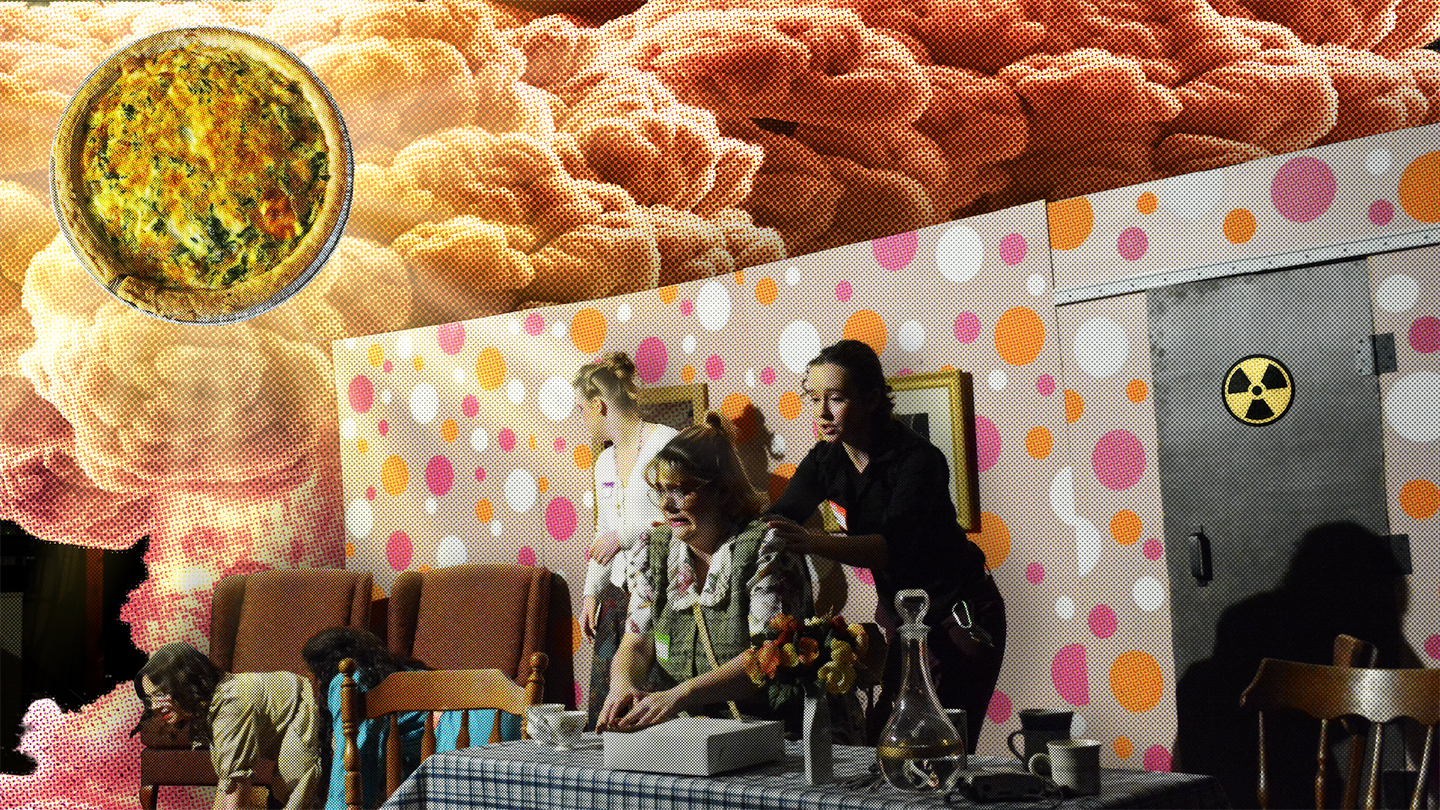
On November 9th—coincidentally the first day of snow this winter—Arthur had the pleasure and privilege to witness who will save the night sky?, a play created and performed by Philip Jonah Logan Geller at the Nozhem First Peoples Performance Space during the last day of the Trent’s annual Elders and Traditional People’s Gathering. The play was curated by Indigenous Performance Initiative and co-presented by Public Energy Performing Arts and Nozhem First Peoples Performance Space.
The performance follows a coalition of star beings–various figures which were inspired by Jewish and Métis traditions –as they hold a summit to decide the fate of the “two-leggeds” (humans) in a celestial boardroom overlooking the Milky Way. The story is told through the eyes of the Trickster, a mischievous being also taking inspiration from Jewish and Métis knowledge systems, who brings chaos, laughter and wisdom during uncertain times.
The show incorporates elements of absurdist thought, explores the spiritual connection between humans and the stars, and ends on a hopeful rejection of colonial and capitalistic nihilism. Geller guides you through their profound tale, utilizing an ingenious incorporation of props, sound design, lighting, eccentric solo character acting, and audience interaction.
Geller’s portrayal of the star beings: Mars, Baba Shpin, Mista Muskwa, Auntie of Your Wildest Dreams, and most importantly, the Trickster; shows the audience just how talented they are as a storyteller and enlivens the intricate tale being woven before our eyes.
Balancing existential topics like the hubris of humanity’s slow severing of the webs that bind them to the stars and the spirit world, with something as hysterical as the feisty bipolar personality of the Trickster. Geller expertly brought the audience to a deep and vulnerable emotional state while still making us laugh to the point of tears.
Their performance was full of a creative passion that quickly eased a nervous audience. Through the Trickster, they showed the audience that mistakes were meant to be made and that we should laugh in the face of our failures. As member after member of the audience was soothed into participating, we quickly abandoned our self-inflicted shame and opened ourselves to the lesson the Trickster was trying to impart.
Near the end, I was even brought to tears multiple times, as the discussion of the fate of our connection to the stars was placed into the hands of the audience. In a profound moment, the audience was told to hold a cord connecting us to the ladder that was representative of the celestial boardroom, and the choice to either let go or continue holding was given as a pair of scissors was slowly lowered from the ceiling to ominously threaten our metaphorical relationship to the stars.
Geller blends the primal fear of standing on the edge of oblivion with the hope that comes from facing the end through laughter and imperfection, the pain of losing one's tether to the spiritual world with the knowledge that an outcome we all dread has not been woven into the stars just yet.
After roughly over an hour, the show concluded with a brief Q&A. Since this was their last performance in Peterborough for the time being, Geller was given a heartfelt send off in the form of a traditional travelling song.
Philip Geller was gracious enough to provide Arthur with an in-depth interview days before the performance in which they discussed their inspiration for creating who will save the night sky?
“It all started with one night I was sort of contemplating things in an existential moment, going, ‘Who am I? What's happening?’ And I looked up at the night sky, and I sort of realized this lack of relationship that I had to the stars and the star world and the star stories… that exploration of the Star World is a metaphor of identity,” Geller told Arthur.
They discussed the meaning behind the Star World as well as what the future of humanity represents for the Star World.
“I think the Star World means so much. I mean, in many stories, it is the place where we come from, and it's the place where we will go. It is the connection to the Spirit.”
“I think there's also the contemporary Star World, where it's like the space race. Trying to live on the moon, or,, trying to do this really strange neo-colonialism of Mars and everything,” Geller continued. “And I think that has a lot of the same roots [as] the colonialism my ancestors experienced 500 years ago and continue to experience.”
Geller also explained the meaning of the trickster and what they represent in both Métis and Jewish culture.
“It’s really important to acknowledge that Trickster is this anthropological term that was coined sometime in the late 19th century that was this broad encompassing of these figures that all are different and nation-specific, and have different narratives and serve different purposes according to the needs of a community,” Geller said.
“Some of the Trickster world in Judaism is this village of Chelm, this village of fools, and sometimes you think of the village idiot. Well, the entire village is idiots, and they make all the mistakes for everyone, so that we learn from them. But they're also very wise in their stupidity, in their idiocy and their foolishness,” Geller explained.
“[The] Trickster, really for me, offers this alternative worldview about embracing the messiness, embracing the unknowing, living at the crossroads, yeah, the sacred and the profane, the prophetic and the poop,” Geller said.“We need more of the upending of what authority is, and the mockery and to be able to laugh at ourselves, and then to laugh at other people sometimes too. But we're all sharing that laughter together.”
Geller shared their insights on their methodology of performing.
“I think there is a lot of storytelling right now about a performative identity, because we want to understand it in a way that's consumable, like I said, with Trickster, this sort of messiness, the unknowing, the cracks, that is, that is where I come from. That identity is not fixed, yet to also balance that with a deep accountability to kinship, land, and community” they said.
“I think it's that linear thinking: ‘this has to go here’ and, and it's about these very rigid structures that are in place. I think that's colonialism, that's capitalism, that's the patriarchy. It's about confinement, it's about carceral thinking. And I think those are all tied together in that liberating sort of storytelling practice; to be free and fluid.”
“Even in my process,” Geller continued, “I'm freaking out because I'm like, ‘I don't remember my lines,’ but then I have to go ‘Who? Where? What voice is that? Where is that coming from? Who says that it needs to be said the same way every night?’”
“Maybe I make it halfway through the show and I have to stop. I think that there's healing for me in that too, about letting go of what I think is right and correct and the right way of doing things.”
For those who missed the show, Philip Geller can be seen performing who will save the night sky? again in Whitehorse in April. They are also working on a practice: Misinterpretation (a performance) which will be performed in Montreal at the OFFTA festival in June 2026 and the annual story creation project at the Centre for Indigenous Theatre which will be presented in Toronto at the end of January 2026.
They encouraged audiences to check out their website at www.philipgeller.com and instagram @philipjgeller.


.jpg)
.png)
The rich text element allows you to create and format headings, paragraphs, blockquotes, images, and video all in one place instead of having to add and format them individually. Just double-click and easily create content.
A rich text element can be used with static or dynamic content. For static content, just drop it into any page and begin editing. For dynamic content, add a rich text field to any collection and then connect a rich text element to that field in the settings panel. Voila!
"Headings, paragraphs, blockquotes, figures, images, and figure captions can all be styled after a class is added to the rich text element using the "When inside of" nested selector system."
The rich text element allows you to create and format headings, paragraphs, blockquotes, images, and video all in one place instead of having to add and format them individually. Just double-click and easily create content.
A rich text element can be used with static or dynamic content. For static content, just drop it into any page and begin editing. For dynamic content, add a rich text field to any collection and then connect a rich text element to that field in the settings panel. Voila!
"Headings, paragraphs, blockquotes, figures, images, and figure captions can all be styled after a class is added to the rich text element using the "When inside of" nested selector system."

.jpg)
.png)