.png)



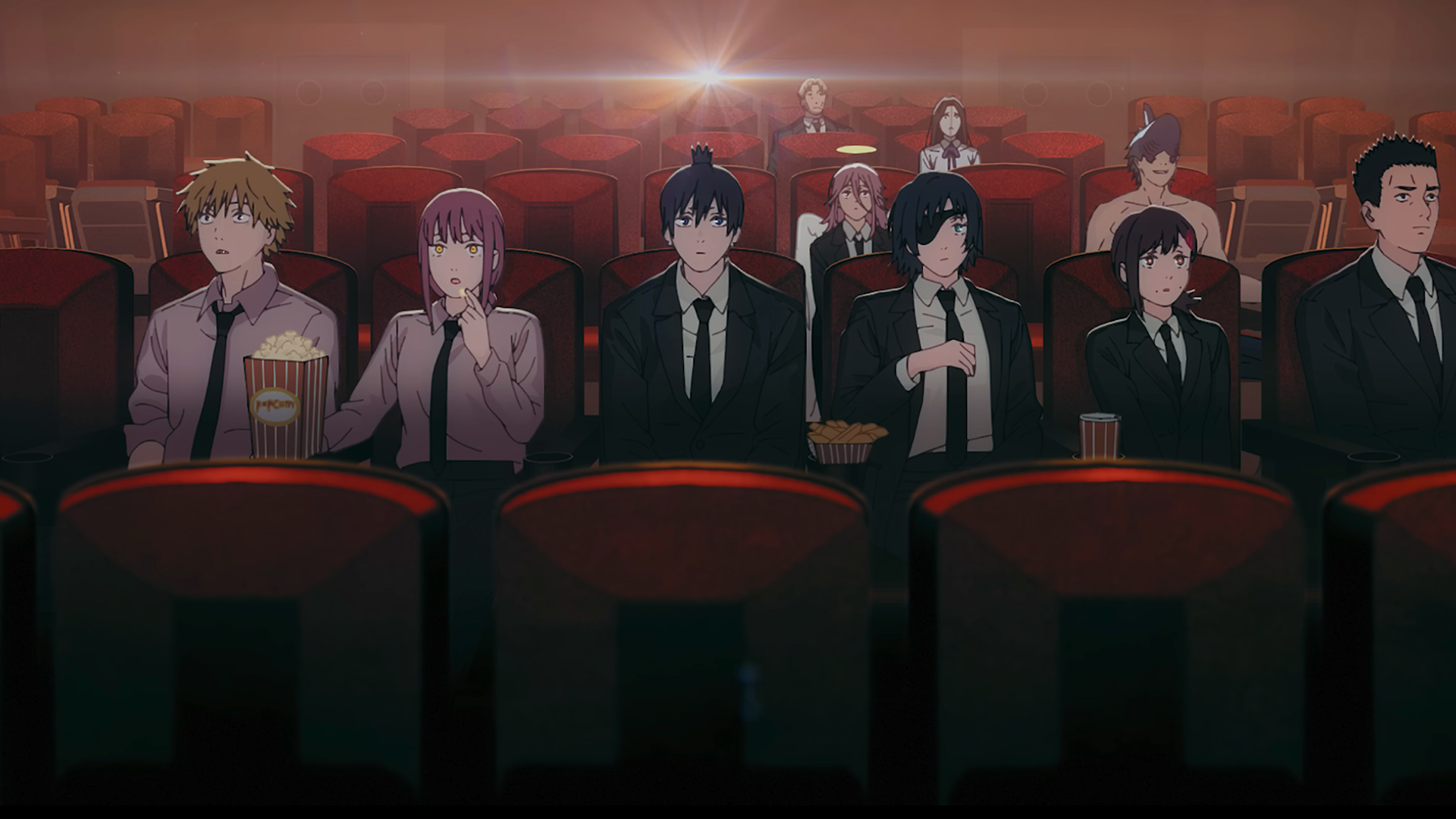
"Only one in every ten movies I watch are any good, but every now and then one of those movies changes my life.” – Chainsaw Man, Chapter 39.
Tatsuki Fujimoto loves movies. That much is obvious from reading any of the Chainsaw Man creator’s work. He writes short stories about movies and theatres. He espouses his love for Hereditary and The Texas Chainsaw Massacre in his author bios. He spins manga panels out of stills from everything from French arthouse movies, to pervert trash like Gareth Evans’ The Raid 2.
The one genuinely good idea from Fire Punch—a massively mixed bag of a manga mostly known for being The-Thing-He-Wrote-Before-Chainsaw Man—is an afterlife rendered in the form of a movie theatre, a sort of uncanny non-heaven straight from Marc Augé’s nightmares whose visual resonances colour the rest of his work.
In some ways, Fujimoto’s cinephelia is borderline fetishistic, if slightly more artful than that of, say, Hideo Kojima—who mostly posts posters of American studio slop (or selfies of himself, in theatre, watching them) to his millions of Instagram followers. He is a weird savant of a writer who mixes Soviet realism with esoteric daemonology and writes his obvious femdom fetish into his comic books.
He renders existential concerns about the nature of good, evil, and humanity in equal measure through gratuitous sex and violence or two people having a conversation about smoking.
In other words, Tatsuki Fujimoto is a visionary—for better and for worse. His sensibilities are intensely cinematic. He crafts stories through images and impressions and evocation.
Fujimoto seems invested in taking what he can learn from cinema and applying it to his craft as a mangaka. Beyond the panels themselves, he traffics in tropes lifted from the big screen reduced to a more comic-appropriate serving size. Part of Chainsaw Man’s ubiquitous appeal is the way it dances between genres; from action, to thriller, to slice-of-life, only to throw you in the deep end of a horror movie.
In many ways, adapting his work into motion pictures has always seemed a forgone conclusion. When Chainsaw Man was eventually brought to the small screen in its twelve-episode first television season in 2022, its opening titles pilfered everything from Reservoir Dogs and No Country for Old Men to Attack of the Killer Tomatoes. The series’ deliberate, simmering atmosphere in contrast to the breakneck pace of its source material made clear its debt to cinema, or at the very least prestige television. Jujutsu Kaisen this was not, despite both shows being produced down the hall from one another.
But it wasn’t till last year that Fujimoto’s work had actually been properly rendered at feature-length, with the adaptation of his one-shot webcomic Look Back, which became something of a summer festival darling.
Flash-forward nearly a year, and Fujimoto’s flagship work has finally hit theatres. Chainsaw Man – the Movie: Reze Arc debuted in Japan late in September, and began two weekends of back-to-back box office dominion in North America on October 24th, 2025.
I have also seen it, if you hadn’t guessed by this point. That’s what all this is about.
Chainsaw Man – the Movie is a bit of an oddity. It’s a 90-minute movie (give or take) in a climate of perpetual two-and-a-half-hour bloat; an animated movie without a strange frame rate or sing-along gimmick to create Twitter buzz; a movie that actually made its money back (and then some).
All these things set it apart in a theatre otherwise showing the Bruce Springsteen biopic (113 min) Tron: Ares (two hours) or The Black Phone 2 (114 mins).
More crucially, it differs from these in the sense it doesn't seem all that interested in being a movie. At the risk of vindicating Martin Scorsese, it's a bit of a theme park ride.
I’m trying to do this thing where I’m more direct in my commentary; I’m not going to keep you hanging. I like Chainsaw Man – The Movie—perhaps even a lot—but that appreciation is not entirely uncomplicated.
On Letterboxd I wrote “To the extent that Chainsaw Man rules, so too does this,” and all told I had a good time watching the movie. But walking home after the fact, I was left with this nagging little ache inside of me.
Not the delicious pang of catharsis I feel whenever I watch a particularly good movie—the thing I feel each time I’ve read Chainsaw Man’s 97th chapter; the end of its manga’s first part. If anything it was a kind of nihilism, this feeling of “This is What Chainsaw Man is Now,” that is less a sense that I watched something and wholly processed it than it is an emotional hole still waiting to be filled.
Chainsaw Man is a series that makes me feel a lot of things deeply. I cry every time I read the manga’s Part 1 ending. Hell, I cry at the movie theatre scene which opens this movie most times I read it, but for whatever reason, I didn’t watching it this time around.
It’s not that the Chainsaw Man movie isn’t good, it’s that it is competent to the point of being uninspired.
I should say I was skeptical from the get-go of the merit of adapting the next arc of Chainsaw Man into a movie. This has been a recent trend in shōnen anime. Back in 2020, the box-office busting Demon Slayer: Mugen Train showed this approach’s financial viability, and seeing money signs, animation studios have since adapted everything from Attack on Titan to Jujutsu Kaisen to My Hero Academia to Blue Lock into limited theatrical releases.
While I understand the cynical reason a lot of them do this (it’s an opportunity to make a box office profit on top of subsequent revenue from streaming licenses and Blu-Ray sales), it never struck me as a particularly good approach to adapting manga series.
Manga and television go intuitively hand-in-hand, as both tend to be told in serialized, piecemeal portions week after week after week. Not only does the feature film format not make sense for some series where the style of storytelling is that of bite-sized, 20-minute action set pieces (see, for example, the Jojo’s Bizarre Adventure movies from the 90s), it interrupts the flow of storytelling when you have to shoehorn an hour-and-a-half movie between two seasons of 24-minute episodes.
Granted, of all the parts of Chainsaw Man to render in this way, the Reze arc does make the most sense. While it heralds a turning point of sorts in the first part of the series, and ushers in a series of revelations which prefigure a marked paradigm shift in the series’ second half, for the most part the story the movie adapts serves as a more muted interlude between the broad and bombastic conspiracy thriller of the Yakuza arc that it prefigures and the International Assassins arc which follows.
Despite my reservations, I was ready to be proved wrong in my prejudice going into this movie. What I wound up watching failed to do that.
The Reze Arc is ruthlessly loyal to its source material in a way I find depressing. It impedes the movie from meaningfully addressing the things that Chainsaw Man is beyond lines on a page, and it diminishes the tangible realization of Fujimoto and the crew of season ones’ cinematic aspirations.
Because while by any conventional wisdom this is indisputably a movie, it plays like a hundred-minute episode of a television show of which it expects you to have seen the first twelve episodes.
There is no period of gradual reacquaintance with this world and its characters beyond a brief opening vignette of Denji’s recurring dream, which leads into the opening titles almost as soon as he wakes.
The few moments we do get with Denji, Power, and Aki, whose found family dynamic made up so much of the first season, are cute, but they don’t really lead to much of anything when Power is largely absent from this arc (she’s booted off-screen immediately after the titles) and Aki’s B-plot revolves around him having to learn to work with a new partner instead of anything to do with our main character.
You’d be forgiven were this your first time engaging with the franchise for being very confused as to why this sixteen-year-old boy sprouts chainsaws. You’d be forgiven for not knowing anything, really, because this movie isn’t interested in telling you.
It’s perhaps a strange complaint for someone as intimately familiar with Chainsaw Man as I to make, but my reasoning is thus: say a friend of yours is curious about the hype. You can’t take them to see this movie because they won’t know what the fuck is going on.
I can say this for a fact, because there were two guys behind me in the theatre when I saw this film, and this was very obviously the case for one of them.

In my mind, a big-budget theatrical release like this should serve as a logical onboarding point, even if it’s effectively a sequel. Devote the first 15 minutes to bringing new viewers up to speed, and hope that by the end of it they feel compelled to watch the first season, or maybe pick up a volume in the manga.
In order to do that, though, you need to shape the contents of the story into the structure of a feature length film, not just procedurally animate 15 chapters blow-by-blow at the pace they were written until you run out of material.
Yet that’s exactly what Chainsaw Man – The Movie does. We’re dropped in, not even in media res, just midway through the contents of Chapter 38, and it proceeds as written from there almost exactly until we reach the end of Volume 6. Events from previous arcs are alluded to under the assumption that you know exactly what they mean, and characters appear and disappear from the movie seemingly at random if only because they did so in the comic.
There’s none such as even a Mad Max: Fury Road opening monologue for Denji to explain “I fused with the Chainsaw Devil, and now I hunt devils for the government.”
It doesn’t help that the first 30 minutes of the film are not really about that. There’s nary a mention of devils or contracts or even the Special Division for which Denji works until much later in the film, after he spends the day going to see movies with Makima.
If anything, this movie actively needs more “Chainsaw Man stuff” in the first half, if only because absent the context of how horrific working for Public Safety’s Devil Extermination Division actually is, Reze’s imploration for Denji to run away with her comes off as strangely naïve; almost childish. Once again, the movie only coheres with the benefit of texts external to itself.
That’s frustrating considering the fact that it bills itself as a definitive thing. I mean, it’s Chainsaw Man – The Movie, not “A Chainsaw Man Movie,” after all.
Instead, absent the daily drive of killing devils, the Chainsaw Man movie opens with the aforementioned theatre sequence—a more-than-coworkers, less-than-friends date in which Makima invites Denji to accompany her on a movie marathon from morning to midnight. It’s a pivotal moment in the manga, one in which Denji is forced to contemplate whether or not being host to a devil has begun to strip him of human empathy, and in which we see a rare glimpse of Makima the person, as opposed to the aloof taskmaster of Special Division 4.
It plays better in the manga, to me, where it comes towards the second half of Volume 5—a reminder that, despite his apparent apathy to the gruesome deaths of many of his coworkers in the manga’s prior arc, Denji is still capable of emotion—as opposed to how it’s used as a slice-of-life introduction to the first 20 minutes of the movie here.
The effectiveness of that payoff in the Reze Arc movie hinges on you having seen the last season and remembering exactly what happened in it, and even then, it’s unlikely the average viewer is able to reconjure the emotional headspace they were in after watching a six-hour television series three years ago.
Admittedly, the principal content of the eponymous arc does play better, confined as it is to the runtime of this movie, though I have to question the degree to which that is simply because Chainsaw Man is already good.
As a movie, this adds nothing to the source material beyond good animation and a pretty score. It plays off the same beats, with the same dialogue, the only difference being that these characters are rendered in motion and made audible through voice acting. Perhaps to some people that’s a net improvement, though to me it introduces further opportunities for granular nit-picking.
Comics and cinema speak in different languages. What works in one medium does not necessarily resonate in the other. I can already read Chainsaw Man whenever I want to, and it is already perfect in that form. What an adaptation of that perfect manga should necessarily do is translate it to the strengths of a different medium.
While Chainsaw Man – The Movie does make use of film conventions in moments (the black & white dream sequence which opens the film comes to mind) they’re never so exceptional as to make you understand why this had to be a standalone movie, and not the first part of a second season.
While a manga need only contend with art and story, cinema engages both audio and visual sensoria in service of its narrative. Sound design, line delivery, and music are all elements it must juggle on top of the composition of its visuals, and even there, cinema introduces additional dimensions through editing, cinematography, and mise en scène.
I love the first season of Chainsaw Man. I love its bleak, desaturated palette which captures a hazy vision of 1996 Tokyo. I love its long takes, and its tracking shots, and the way it composes sequences in long, deliberately plotted ways that make it look more like a David Fincher movie than a monster-of-the-week show. I love its droning electronic score, its foley—the way sounds like the crackle of a cigarette become as much a part of the mix as footsteps, explosions, or the ambient sounds of the city.
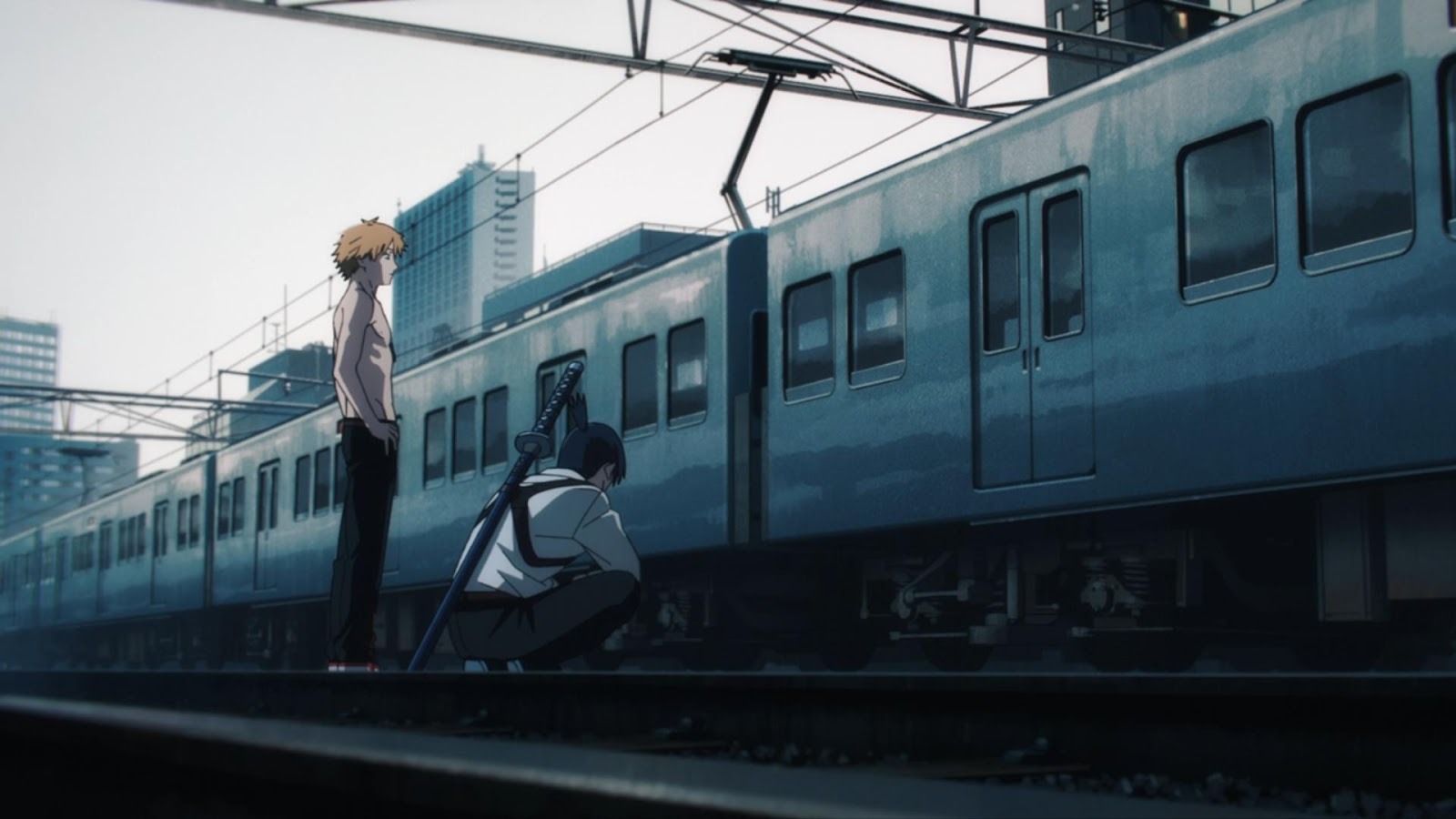
While all of these are departures from the precise way in which the source manga is visually rendered, they are departures that ultimately benefit the story it tells. Chainsaw Man season 1 drips in mood, and atmosphere. It communicates as much, if not more, from what it implies than what it shows directly.
Which I raise, because much of Reze Arc doesn’t strike me as especially cinematic by comparison. The shot composition is largely functional and never especially clever in ways that aren’t lifted directly from the manga. There are none of the first season’s bits of extreme perspective, no manipulating the virtual camera with dolly or crane shots to force greater depth into scenes.
When replicated exactly in motion picture, the little bits of comic levity come off like Family Guy gags.
Part and parcel of this is the film’s aforementioned devotion to its source material. In any other medium we seem to accept that adaptations take certain licenses in their rendering of the source material. Despite the monumental extent of its changes, P.T. Anderson’s One Battle After Another has received significant critical acclaim, and relatively few people seem put off that it is only in the broadest sense an adaptation of Thomas Pynchon’s Vineland.
Yet when it comes to manga, adaptations seem curiously stuck in their obsessive devotion to the thing they’re adapting. When Attack on Titan season 4 was first airing in 2020–2021, despite the marked decrease in quality of the series’ animation, I remember fans would routinely defend it on Twitter by posting side-by-sides of how exactly certain scenes replicated Hajime Isayama’s drawings, as if the first three seasons were not good in part because WIT Studio felt empowered to create their own visual style for the series.
I feel to some degree the same is happening with Chainsaw Man—the series has traded artistry for fidelity. With the departure of season 1 director Ryū Nakayama, the character sheets for the movie have been redrawn to bring them closer to Fujimoto’s willowy manga proportions from the more realistic renderings of the anime. The colours, too, have been resaturated to evoke the pop artistry of the tankōbon volume covers.
The effect is perhaps more “faithful,” though it lacks the depth of season 1’s contemplative, cinematic composition. The character proportions occasionally become distracting when we’re staring at Makima’s inhumanly thin waistline during an important dialogue conversation, and the bright saturated colours and the rough linework detract from the otherwise serious, tragic story Reze Arc is trying to tell.
This is a problem for a series which spent a lot of its first season doing character work, and which hinges its emotional profundity on the humanity of even its non-human characters. It’s a problem which is also further exacerbated by Reze Arc’s runtime and editing.
Whereas a reader can pause on the big reveals in the manga—such as the full-page spread unveiling the Bomb Devil—the movie dictates the pace at which a reader experiences each scene. Unlike manga, whose pace is limited only by that at which the reader can or prefers to read, motion picture is constrained to a specific, immutable runtime determined by a combination of script, line reads, and decisions made during the editing process.
Depending on how each of those factors compound, this can be either a terrific boon or a massive impediment. Jojo’s Bizarre Adventure Part 5 (Golden Wind) is a significant improvement in animation because of how much the 39-episode run tightens up the more aimless parts of the manga. At the same time, shows like DragonBall and Naruto are notorious for deliberately drawing out story beats in a way that kills the pacing of the source material.
In closely replicating the content of Chainsaw Man volumes 5 and 6, the Reze Arc movie preserves the frenetic pace of the manga to its own detriment. Given the film has the same scriptwriter as the TV series, this can’t be solely a product of the screenplay. Instead, the editing, almost metronomic at times, feels largely to blame—as though the director had instructed the animation team to hit a new panel every three seconds on the dot. At times I felt I was being dragged by the tie through the movie, or watching a Let’s Play with a player furiously mashing the “action” button through all the lines of dialogue.
There are no moments of quiet tension, like so many in the first season, no sense of slowly ratcheting dread. The final speech about the country mouse and the city mouse—one of the manga’s most effective recurring motifs—lacks any punch because the film does not take the time to savour its weight.
It leads me to say something I rarely say about movies these days: Reze Arc could have been longer.
Nay, I daresay the movie should have been longer. One of the points of near-universal adulation is reserved for the film’s slice-of-life sequences, a point with which I generally agree. Sequences like the theatre date and the scene in which Denji and Reze break into a pool to go skinny dipping at night make you wish you could inhabit this world for just a little longer, eke out a few more precious moments with these characters.
Which frustrates me, because the characters feel underserved by the brevity of the story. Makima’s affective potential relies on the viewer knowing and caring about Denji’s feelings for her. Power is not here. Aki’s character development feels undercooked; he and Angel don’t have much screen time and what they have is secondary to the A-plot.
The fact that the payoff line about Aki’s reluctance to befriend a devil is directed to the Violence Fiend and not Angel only serves to undercut that character arc, and also reminds me that Kobeni and the Violence Fiend do indeed show up for 30 seconds in the second act without any context.
Kishibe, too, shows up at random in the last five minutes of the film, which will no doubt prompt the uninitiated to ask “Who’s this drunk guy rambling about MK Ultra?”
The problem is not necessarily that these characters are ancillary to the main plot, but rather that their presence reminds you you’re watching a disconnected piece of a bigger story. Many of them still have lots of growing to do, which is fine in a weekly serialized manga, but in a feature film feels incomplete.
There’s no effort to make their stories work within a film format, they just sort of show up and if you don’t know why they’re here, then tough luck. Reze Arc winds up suffering the same problem as Ghost in the Shell as a result: while all of the elements it's working with are theoretically interesting, but none of the characters are sufficiently rendered to make any of them great.
What’s frustrating is that so much of this could be solved in the same manner as that film; with less than 20-minutes of punch-up to make the story function more as its own thing. There’s ample opportunity to tell us more about Reze—to tell us more, even, about the way her presence affects Denji’s life.
While the film uses its opening title sequence to show us a montage of its characters getting ready for work, and later to speed through Denji and Makima’s day at the movies, it doesn’t bother using the same technique to illustrate he and Reze getting closer.
It’s frustrating, considering how much of the movie hinges on the believability of that romance. It would seem a no-brainer to show something even as simple as Denji daydreaming about Reze while at work after the pair’s night at the pool, instead of cutting abruptly to the festival the next day.
In preserving the quick, impressionistic storytelling of the manga, the film ports over one of the form’s worst constraints: its obligation towards hyper-economical dialogue and character writing. Even without adding anything, many, many scenes in Chainsaw Man – The Movie would have benefited from another five seconds either side of a line to simply let them breathe.
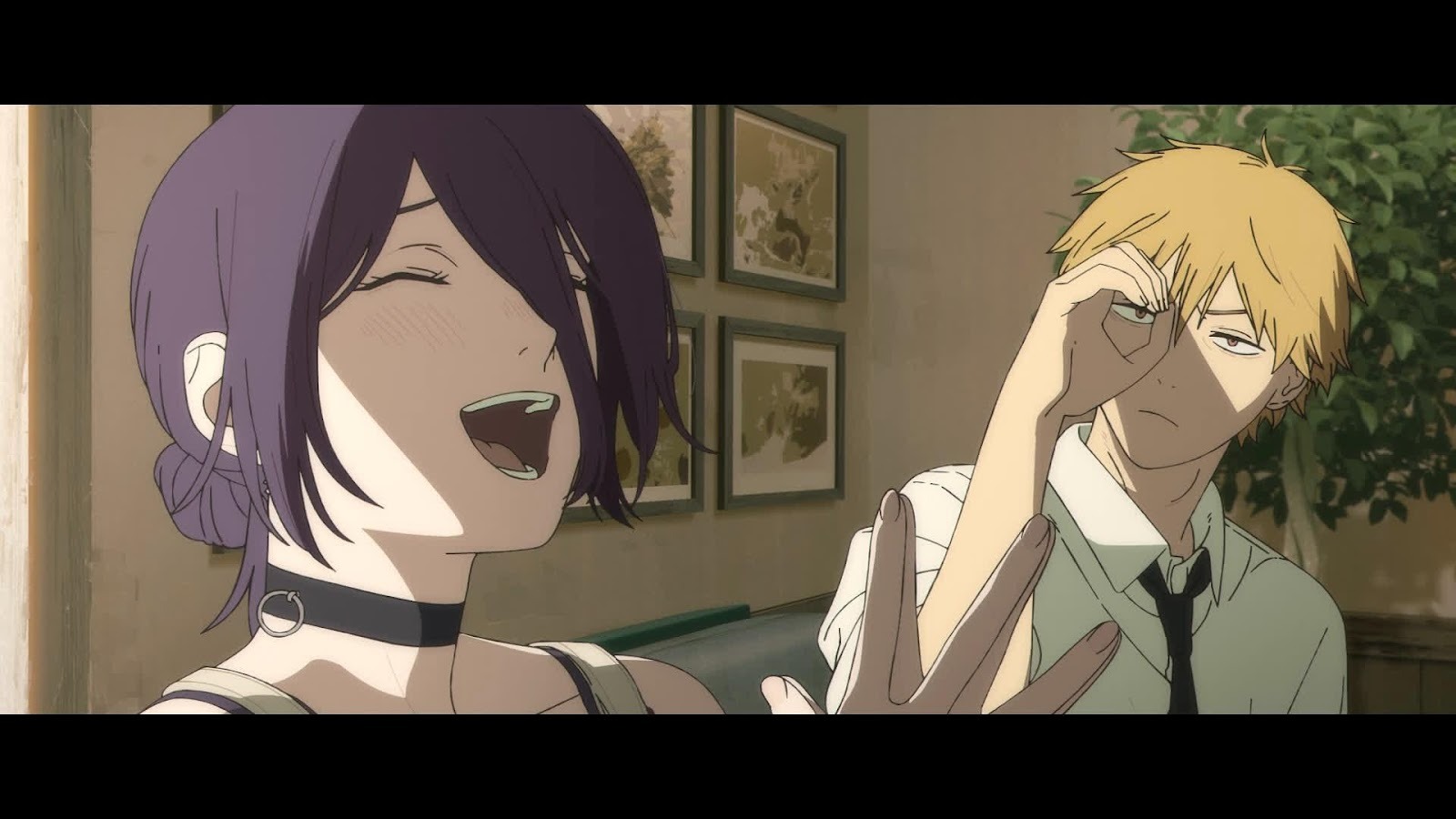
Everyone in Reze Arc speaks like they’re running out of breath. Hell, maybe they are, because this movie adapts almost 400 pages nearly word-for-word in less than 100 minutes. The speed makes it feel a lot more like a conventional shōnen anime (to its detriment) and diminishes the budding romance between Reze and Denji—the film has to rely on the latter telling the audience that he’s attracted to her, instead of conveying it through more deliberate and subtle cinematic techniques.
And in this we come full circle to my belief: that this movie functions neither as a stand-alone movie, nor as cinema in its own right.
There are several moments I find illustrative of this, where the film strangely undercuts its own tension. Leading up to The Big Reveal™, Beam, the Shark Fiend, interrupts the scene and announces to Denji “[Reze]’s the Bomb Devil!” immediately before we cut back to her just in time for her to pull the pin in her neck and whisper “Boom.”
The transformation that follows, glorious though its animation may be, feels limp as a result. There’s no sense of wonder at the monstrosity before us, because Beam’s already ruined the surprise.
The same thing happens again in the final fight when Denji asks Reze if she can still use her Bomb Devil powers while she’s wet. Each of these moments is lifted directly from the manga, and there they help the reader make sense of the absurd and often dense imagery they accompany. In the film, however, these lines compromise the story’s ability to show and not tell.
They’re intrusive, imparting the same information an attentive viewer might otherwise infer through visuals alone. Because of how brusquely functional they are as expository dialogue, they also come off as supremely clunky.
Even if the screenwriter had felt it absolutely necessary to include every line from the manga, I think these kinds of lines would better serve the language of cinema were we shown the subject of the reveal first, and then subsequently given context to help resolve that visual tension.
However, that would require the production team to have thought about how best to render these moments in the language of cinema. It’s the very thing that Fujimoto’s writing is so good at—translating the language of one medium to another—yet ironically, it’s the congruence to that writing that makes me think the people who made this movie failed to do exactly that.
Reze Arc strikes me as a deeply conservative piece of adaptation, something so obsessive in its devotion to replicating the thing on which it is based that—like the Gus Van Sant remake of Psycho—it loses part of what made that thing good.
That’s not to say one can’t have a good time watching it. If all you care about is sitting slack-jawed in front of colourful visuals while a shredding electronic score plays, and you think the only thing that makes animation good is the number of frames, you’ll have an incredible time with the second half of this movie.
[The same could be said of Tron: Ares, so I don’t consider this a ringing endorsement.]
However, it fails to live up to the standard of visual and narrative inventiveness set by its first season, and that is what hangs over this movie for me.
I’ve gone so far without mentioning one of the main reasons this movie is so strict in its adherence to the manga—why it looks the way it does, why the characters, colours, and narrative all more closely resemble their comic book counterparts.
A portion of the Japanese audience hated the first season of Chainsaw Man. Blu-Ray sales, while good, were far below projected expectations, and reviews criticized the stylistic departures the series took from the manga.
Despite the series’ financial success and near-universal praise outside of Japan, its domestic reception is alleged to have contributed to MAPPA rethinking their production strategy for the series, and to the departure of series director Ryū Nakayama.
It’s hard not to see the series’ subsequent direction as a knee-jerk response to this, and it’s one that strikes me as massively disappointing. Reze Arc is a capitulation to all the worst impulses of online fandom; a film that betrays its fear of its own prospective audience and which admits that it believes them unable to be challenged.
And perhaps that is the case, but it’s funny all the same when Fujimoto has not stopped doing it himself.
While the first part of Chainsaw Man has been adapted for the television and IMAX screen, the second part of its manga has been slowly releasing new chapters each week. While Part 1 (“Public Safety Saga”) enjoys basically universal praise, Part 2 is proving a strange and divisive beast. Its tone differs from that of its predecessor; it has lots of weird and esoteric ideas and it asks uncomfortable questions about sexuality, autonomy, and the nature of growing up.
Part 2 is good in the way all of Fujimoto’s work is, even when it’s bad. For the same reason I think Fire Punch is important and even commendable, even if it’s not particularly my thing, Chainsaw Man’s “Academy Saga” (that’s what Fujimoto calls it) is laudable for not sitting on its laurels when it had, by right, earned the opportunity to do so.
The thing that made Chainsaw Man a word-of-mouth hit back when I read it in late 2020/early 2021 was its unflinching willingness to be different to anything in the shōnen genre at that time. That difference was a product of Fujimoto’s broad body of references, unique visual sensibilities, and willingness to invert the formula of battle manga by placing the story and characters first.
It’s the team honouring that sensibility which made Chainsaw Man season 1 such a precious oddity in the world of seasonal anime, and which coined the phrase “Absolute Cinema.” It’s that same sensibility that is absent from Reze Arc, which makes it feel like little more than a shōnen of the week.
But what do I know, considering Chainsaw Man – The Movie has received near-universal acclaim? I actually feel kind of deranged writing this, in all honesty, because I seem to be the only person with an even slightly dissenting opinion on the film.
Watching and reading reviews from people on “AniTube” and in the anime commentary space, I get the sense that none of them have ever seen a good movie.
In Chapter 39 of Chainsaw Man, which is adapted in the first 20 minutes of the movie, after a day spent watching mediocre movies Denji and Makima find themselves the only two people in a movie theatre watching a foreign film. Denji ends up crying through it despite himself, and at the end he tells Makima that he thinks he’ll never forget the movie until the day he dies.
The movie the pair watch is Ballad of a Soldier, a 1959 Soviet film set during the Second World War, which tells the story of 19-year-old Private Alyosha Skvortsov trying to see his mother during his six-day leave from the front. Alyosha stows away on a train, and on his journey sees the damage wrought by the war on the people of Russia.
It’s a beautiful, tragic, and concise statement on love and humanity, and a strangely appropriate symbol in the original context of the manga. In the context of the movie, however, I’m reminded of the moment earlier in that same chapter where Makima laments that she hates when movies try to get cheap tears out of her.
I know what Reze Arc is doing, and it doesn’t work for me.
I’ve seen a lot of people ask if Chainsaw Man – The Movie is the best anime movie ever made, and for as much as that might be clickbait, it’s just a stupid question on its face. Cowboy Bebop: Knockin’ on Heaven’s Door is not nearly as good as the best episode of that series, and yet as a movie, it’s better than Chainsaw Man because it stands up on its own two feet.
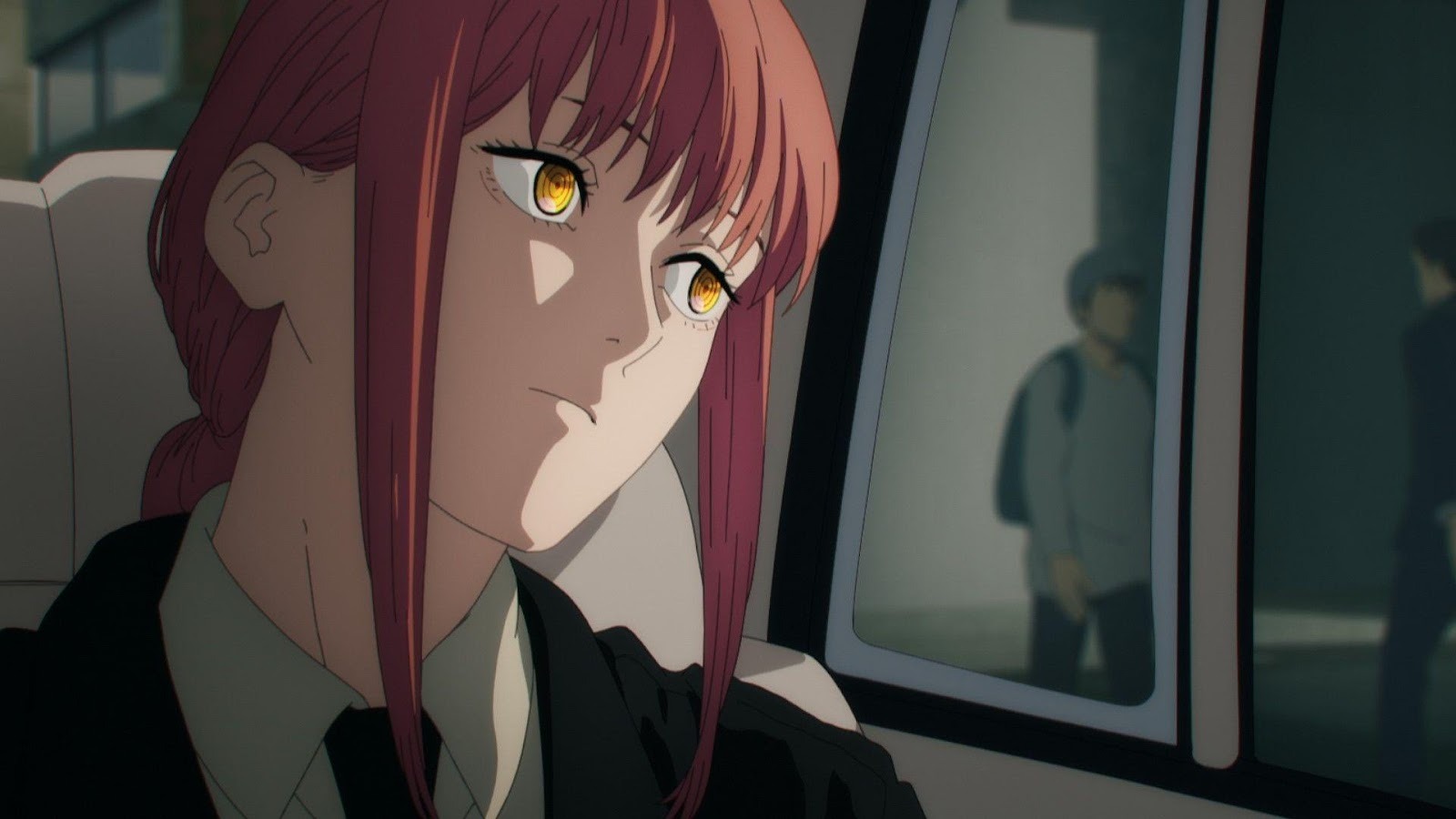
There are bits of Chainsaw Man season 1 which I still think about to this day. The ramen shop; the killing ritual; Himeno’s flashbacks; the Hayakawa household morning routine; the train fight; the way Makima’s coat flutters when she’s introduced in that terrific low angle framing; the snowball fight; Kishibe standing in a field of headstones.
These sequences work because they are treated with the weight of cinema. I may think about them to the day I die.
But for as pretty the animation, and as much everyone and their dog is glazing the pool scene, I can honestly say it feels like Reze Arc slides right off the back of my mind. It has no hooks, no sharp edges on which to hang. Nothing any more interesting than it was reading this story for the first time.
Chainsaw Man – The Movie lacks the cinematic aspirations that made its source material great. It’s less a movie by any intuitive metric than it is an hour-and-a-half trailer for the next season of Chainsaw Man that happens to be showing in theatres. With any luck, we’ll manage to get that season inside of the next decade.
If you think Reze Arc is an arthouse movie, I’m sorry, but you need to get out more.
Go watch Belladonna of Sadness. Watch I Lost My Body. Watch Paprika. Watch Redline. Watch Ghost in the Shell 2: Innocence.
Once you’ve done that, come back and tell me this is art. I think you’ll feel how I feel.
It’s not that Reze Arc is bad, it’s that compared to what preceded it, Chainsaw Man – The Movie feels deeply conservative, bordering on cynical. It is a movie born in part of the resentment of an audience unwilling to be challenged, and that MAPPA internalized that scorn has poisoned this franchise.
As any attempt to engage them on Twitter so often proves, Chainsaw Man fans are (broadly speaking) coddled, illiterate manchildren unable to articulate why they like the thing they profess to love, and more interested in asking whether or not Makima can beat Gojo than feeling anything real.
The result, when you pander to that demographic is mediocrity—at least when it comes to art. As a piece of straightforward entertainment, Reze Arc is exceptional. It simply fails to be anything more than that.








.png)
The rich text element allows you to create and format headings, paragraphs, blockquotes, images, and video all in one place instead of having to add and format them individually. Just double-click and easily create content.
A rich text element can be used with static or dynamic content. For static content, just drop it into any page and begin editing. For dynamic content, add a rich text field to any collection and then connect a rich text element to that field in the settings panel. Voila!
"Headings, paragraphs, blockquotes, figures, images, and figure captions can all be styled after a class is added to the rich text element using the "When inside of" nested selector system."
The rich text element allows you to create and format headings, paragraphs, blockquotes, images, and video all in one place instead of having to add and format them individually. Just double-click and easily create content.
A rich text element can be used with static or dynamic content. For static content, just drop it into any page and begin editing. For dynamic content, add a rich text field to any collection and then connect a rich text element to that field in the settings panel. Voila!
"Headings, paragraphs, blockquotes, figures, images, and figure captions can all be styled after a class is added to the rich text element using the "When inside of" nested selector system."

.jpg)
.jpg)
.png)
.jpg)